
Comprehensive Guide to Brewing Wastewater Treatment: EPC Solutions with GFS Tanks
Industrial wastewater treatment demands specialized engineering, durable equipment, and integrated project delivery. This article examines the core challenges of industrial wastewater management, highlights the superior corrosion resistance of GFS Tanks compared to traditional concrete tanks, details the UASB anaerobic reaction process, and analyzes key brewing wastewater quality characteristics. Through a real-world case study in Indonesia and an overview of Center Enamel's design expertise and full-industry-chain EPC capabilities, we demonstrate why choosing the right Brewing Wastewater Treatment Project EPC Contractor is critical for sustainable, compliant, and cost-effective wastewater solutions worldwide.
Core Industry Challenges of Industrial Wastewater
The core challenges of industrial wastewater treatment center on the "three highs"-high difficulty, high cost, and high energy consumption. Wastewater from new energy, chemical, and pharmaceutical industries is complex in composition with numerous characteristic pollutants, and traditional treatment processes are difficult to remove effectively. Chinese companies have significant price advantages in the mid-to-low-end equipment segment. The industry also faces continuous technological upgrade pressure from increasingly stringent emission standards, as well as new requirements for digitalization and low-carbon transformation on operational refinement management capabilities.
These multifaceted challenges demand not only advanced treatment technologies but also durable, long-lasting equipment capable of withstanding the harshest corrosive environments. As a leading Brewing Wastewater Treatment Project EPC Contractor, Center Enamel addresses these challenges head-on by engineering solutions that combine process innovation with materials science breakthroughs-most notably through the deployment of GFS Tanks as core anaerobic reaction and storage equipment.
GFS Tanks: Corrosion Resistance Far Superior to Traditional Concrete Tanks
Center Enamel's independently developed double-sided double-layer enameling technology is the industry's leading coating anti-corrosion technology, with corrosion resistance completely surpassing concrete tanks. Concrete tank interiors are riddled with pores, allowing wastewater and acid/alkaline media to easily penetrate and corrode the structural layer. Long-term use leads to irreversible problems such as internal wall spalling, water seepage, and rebar corrosion, which are difficult to repair and cannot be fundamentally resolved.
GFS Tanks feature high-temperature enameling on both the interior and exterior surfaces of steel panels, with a dense, non-porous enamel finish that completely blocks corrosive liquids and biogas permeation. The enamel layer has extremely strong chemical stability, resisting acids, alkalis, salts, and microbial corrosion. Concrete tanks will develop extensive corrosion and leakage after 5-8 years of use, while GFS Tanks' anti-corrosion service life can exceed 30 years, with no need for frequent internal lining repairs throughout the service life, significantly reducing long-term anti-corrosion maintenance investment and fundamentally eliminating environmental risks of medium leakage contaminating sites and groundwater. Compared to traditional concrete and FRP tanks, GFS Tanks coatings have no risk of peeling or blistering, and are adaptable to highly corrosive conditions such as palm oil mill effluent, livestock manure, and chemical high-salinity wastewater, with outstanding long-term comprehensive cost advantages.
The exceptional durability of GFS Tanks makes them the ideal vessel for advanced anaerobic treatment processes, where corrosive biogas and acidic wastewater are continuously present. Building on this material advantage, the next critical component in the treatment chain is the UASB (Upflow Anaerobic Sludge Blanket) reactor-a proven biological process that, when housed within GFS Tanks, delivers both treatment efficiency and structural longevity for any Brewing Wastewater Treatment Project EPC Contractor.
UASB Reaction Process
After pretreatment through screens and equalization tanks to remove impurities and balance water quality and flow, wastewater is uniformly fed into the reactor through the bottom distribution system. The wastewater rises at a constant rate through the high-concentration granular sludge bed at the bottom, where anaerobic microorganisms rapidly degrade most organic matter, converting it into biogas, clean water, and a small amount of sludge. Gentle hydraulic mixing maintains sludge suspension, expanding microbial contact area. Remaining pollutants continue to degrade in the mid-section suspended sludge layer, with the mixed liquor finally entering the top three-phase separator for gas, solid, and liquid separation. Biogas is collected upward for utilization, sludge settles back to the reaction zone, treated effluent overflows from the top, and aged sludge is periodically discharged-fully automated continuous operation.
Understanding the UASB process is essential, but equally important is understanding the specific wastewater characteristics that determine reactor design and sizing. For any Brewing Wastewater Treatment Project EPC Contractor, a thorough analysis of influent water quality is the foundation upon which all subsequent engineering decisions rest-from reactor volume to GFS Tanks specifications and biogas utilization pathways.
Key Water Quality Characteristics of Brewing Wastewater
High concentration, high suspended solids, high color, slightly acidic, and excellent biodegradability-with significant fluctuations. COD typically 5,000-25,000 mg/L, with high-strength spent mash and still bottoms peaking at hundreds of thousands of mg/L. Suspended solids up to 40,000 mg/L, with thick turbid liquor. Stable slightly acidic pH 3-5. Pollutants are primarily natural organics from grain fermentation-starches, reducing sugars, proteins, alcohols-with no synthetic toxic substances. BOD/COD can reach 0.5-0.6-industry-leading biodegradability. Significant fluctuations with production batches and seasonal capacity, and susceptible to secondary fermentation and odor if left standing.
These water quality parameters-high organic concentration and excellent biodegradability-make brewing and similar industrial wastewater an ideal feedstock for anaerobic digestion with biogas recovery. The following case study from Indonesia demonstrates how GFS Tanks, combined with UASB technology, deliver proven results in tropical, high-corrosion environments, reinforcing the value proposition of an experienced Brewing Wastewater Treatment Project EPC Contractor.
Indonesia Palm Oil Biogas Upgrade Project
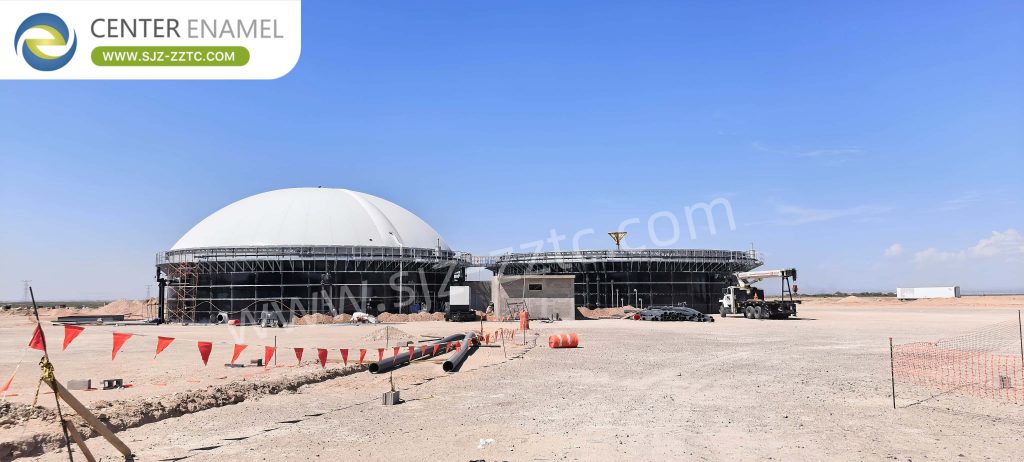
Commissioned in 2013 as the core anaerobic digestion reactor for the POME treatment station, with 3 GFS Tanks in two sizes: 17.58 m dia. × 8.4 m height / 16.82 m dia. × 7.2 m height. The tanks serve as the core anaerobic reaction equipment specifically for high-organic palm oil production wastewater-anaerobic digestion degrades pollutants and recovers biogas. Tanks are adapted to local palm industry wastewater needs. GFS Tanks assembly is convenient with corrosion resistance for Southeast Asia's hot humid high-corrosion environment-a mature biomass energy environmental benchmark project.
This successful project exemplifies how robust equipment selection and site-adapted engineering produce long-term operational success. However, superior equipment alone is not sufficient-the engineering expertise behind every project is what transforms standardized components into site-specific solutions. The design team at Center Enamel brings precisely this level of professional capability to every Brewing Wastewater Treatment Project EPC Contractor engagement.
Center Enamel Design Team
The design team includes senior engineers registered in the Hebei Provincial Science and Technology Expert Database, with design standards aligned with strict European/American high-end equipment safety standards. The team can provide complete integrated design for differentiated overseas projects in livestock biogas, POME, municipal wastewater, hazardous waste storage, seawater desalination, etc.-covering tank structure, anti-corrosion/sealing systems, biogas piping, and anaerobic process integration.
Pre-design thoroughly investigates local seismic zone, wind pressure, soil bearing capacity, water quality corrosivity, and local environmental discharge standards-applying thickened panels, reinforced anchored bases, and optimized sealing/corrosion structures as needed. Complete customized equipment solutions can be tailored to customer plant area, wastewater load, treatment targets, and budget-balancing safety, economics, and local adaptation-providing compliant, stable, and highly adaptable equipment structural design support for global environmental projects.
This design rigor ensures every GFS Tanks installation is engineered for the specific site and application, not merely assembled from generic components. Yet design excellence reaches its full value only when paired with end-to-end project delivery capability-the ability to carry a project from concept through commissioning under a single accountable entity.
Full-Industry-Chain Integrated Delivery Capability
Center Enamel is the only company globally integrating proprietary enamel frit R&D, self-manufactured GFS Tanks, and EPC general contracting-full-process self-control from solution design, equipment production, cross-border logistics, overseas construction, to post-construction O&M-significantly reducing client coordination and time costs.
This unique integration-combining materials science, manufacturing, engineering, and construction under one roof-is what distinguishes a true Brewing Wastewater Treatment Project EPC Contractor from equipment suppliers or construction firms alone. The following FAQs address common questions about this comprehensive approach.
Frequently Asked Questions (FAQs)
Q1: What makes GFS Tanks superior to traditional concrete tanks for wastewater treatment?
GFS Tanks feature a dense, non-porous enamel coating fused to steel at high temperatures, providing resistance to acids, alkalis, salts, and microbial corrosion. Unlike concrete tanks-which suffer from pore penetration, spalling, and rebar corrosion within 5-8 years-GFS Tanks maintain structural integrity for over 30 years without lining repairs, dramatically reducing lifecycle costs and eliminating environmental contamination risks. This makes them the preferred choice for any Brewing Wastewater Treatment Project EPC Contractor seeking long-term reliability.
Q2: Why choose an EPC contractor model for a brewing wastewater treatment project?
An EPC (Engineering, Procurement, and Construction) contractor provides single-point accountability across the entire project lifecycle-from water quality analysis and process design to equipment manufacturing, on-site construction, and commissioning. This integrated approach, combined with GFS Tanks and UASB technology, eliminates coordination gaps between multiple vendors, ensures quality control consistency, accelerates project delivery, and provides long-term operational reliability for high-strength organic wastewater treatment.
Q3: How does the UASB process work in brewing wastewater treatment?
The UASB (Upflow Anaerobic Sludge Blanket) reactor channels pretreated wastewater upward through a granular sludge bed, where anaerobic microorganisms degrade organic pollutants-converting them into biogas, clean water, and minimal sludge. A top-mounted three-phase separator separates biogas for energy recovery, returns sludge to the reaction zone, and discharges treated effluent. The process operates fully automatically and continuously, making it ideal for high-COD brewing wastewater with BOD/COD ratios of 0.5-0.6 when housed in corrosion-resistant GFS Tanks.