
Comprehensive Guide to Global Biogas Frameworks and Optimized Wastewater Treatment Process Solutions
Global biogas policy has evolved from a purely waste treatment orientation to a core component of energy strategy and climate action. The EU, through the Renewable Gas Directive and REPowerEU Plan, has set mandatory targets for biomethane production growth and uses the Carbon Border Adjustment Mechanism to incentivize member states to improve organic waste treatment rates, incorporating biogas into the green hydrogen certification system. The US, under relevant energy legislation, provides multiple incentives such as production tax credits and investment tax credits for biogas and biomethane projects, and includes biogas in the Renewable Fuel Standard system.
China has incorporated biogas into its rural revitalization strategy and the "Rural Energy Revolution" priority development catalog, updated national standards for automotive biomethane, and promotes the integration of biomethane into urban gas pipeline networks. The global policy framework is shifting from fiscal subsidy-driven to carbon market-driven and quota-mandatory approaches, with more countries incorporating biogas into their Nationally Determined Contributions, thereby driving continuous optimization within every modern wastewater treatment process.
CSTR Applicable Scenarios in Wastewater Treatment Process
Primarily for high-solids organic pollutant treatment, widely used in food waste leachate, large-scale livestock manure, slaughterhouse wastewater, and food processing high-strength wastewater. Also suitable for municipal sludge and industrial organic sludge anaerobic digestion. In the agricultural and environmental sector, CSTR is used for large-scale farm manure resource recovery, achieving wastewater reduction, harmless treatment, and energy recovery. In the food and brewing industry, it is suitable for high-oil, high-protein, high-suspended-solids wastewater. It is also suitable for small to medium-sized wastewater treatment projects, township decentralized wastewater treatment, and as a pretreatment process for high-strength organic wastewater in large industrial parks to reduce downstream load as part of a comprehensive wastewater treatment process. It is particularly suitable for difficult-to-treat organic wastewater with complex composition, high solids content, and easy crusting.
Biogas Plant Digestate Standardized Treatment Solutions
Treatment focuses on nitrogen and phosphorus removal, desalination, and polishing-suitable for the unique water quality of low organics, high nutrients. The mainstream "pretreatment + biological nitrogen removal + advanced polishing" system. Pretreatment is minimal, only simple filtration to remove trace suspended solids-no complex solid-liquid separation or organic degradation steps required. The main stage uses AO or A²O multistage biological nitrogen removal processes to target high ammonia nitrogen, total nitrogen, and total phosphorus-addressing the core eutrophication issue within an efficient wastewater treatment process. For high-salinity digestate, coagulation/sedimentation and membrane treatment for desalination ensure effluent compliance. The entire process requires no high-intensity organic degradation units, with simplified flow, stable operation, strong shock load resistance, convenient O&M, and suitability for the stable single-component digestate.
Malaysia Palm Oil Biogas Project Case Study
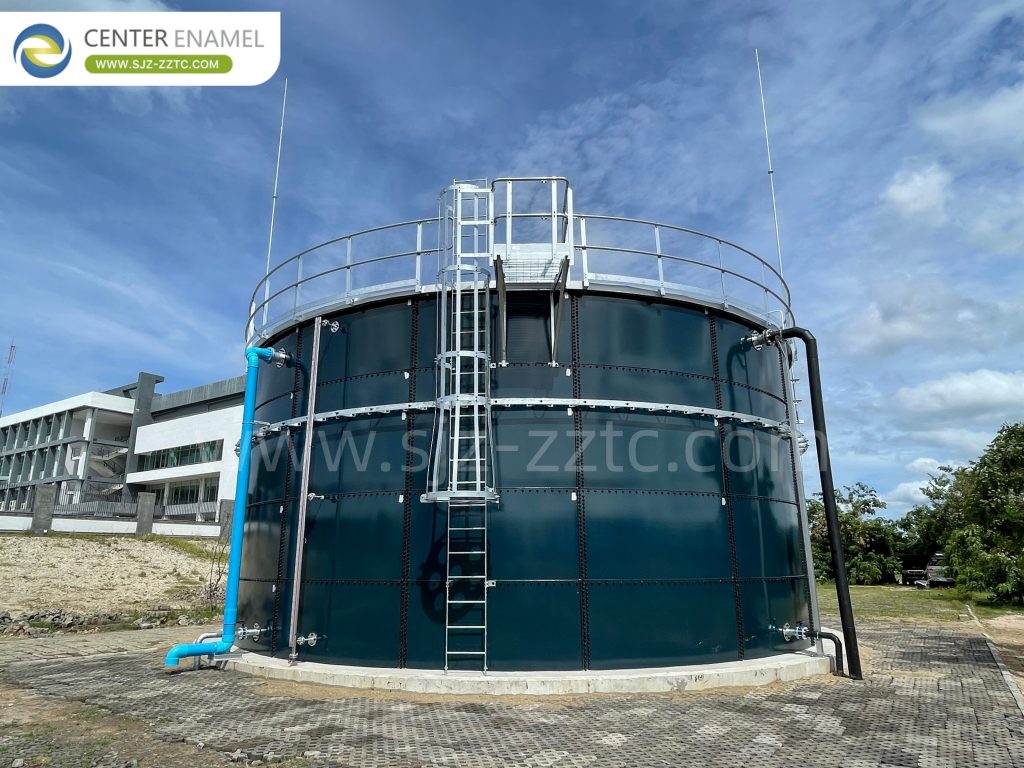
The project uses Center Enamel GFS tanks as the core anaerobic digestion facility with 5 tanks, each with effective volume of 5,400 m³, total effective volume 27,000 m³. Influent COD ≥ 60,000 mg/L, BOD ≤ 25,000 mg/L. After anaerobic digestion, effluent COD drops to below 12,000 mg/L, BOD ≤ 5,000 mg/L-overall organic removal efficiency approximately 80%. Single tank daily biogas production 4,400 m³, total project daily biogas 22,000 m³-stable biogas yield of 0.45 m³ per kg COD removed-efficient biogas energy recovery while solving palm oil processing pollution through an optimized wastewater treatment process.
Center Enamel Overseas Installation Coverage and Delivery Capability
Center Enamel is the pioneer of Chinese GFS equipment exports, with installation service coverage across over 100 countries and regions-possessing full delivery capability across climates, regulations, and geographies.
Overseas coverage includes Southeast Asia (Vietnam, Thailand, Malaysia, Indonesia, Cambodia, Bangladesh, Nepal, etc.), Africa (Ghana, South Africa, Mali, Guinea, Zambia, Kenya, Pakistan, etc.), Europe/Americas (Sweden, USA, Russia, etc.), the Middle East, and Latin America-adaptable to tropical rainy high-salt spray, high-altitude mountainous, Nordic severe cold, and high-standard European/American facility conditions.
The company uses a dual-service model of "own cross-border construction teams + overseas local agent coordination"-whether clients are in developed countries or remote developing regions-providing one-stop services including on-site survey, on-site installation, process commissioning, and operator training. Complete coverage covers biogas engineering, municipal wastewater, industrial wastewater, livestock manure, drinking water storage, and other global mainstream environmental engineering projects-possessing the full delivery capability to undertake large-scale tank farm projects and any custom wastewater treatment process in any country worldwide.
Center Enamel After-Sales and Technical Support Team
The after-sales team adheres to the service principles of rapid response, professional efficiency, and full-cycle support-providing 24/7 full-lifecycle O&M support to global clients.
Standard remote services include fault diagnosis, process parameter adjustment, and tank anti-corrosion maintenance guidance. For domestic and long-distance overseas clients, overseas technical service personnel can be dispatched for on-site inspection, annual inspection, and equipment refurbishment as needed. The team also maintains long-term client feedback tracking mechanisms-regularly collecting tank and anaerobic equipment operational data to continuously optimize product structure and support processes.
Supporting external technical expert teams provide specialized support for anaerobic process commissioning, biogas upgrading O&M, and wastewater upgrade/retrofit projects-ensuring long-term stable operation of domestic and overseas projects, continuously improving global client satisfaction and repurchase rates across every implemented wastewater treatment process.
Glass-Fused-to-Steel Roof Cover Solution for Biogas Systems
Glass-Fused-to-Steel Roof is a specialized tank cover solution designed for high air-tightness applications, primarily suited for CSTR anaerobic fermentation tanks and other biogas reactor tanks, serving as a core supporting component in organic waste anaerobic treatment projects. The roof is manufactured with the same material system as glass-fused-to-steel assembled tanks, with steel substrate and high-temperature fused glass coating integrated into one unit. The roof panel joints are equipped with specialized sealant strips and fasteners, achieving high-level overall air-tightness that completely seals biogas generated from anaerobic reactions inside the tank, preventing methane and odorous gas leakage while enabling biogas recovery and on-site odor control.
The product resists long-term corrosion from fermentation liquid and acid/alkaline biogas slurry, and will not be corroded or delaminate due to microorganisms or sulfides in the anaerobic environment. Its service life is synchronized with the glass-fused-to-steel tank, significantly reducing maintenance frequency. The structure employs steel truss supports for the glass-coated panels, providing stable load-bearing capacity. It can accommodate various process openings for mixers, biogas collection, monitoring, and manways, offering high integration. Modular components enable rapid on-site assembly, suitable for large-volume anaerobic fermentation tanks. It is widely used in livestock manure treatment, food waste anaerobic digestion, straw biogas, and municipal sludge disposal projects, and is the mainstream reliable roof selection for anaerobic fermentation tanks.