
Comprehensive Guide to Industrial Wastewater Treatment Project Solutions and GFS Tanks
The global biogas industry is in a phase of large-scale expansion, with China contributing the major share of new capacity, becoming the fastest-growing single market. Europe's mainstream model focuses on combined heat and power (CHP) and biomethane grid injection, with active biomethane certificate trading and application scenarios covering power generation, heating, and transportation fuel. China, in contrast, emphasizes vehicle fuel and industrial heating while actively promoting the fertilizer utilization of digestate, showing significant differentiation in application scenarios.
Southeast Asian emerging markets show rapidly growing food waste treatment demand, becoming key areas for global companies; while African and Latin American markets remain in the early stages, primarily relying on low-cost direct application models. Countries show differentiated development paths in biogas resource utilization: Europe focuses on energy output, China emphasizes comprehensive utilization, and emerging markets prioritize pollution control, driving the steady expansion of every major Industrial Wastewater Treatment Project internationally.
GFS Tanks Adaptable to Modern Intensive Plant Layouts
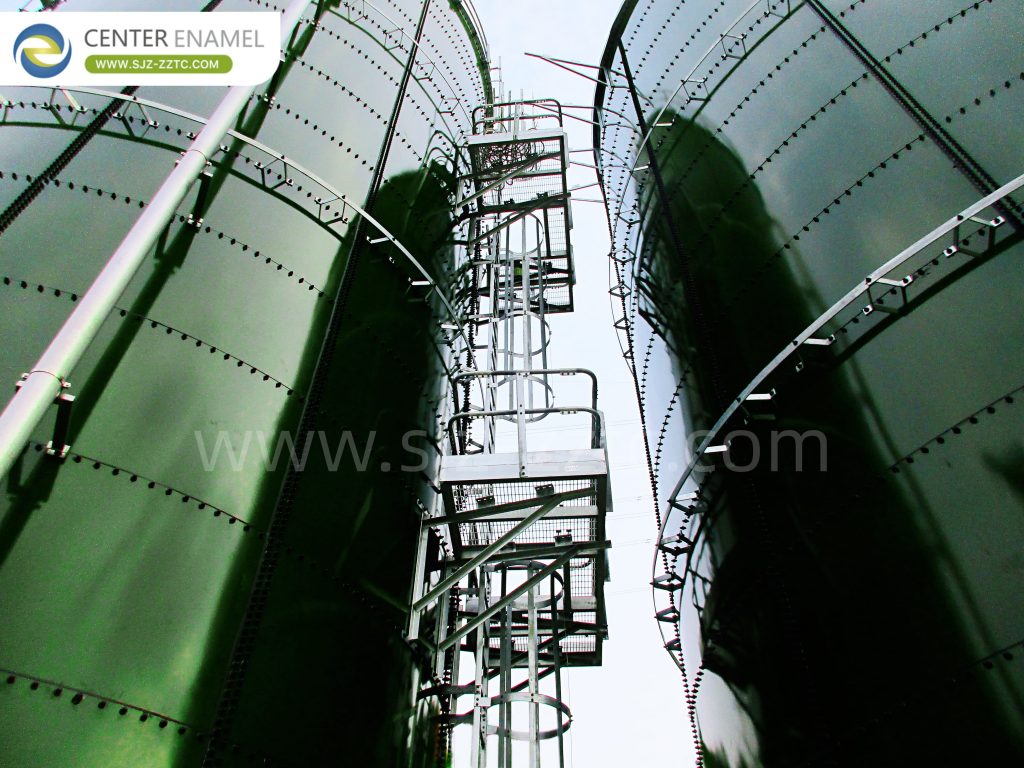
GFS tanks offer flexible customization of size and appearance, with higher land utilization rates, ideally suited for modern compact plant layouts, with significant advantages over fixed poured concrete tanks. Concrete tanks cannot alter volume or shape after pouring, with heavy bases occupying large areas, making placement difficult on narrow or irregular plots. Their rough, uniform appearance cannot match modern facility aesthetic requirements.
GFS tank volume can be precisely customized as needed, with capacities ranging from dozens of cubic meters to 50,000 cubic meters freely selectable. Tank height and diameter can be flexibly combined to fit narrow or irregularly shaped plots, effectively saving plant land occupation. Enamel color customization is also supported, achieving visual harmony with plant buildings and environmental facilities. During later plant expansion, GFS tanks can be directly adjusted in layout and expanded; concrete tanks, being monolithic structures, must be demolished and rebuilt, offering less flexibility in land resource utilization. This aligns well with the intensive construction and aesthetic operation and maintenance needs of any large-scale Industrial Wastewater Treatment Project.
Supporting Equipment in CSTR Process for Industrial Wastewater Treatment Project
The core equipment is a vertical sealed anaerobic reactor tank, with Center Enamel GFS tanks as the mainstream choice for high-corrosion, high-viscosity wastewater conditions within any advanced Industrial Wastewater Treatment Project. The key operating equipment is a low-speed mechanical stirrer, comprising motor, gearbox, and impeller blades, achieving uniform mixing throughout the reactor and preventing sedimentation and crusting.
Supporting equipment includes corrosion-resistant feed pumps, flow control valves, and inlet piping for precise feed flow control; biogas collection systems (piping, water seals, dual-membrane gas holders, desulfurization units) for biogas collection, purification, and storage. Online monitoring equipment for temperature, pH, and liquid level is integrated for real-time reaction parameter monitoring. Sludge discharge pumps, return piping, and emergency drain systems complete the equipment package, with convenient operation and maintenance, low failure rates, and support for long-term continuous stable operation.
Biogas Plant Wastewater Sources and Management
Biogas plant wastewater is secondary wastewater from organic waste resource recovery-primarily digestate from anaerobic digestion, distinct from primary production wastewater. It originates from anaerobic digestion of livestock manure, crop straw, food waste, and brewery residues, as a byproduct of biogas fermentation. Auxiliary wastewater includes equipment washing, digester tank cleaning, desulfurization system drainage, and plant floor washdown. Continuous stable production with only minor variations with feedstock input and fermentation cycles. Pollutants are significantly transformed through anaerobic digestion, with composition distinct from primary high-concentration organic wastewater-it is the core wastewater requiring specialized handling in any operational Industrial Wastewater Treatment Project.
Comprehensive International Authoritative Certifications
Center Enamel holds CE, NSF, WRAS, ISO9001, BSCI, ASME, and other global certifications-fully clearing EU, North American, Southeast Asian, and African project tendering barriers-providing critical hard credential advantages for large overseas project bidding and compliance assurance across every regional Industrial Wastewater Treatment Project.
Single and Double Membrane Roof Cover Solution
Single and Double Membrane Roofs are proprietary airtight tank cover systems for anaerobic digestion and biogas storage projects, specifically developed for biogas collection and odor containment, representing a benchmark lightweight sealing solution for fermentation tanks. The single-layer membrane roof features a simple structure with economical cost, meeting basic biogas containment needs. The double-layer membrane roof consists of inner and outer corrosion-resistant membrane materials, with pressurized air in the interlayer forming rigid support, providing outstanding thermal insulation that reduces biogas condensate formation inside the tank, with enhanced wind and snow load resistance suitable for high-altitude and windy outdoor sites.
The membrane material is specialized aging-resistant and biogas-slurry-corrosion-resistant PVDF membrane, which will not leak or degrade from long-term contact with biogas or hydrogen sulfide. The flexible structure accommodates tank settlement and slight deformation without cracking or gas leakage. The lightweight design eliminates heavy steel support trusses, significantly reducing the load on the tank and foundation, saving construction costs.
The roof integrates biogas outlets, safety pressure relief valves, and access channels, fully enabling closed gas collection for anaerobic fermentation tanks, recovering biogas for power generation and heating while blocking odor diffusion to meet environmental odor control requirements. It is widely used in large-scale livestock biogas projects, municipal sludge anaerobic digestion, and food waste fermentation projects, compatible with large-volume glass-fused-to-steel anaerobic tanks, with fast construction and simple maintenance requiring only periodic membrane seal integrity checks, offering significant overall engineering advantages.