
How We Help Farms Convert Livestock Manure into Biogas with EPC Expertise
Global livestock inventories such as swine remain stable, yet manure management has become a critical battleground for agricultural carbon reduction. The US has developed technical models represented by integrated crop-livestock systems with on-field application and Comprehensive Nutrient Management Plans; Denmark, the Netherlands, and others have developed centralized biogas projects with digestate application systems.
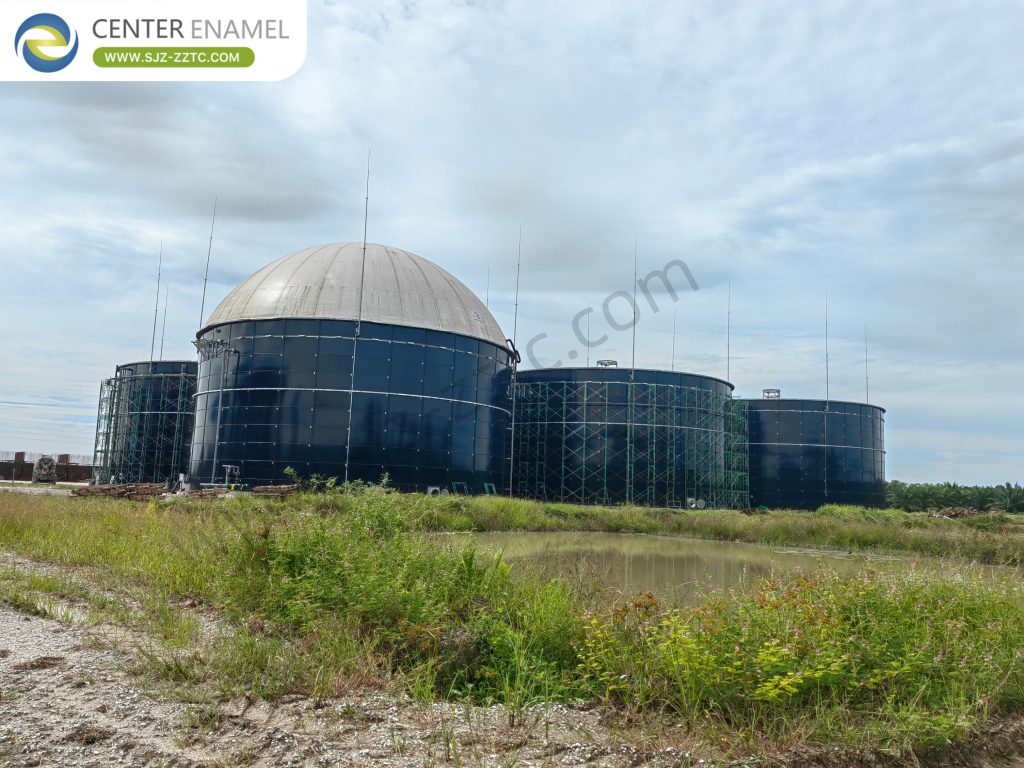
China's large-scale farms still have considerable room for improvement in supporting biogas project coverage, and digestate resource utilization rates lag behind advanced European levels. Greenhouse gas emissions from livestock account for a significant proportion of total global anthropogenic emissions. Latin American countries started later in manure management but are accelerating relevant infrastructure development. Converting manure into biogas is now a proven pathway-and choosing the right Biogas Project EPC Contractor and reliable GFS Tanks is the foundation of success.
GFS Tanks: Bolted Assembly Construction Advantages
GFS tanks are assembled on-site from prefabricated panels, with short construction periods and support for expansion, relocation, and reuse-advantages distinctly different from immovable concrete tanks. Concrete tank pouring requires formwork, rebar tying, pouring, and long curing periods, with a single tank construction taking months. Rain, snow, and low temperatures force work stoppages and delays. Once poured, they are permanent fixed structures that cannot be dismantled, expanded, or relocated-project relocation means complete abandonment.
GFS tank panels are all factory-prefabricated, transported to site, and directly assembled in panels with simple procedures. Construction can proceed even in low-temperature, light-rain conditions, with installation time only one-third that of concrete tanks-construction schedules are controllable. For expansion, additional steel panels can be installed to increase volume; for plant relocation, tanks can be fully disassembled with panels transported to new sites for reassembly and reuse, significantly reducing material and construction costs for new construction and reconstruction. This is ideally suited for short-term environmental projects, phased expansion projects, and relocated construction projects.
Table 1: GFS Tanks vs. Concrete Tanks
| Comparison Item | GFS Tanks | Concrete Tanks |
| Construction period | One-third of concrete tanks | Months per tank |
| Weather impact | Works in low temperature, light rain | Rain, snow, low temperature cause stoppage |
| Expansion | Add panels to increase volume | Difficult, permanent structure |
| Relocation | Fully disassembled and reused | Abandoned |
| Best suited for | Short-term, phased, relocated projects | Permanent fixed sites |
Inside the USR Reaction Process
High-solids organic wastewater, after simple pretreatment to remove large debris, is uniformly fed into the reactor through the bottom distribution system. The upward flow drives solid substrates and anaerobic sludge to slowly rise and thoroughly mix. In the sealed anaerobic environment, microorganisms sequentially hydrolyze/acidify and then methanogenically ferment, degrading macromolecular organic pollutants and generating biogas and treated water. Without complex separation structures, gentle hydraulic disturbance prevents clogging. The mixed liquor rises to the upper portion of the reactor where natural gas-liquid-solid separation occurs. Biogas is collected, effluent overflows, and solid sludge and unreacted substrate settle back to the lower reaction zone for continued reaction, with a small amount of aged sludge periodically discharged-continuous stable operation. This is how GFS Tanks and anaerobic engineering combine to deliver consistent biogas output.
Key Water Quality Characteristics of Livestock Wastewater
Typical high-concentration organic wastewater with "four highs"-high COD, high ammonia nitrogen, high total phosphorus, and high suspended solids-very high pollution load. Livestock wastewater COD can exceed 8,000 mg/L, with high turbidity and suspended solids. Nitrogen and phosphorus levels far exceed discharge standards, being the primary cause of eutrophication. Wastewater is rich in manure, feed residues, and metabolic waste, readily turning black and odorous. Water quality fluctuates significantly with production cycles, seasons, and washing frequency. Aquaculture wastewater has lower pollutant concentrations but significant nitrogen/phosphorus accumulation issues, causing algal blooms and water quality deterioration with long-term discharge.
Bangladesh Large-Scale Poultry Farm Manure Resource Recovery Project
Targeting local poultry farm manure resource recovery with daily treatment of 47 tons. Influent COD, BOD, SS as high as 50,000 mg/L, 25,000 mg/L, 50,000 mg/L-after CSTR + UASB anaerobic treatment, all three parameters reduced to below 200 mg/L, 100 mg/L, and 100 mg/L-effluent compliant with local environmental discharge standards. Project produces approximately 4,900 m³ biogas daily-each m³ biogas can generate 2 kWh of electricity, with daily power generation of 9,800 kWh-simultaneously achieving pollutant reduction and clean energy recovery. This is a benchmark project for livestock waste recycling in Southeast Asia.
Table 2: Bangladesh Poultry Farm Manure Treatment Performance
| Parameter | Influent (mg/L) | Effluent (mg/L) | Removal Rate |
| COD | 50,000 | <200 | >99.6% |
| BOD | 25,000 | <100 | >99.6% |
| SS | 50,000 | <100 | >99.8% |
| Biogas Production | - | 4,900 m³/day | - |
| Power Generation | - | 9,800 kWh/day | - |
Center Enamel Design Team
The design team includes senior engineers registered in the Hebei Provincial Science and Technology Expert Database, with design standards aligned with strict European/American high-end equipment safety standards. The team can provide complete integrated design for differentiated overseas projects in livestock biogas, POME, municipal wastewater, hazardous waste storage, seawater desalination, etc.-covering tank structure, anti-corrosion/sealing systems, biogas piping, and anaerobic process integration.
Pre-design thoroughly investigates local seismic zone, wind pressure, soil bearing capacity, water quality corrosivity, and local environmental discharge standards-applying thickened panels, reinforced anchored bases, and optimized sealing/corrosion structures as needed. Complete customized equipment solutions can be tailored to customer plant area, wastewater load, treatment targets, and budget-balancing safety, economics, and local adaptation-providing compliant, stable, and highly adaptable equipment structural design support for global environmental projects.
Full-Industry-Chain Integrated Delivery Capability
Center Enamel is the only company globally integrating proprietary enamel frit R&D, self-manufactured tanks, and EPC general contracting-full-process self-control from solution design, equipment production, cross-border logistics, overseas construction, to post-construction O&M-significantly reducing client coordination and time costs. As a Biogas Project EPC Contractor, this integrated model means clients work with one accountable partner from concept to commissioning, with GFS Tanks manufactured under the same roof as the engineering design.
Ready to turn your livestock manure into biogas with a trusted Biogas Project EPC Contractor?
Contact Center Enamel today for a customized GFS Tanks solution and a free feasibility consultation for your farm.
Let's design your biogas plant together-reach out to our team and start converting waste into energy with confidence.
FAQ
1. How does Center Enamel convert livestock manure into biogas?
We combine USR/CSTR anaerobic digestion with GFS Tanks. Manure is fed into the sealed reactor, microorganisms degrade organics and produce biogas, which is collected for power generation or heating while digestate becomes organic fertilizer.
2. What makes Center Enamel a reliable Biogas Project EPC Contractor?
We control the full chain-enamel frit R&D, tank manufacturing, design, logistics, overseas construction, and O&M. With 30+ years and 30,000+ projects, we deliver turnkey biogas plants worldwide.
3. Why use GFS Tanks for biogas projects instead of concrete?
GFS Tanks install in one-third the time, tolerate low temperatures during construction, resist corrosion from high ammonia and sulfide, and can be expanded, relocated, and reused-unlike permanent concrete structures.