
Cost-Effective USR Process and Durable GFS Tanks for Singapore Fruit and Vegetable Waste Biogas Project
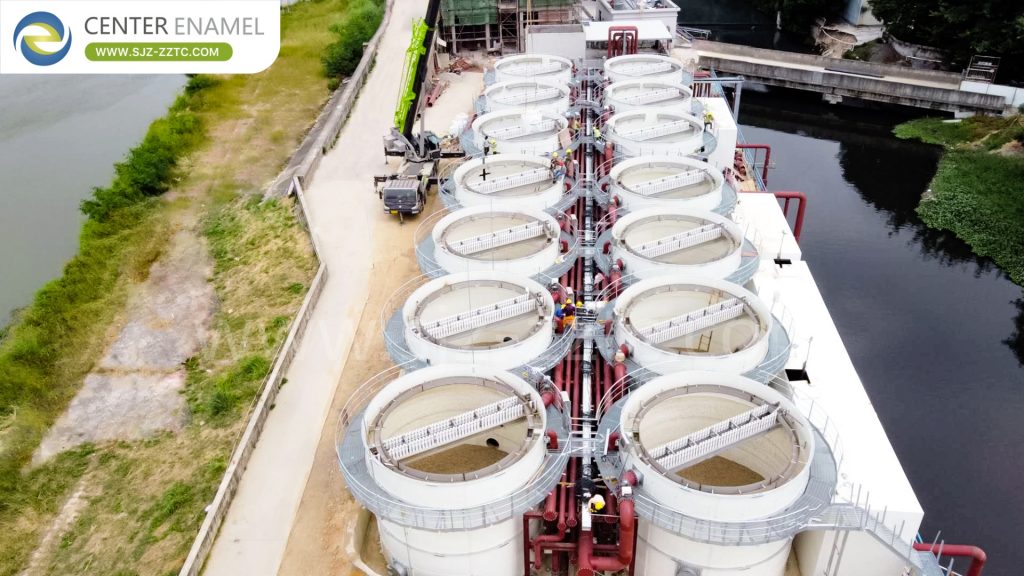
As a densely populated urban nation with developed catering, retail and food processing industries in Southeast Asia, Singapore imposes stringent carbon reduction and zero-waste policies to advance circular urban development. Massive fruit and vegetable waste is generated annually from daily consumption and food industrial operations across the city-state. Conventional landfill and incineration disposal cannot satisfy Singapore’s strict environmental emission standards and renewable energy development goals.
As a professional global EPC contractor focused on organic waste-to-biogas solutions, Center Enamel delivers customized anaerobic design for local Fruit and Vegetable Waste Biogas Project. With cost-efficient USR Process and corrosion-resistant GFS Tanks, the enterprise converts discarded fruit and vegetable residues into clean biogas to help Singapore cut waste discharge, boost resource recycling and realize low-carbon urban sustainable development.
Source of Singapore’s fruit and vegetable waste
Singapore’s fruit and vegetable waste mainly originates from three primary fields.
First, countless supermarkets, fresh produce markets and convenience stores across residential and commercial districts discard overripe, damaged and unsold fruits and leafy vegetables daily due to strict shelf-life rules.
Second, large quantities of trimming, peel and core waste are produced from central food processing factories, salad manufacturers and fruit beverage plants serving local catering chains.
Third, thousands of restaurants, hotel kitchens and F&B stalls in tourist hubs generate massive vegetable scraps and leftover fruit materials; limited domestic farmland means nearly all fresh produce is imported, raising overall residual waste volume, providing stable raw feedstock for the local Fruit and Vegetable Waste Biogas Project.
Disposal challenges of Singapore’s fruit and vegetable waste
Singapore faces unique difficulties in fruit and vegetable waste governance restricted by limited land resources. Land space scarcity makes new landfill construction impossible, and most organic waste is transported to incineration plants, bringing extra fuel consumption and flue gas emission pressure for local environmental management. High population density leads to centralized waste output, while mixed packaging plastic and inorganic sundries in fruit and vegetable leftovers increase pre-treatment cost significantly.
In addition, high temperature and humid tropical climate accelerate waste spoilage and odor diffusion during short-distance transportation, worsening neighborhood environmental complaints. Conventional composting requires extra land and yields low economic returns, pushing Singapore to accelerate the layout of standardized Fruit and Vegetable Waste Biogas Project.
How fruit and vegetable waste produces biogas via anaerobic digestion
Biogas conversion depends on closed anaerobic digestion carried out inside sealed GFS Tanks and matched anaerobic reactors through four sequential biochemical phases.
Hydrolysis: microorganisms secrete enzymes to break down cellulose, pectin, starch and protein into small soluble organic molecules.
Acidification: acid-forming bacteria convert small soluble substances into volatile fatty acids and intermediate alcohols.
Acetogenesis: intermediates are further transformed into acetic acid, hydrogen and carbon dioxide.
Methanation: strict anaerobic methanogens generate raw biogas containing 55%–70% methane.
After desulfurization, dehydration and compression purification, refined biogas can be applied for factory power generation, facility heating and urban auxiliary gas supply; post-fermentation digestate is processed into high-grade organic fertilizer for Singapore’s urban rooftop gardening and landscape planting.
Core benefits of Fruit and Vegetable Waste Biogas Project for Singapore
Building Fruit and Vegetable Waste Biogas Project creates comprehensive environmental, economic and social gains for Singapore’s urban sustainable development. Environmentally, it drastically reduces organic waste incineration volume and associated exhaust pollution, cuts fugitive methane greenhouse gas emissions to help Singapore complete national carbon peaking targets. Energy-wise, self-produced biogas supplements urban clean energy supply, lowers reliance on imported natural gas and electricity and eases urban energy pressure.
Economically, local food enterprises slash expensive waste incineration and outsourcing disposal fees, improving corporate green economic benefits and market competitiveness. Socially, the project forms closed circular urban agriculture chain and creates posts in waste sorting, plant operation and equipment maintenance to promote local green employment.
Advanced Anaerobic Technologies: CSTR, UASB, USR Process, IC
Center Enamel configures four mature anaerobic technologies for Singapore’s compact-site biogas projects, with cost-saving USR Process prioritized for small and medium-scale urban waste treatment.
USR Process: Upflow Solid Reactor is specially developed for high-solid fruit and vegetable waste, featuring simple internal structure, low initial construction investment and outstanding anti-clogging performance. Raw waste can be directly fed without complicated pre-crushing and dehydration, perfectly matching Singapore’s scattered small-scale urban biogas stations with limited construction space.
CSTR: Equipped with mechanical stirring inside GFS Tanks, it ensures full mixing of high-moisture waste and microbes, ideal for centralized large-scale biogas plants in industrial parks.
UASB: Relying on granular sludge bed for high COD removal, suitable for pre-treated fruit and vegetable leachate with low energy consumption.
IC: High-efficiency internal circulation reactor with 3–5 times higher treatment capacity than traditional processes, designed for super-large centralized waste disposal hubs.
Advantages of GFS Tanks for Fruit and Vegetable Waste Biogas Project
As core supporting equipment, GFS Tanks (Glass-Fused-to-Steel Tanks) perfectly adapt to Singapore’s hot, rainy and coastal high-salt urban climate.
High-temperature sintered enamel coating resists acid corrosion from acidic fruit fermentation liquid and coastal salt mist to guarantee over 30 years stable service life.
Professional sealing structure delivers excellent airtightness to avoid biogas leakage and energy waste.
Modular bolted prefabricated design realizes rapid on-site assembly without field welding, greatly shortening construction period for Singapore’s compact urban construction land.
Smooth inner tank surface prevents organic pomace scaling to cut daily maintenance cost; tank volume can be flexibly expanded to adapt seasonal fluctuation of fruit and vegetable waste output and fits all four anaerobic processes for multi-purpose fermentation and storage.
Reasons to select Center Enamel as EPC contractor
- Own over 200 independent enamel technology patents; all GFS Tanks are manufactured strictly following ISO and AWWA international quality standards.
- Provide full turnkey EPC services covering project design, equipment production, cross-border logistics, installation, commissioning, staff training and lifelong after-sale maintenance.
- Customize engineering design based on Singapore’s compact land condition, waste composition and tropical weather to optimize USR Process operating parameters and maximize biogas yield.
- Possess rich Southeast Asian urban biogas project experience to comply with Singapore’s strict local construction codes and environmental regulations.
- Optimize overall system layout to reduce equipment failure rate and daily operation cost, securing stable long-term investment returns for project owners.
- Global service network provides timely on-site overhaul and remote technical support for local Fruit and Vegetable Waste Biogas Project.
Professional GFS Tanks Installation from Center Enamel
Center Enamel develops space-saving installation solutions matching Singapore’s narrow urban construction sites.
Hydraulic jacking top-down installation eliminates high-altitude scaffold erection to improve construction safety in crowded downtown and industrial areas.
Full bolted assembly cancels on-site hot welding, avoiding quality defects caused by Singapore’s high humidity and frequent sudden rainfall.
Experienced international engineers conduct full-process on-site guidance and cooperate with local construction teams to speed up construction progress.
After installation completion, comprehensive airtightness, pressure resistance and anti-corrosion tests are carried out to ensure tanks meet urban biogas plant standards and stable running of the core USR Process.
Successful Global Project Cases
Case1: Singapore Biogas Project
Process Stage: CSTR
Tank Dimensions:
φ18.34 × 8.4 m (H) — 1 Unit
φ8.41 × 9.0 m (H) — 1 Unit
φ11.46 × 7.2 m (H) — 1 Unit
Total Volume: 3,458 m³
Completion Date: 2021
Case2: France Biogas Project
Process Stage: CSTR
Tank Dimensions: φ18.33 × 8.4 m (H) — 1 Unit
Total Volume: 2,215 m³
Completion Date: 2021
Restricted by scarce land and strict environmental laws, Singapore’s Fruit and Vegetable Waste Biogas Project supported by cost-efficient USR Process and high-performance GFS Tanks becomes a core solution to tackle organic waste troubles. As a reliable full-cycle EPC provider, Center Enamel tailors practical waste-to-energy schemes matching Singapore’s urban development features. These biogas projects effectively cut incineration pressure, boost urban clean energy supply, develop circular urban agriculture and help Singapore steadily advance its national zero-waste and carbon reduction goals, laying a solid green foundation for the city’s long-term sustainable urban development.