
CSTR Process for Mixed Organic Waste Including Coffee Grounds | Center Enamel
In the global push toward sustainable waste management and renewable energy, the ability to process diverse organic waste streams efficiently is critical. The Continuous Stirred Tank Reactor (CSTR) process has emerged as a robust solution for handling mixed organic waste, including challenging substrates like coffee grounds. Center Enamel leverages decades of engineering expertise to design CSTR systems that maximize biogas yield while ensuring long-term operational stability and environmental compliance.
Understanding the CSTR Process for Organic Waste
A Continuous Stirred Tank Reactor (CSTR) is an anaerobic digestion system characterized by continuous mixing, which maintains a homogeneous environment within the reactor. This uniformity is essential for sustaining optimal microbial activity and ensuring the efficient breakdown of organic materials.
In a CSTR, feedstock is continuously introduced while digested material is simultaneously removed. This continuous operation maintains steady-state conditions-temperature, pH, and nutrient levels-within ideal ranges for anaerobic digestion. The result is not only improved biogas production efficiency but also reliable, large-scale processing capability suitable for municipal, agricultural, and industrial waste management applications.
Advantages of CSTR for Mixed Organic Waste
The CSTR process offers distinct advantages when applied to heterogeneous organic waste streams:
Uniform Mixing and Temperature Control: Continuous stirring prevents the formation of dead zones where microbial activity could decline. This uniformity maintains stable temperatures throughout the reactor, enhancing the biological conversion of organics into biogas.
Improved Substrate Utilization: Mixed organic waste contains diverse components-lignocellulosic materials, fats, proteins, and carbohydrates-that degrade at variable rates. The CSTR's continuous operation ensures that even slower-degrading substrates are eventually processed, leading to higher overall conversion efficiency.
Enhanced Biogas Yields: The consistent environment supports a robust and diverse microbial population, optimizing methane production. Continuous feed and discharge maximize biogas yield from available waste.
Operational Flexibility and Scalability: CSTR systems can be designed to handle a wide range of organic waste compositions and volumes, making them suitable for agricultural settings, municipal facilities, and industrial applications where waste characteristics vary over time.
Special Considerations for Coffee Grounds in CSTR Systems
Coffee grounds represent a significant organic waste stream in urban and industrial environments. Their high organic content and unique composition present both opportunities and challenges for CSTR processing:
High Energy Content: Coffee grounds are rich in biodegradable organic compounds, making them an excellent substrate for biogas production. When properly processed, they can contribute significantly to the overall methane yield of the reactor.
Potential Inhibitory Compounds: Coffee grounds may contain compounds that can inhibit microbial activity if present in excessive concentrations. The continuous mixing provided by a CSTR helps mitigate these effects by diluting potential inhibitors and maintaining a balanced microbial ecosystem.
Pre-Treatment Requirements: Depending on the source and composition, coffee grounds may require minimal pre-treatment to enhance their biodegradability. Mechanical pre-treatment or blending with other organic substrates can improve the overall performance of the anaerobic digestion process.
Center Enamel's CSTR Engineering Approach
Center Enamel applies precision engineering to develop CSTR systems tailored for mixed organic waste applications:
Precision Engineering: Using advanced computational modeling, Center Enamel engineers design CSTR systems that precisely control mixing intensity, temperature, and retention time, ensuring optimal conditions for maximum biogas production.
Customizable Configurations: Recognizing that waste streams vary significantly, Center Enamel offers customizable reactor designs adaptable to specific mixtures of organic waste, including high proportions of coffee grounds.
Robust Material Selection: Reactors are constructed using Glass-Fused-to-Steel (GFS) technology, which provides exceptional corrosion resistance against the corrosive nature of organic waste streams. This durability ensures long-term operational reliability and minimizes maintenance requirements.
Integrated Process Monitoring: Modern CSTR systems incorporate real-time data acquisition tracking key parameters such as temperature, pH, and biogas production rates, enabling proactive management and rapid troubleshooting.
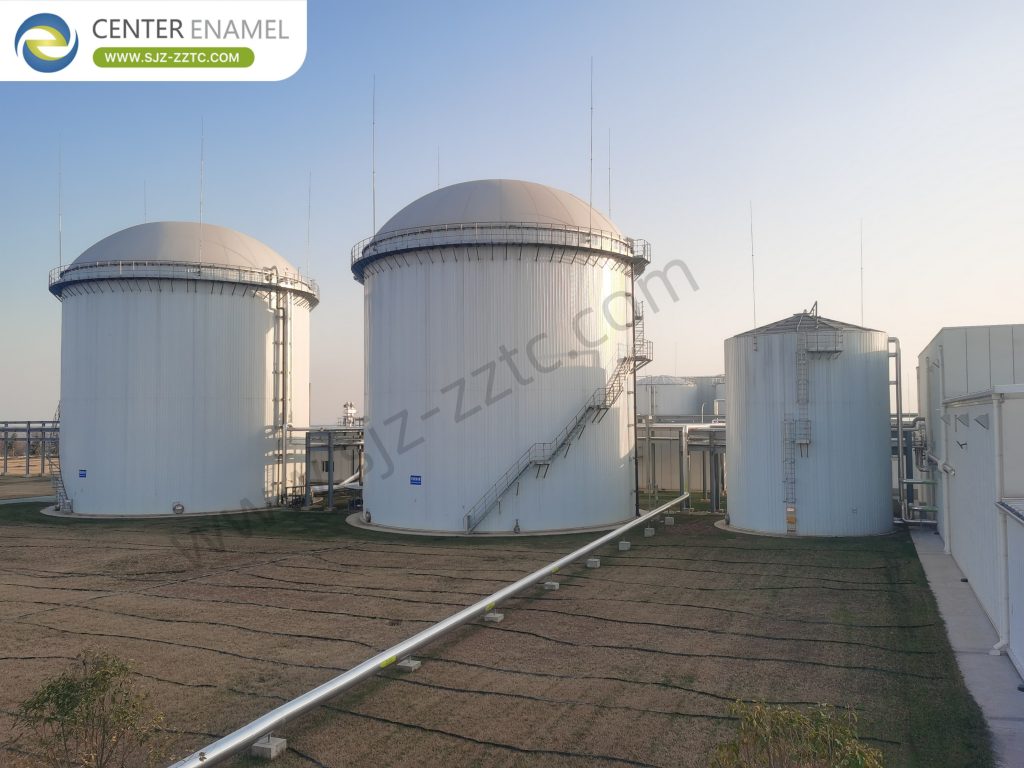
Project Overview: Food Waste Anaerobic Digestion Tank in Anhui Province
Center Enamel successfully completed a food waste anaerobic digestion tank project in Anhui Province, demonstrating the company's CSTR capabilities in real-world applications.
Scope of Work
The project involved the design, fabrication, and installation of a Glass-Fused-to-Steel anaerobic digestion tank configured as a Continuous Stirred Tank Reactor (CSTR) for food waste treatment.
Technologies Used
| Technology Component | Specification |
| Reactor Type | Continuous Stirred Tank Reactor (CSTR) |
| Tank Material | Glass-Fused-to-Steel (GFS) |
| Effective Volume | 1,000 cubic meters |
| Application | Food waste anaerobic digestion |
The GFS construction provides significant advantages over alternative containment options:
| Evaluation Parameter | Center Enamel GFS CSTR | Cast-in-Place Concrete | Uncoated Steel Tanks |
| Corrosion & Acid Resistance | Excellent; permanent glass enamel | Moderate; vulnerable to carbonation and acid etching | Poor; rapid corrosion under moist anaerobic conditions |
| Installation Speed | Rapid modular bolted assembly | Slow civil construction with curing | Slow field erection with complex welding |
| Volumetric Scalability | High; modular panels allow seamless expansion | Difficult without reconstruction | Requires complex field cutting |
Project Results
The project resulted in the successful installation of a GFS CSTR anaerobic digestion tank for food waste treatment, providing a durable, corrosion-resistant reactor suited to the demanding conditions of anaerobic digestion.
Environmental and Economic Impact
Implementing CSTR systems for mixed organic waste delivers measurable environmental and economic benefits:
Greenhouse Gas Reduction: By capturing methane from organic waste that would otherwise be released into the atmosphere, CSTR systems play a crucial role in mitigating climate change.
Resource Recovery: Biogas produced through anaerobic digestion can generate electricity, heat, or be upgraded to biomethane for transportation fuel. Digestate from the process serves as a nutrient-rich organic fertilizer, supporting circular economy principles.
Sustainable Waste Management: Converting waste into valuable resources reduces landfill burden and promotes circular economy practices. Agricultural and urban operations can significantly reduce their overall waste footprint while generating renewable energy revenue streams.
Frequently Asked Questions (FAQ)
Q: What types of organic waste can Center Enamel's CSTR systems process?
A: Center Enamel's CSTR systems are engineered to handle a wide range of organic waste streams, including food waste, agricultural waste, coffee grounds, municipal sludge, and other organic residues. The customizable design allows adaptation to specific waste compositions and project requirements.
Q: How does the CSTR process handle coffee grounds specifically?
A: Coffee grounds are processed through anaerobic digestion in the CSTR, where their high organic content is converted to biogas. The continuous mixing helps dilute potential inhibitory compounds, while blending with other organic substrates can improve process stability.
Q: Why does Center Enamel use Glass-Fused-to-Steel (GFS) for CSTR construction?
A: GFS technology fuses glass enamel to steel, creating an impermeable barrier that resists corrosion from the aggressive compounds present in anaerobic digestion. This construction offers superior durability compared to concrete or uncoated steel, with rapid modular installation and scalability for future capacity expansion.
Q: How long does a Center Enamel CSTR system last?
A: Center Enamel's GFS CSTR systems are designed for long-term operational reliability. The glass-fused-to-steel construction provides exceptional corrosion resistance, with the enamel surface remaining inert in anaerobic environments, significantly reducing total cost of ownership compared to alternative materials.
For organizations seeking to enhance waste-to-energy capabilities, Center Enamel's tailored CSTR solutions provide a pathway to improved performance and sustainability. Contact Center Enamel today to discuss how our reactor systems can be integrated into your organic waste processing operations.