
Digesters for Biogas Projects: Complete Equipment Selection and Design Guide
The digester is the core process vessel of any biogas project—the sealed, heated, oxygen-free tank where microorganisms convert organic matter into methane-rich biogas. Choosing the right digester for a biogas project is the single largest engineering decision in development: it determines 40-60% of total CAPEX, sets the ceiling on methane yield, and defines maintenance burden for the next 20-30 years.
The decision chain runs from feedstock character (solids content, abrasiveness, grit) through reactor configuration (complete-mix, plug-flow, or covered lagoon), tank material (glass-fused-to-steel, stainless, epoxy-coated welded steel, or concrete), to the heating, mixing, and gas-handling systems that keep biology stable. Each link constrains the next, and mis-matching—for example, putting abrasive poultry litter into a high-solids complete-mix tank without grit management—shortens vessel life dramatically.
This guide walks the full selection and design sequence with comparative data on reactor types, tank materials, heating and mixing technologies, and installed cost benchmarks, so developers can specify a digester system matched to their feedstock, climate, and scale.
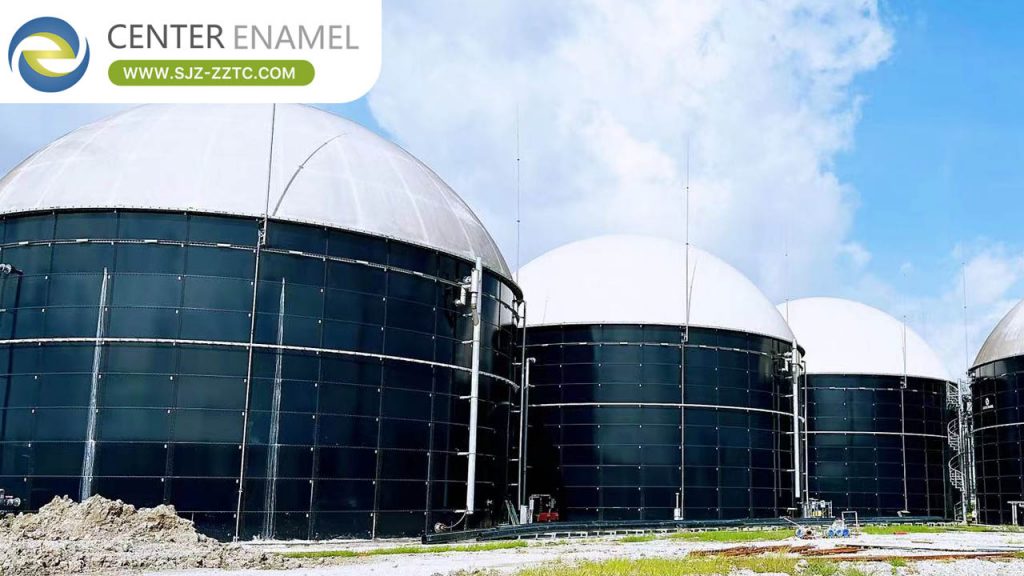
Which Digester Type Fits Your Biogas Project?
Digesters for biogas projects fall into three engineering families: complete-mix (CSTR) digesters—insulated, heated, mechanically mixed tanks handling feedstocks from 2% to 12% solids; plug-flow digesters—elongated heated channels best suited to thick dairy manure (11-14% solids) with no internal moving parts; and covered lagoon digesters—low-cost HDPE-covered basins for flush dairy and swine manure in warm climates (below roughly 25 degrees C mean annual temperature they need supplemental heat). Selecting the family is a feedstock-and-climate decision before any brand consideration.
Sizing Fundamentals: HRT, OLR, and Volume
Digester working volume equals daily feedstock volume multiplied by hydraulic retention time (HRT), corrected for a 75-90% volumetric utilization factor. Mesophilic systems (35-38 degrees C) typically run 20-30 days HRT; thermophilic systems (50-55 degrees C) run 12-18 days at higher risk and higher throughput. Loading must stay within the organic loading rate (OLR) envelope—2-5 kg volatile solids per cubic meter per day for CSTRs—to avoid acid accumulation. A 100 t/day mixed-substrate project at 25-day HRT therefore needs roughly 3,000-4,000 m3 of effective digester volume, usually split across two or more tanks for maintenance redundancy.
Comparative Data Table: Digester Tank Materials
| Parameter | Glass-Fused-to-Steel (GFS) | Stainless Steel (304/316L) | Epoxy-Coated Welded Steel | Reinforced Concrete |
| Corrosion resistance in biogas service | Very high (enamel bond, pH 1-14) | High (316L for H2S-rich gas zones) | Moderate (coating-dependent, needs recoat cycles) | High structurally; gas-tightness needs liner |
| Field installation speed | Fast (bolted panels, weeks) | Moderate (welding, QC-heavy) | Slow (fabrication + coating cure) | Slowest (formwork, curing 28+ days) |
| Design life | 30+ years | 30+ years | 15-25 years (coating life-bound) | 30-50 years (with liner maintenance) |
| Modular expansion | Excellent (add rings/panels) | Limited | Limited | Very limited |
| Relative installed cost (per m3) | Medium | High | Medium-low | High (small scale) / Medium (large) |
| Best fit | Farm/industrial CSTR, municipal sludge | High-chloride or H2S service, gas zones | Budget industrial projects | Very large municipal digesters |
Heating, Mixing, and Gas-Handling Systems
Heating holds digester content at setpoint (35-38 degrees C mesophilic) using CHP jacket heat via external heat exchangers—typically sized 15-30 W per m3 of digester volume in temperate climates plus feedstock pre-heating duty. Mixing distributes heat and substrate, prevents scum and grit stratification, and comes in four proven forms: mechanical center mixers (low energy, 0.2-0.5 W/m3), submersible agitators (flexible, 0.5-1.5 W/m3), pumped recirculation (simple, seal-friendly), and gas injection (no moving parts in liquid). Gas handling requires a pressure-relief valve, flame arrestor, and either a double-membrane holder (3-10% of daily gas volume buffer minimum) or direct engine feed with a flare for excess.
Frequently Asked Questions (FAQ)
Q1: What is the single most common digester selection mistake?
A: Choosing reactor type by brochure rather than feedstock chemistry. High-grit or high-fiber feedstocks (poultry litter, separated manure solids) demand grit-removal pre-treatment and robust mixing before a complete-mix tank makes sense; running them unprepared causes dead zones and volume loss within 2-5 years. A proper feedstock assay—solids, VS, grit load, C:N—should always precede reactor specification.
Q2: How much does a complete digester system cost?
A: Installed digester-system costs (tanks, mixing, heating, gas handling, excluding power generation) typically run $150-$400 per cubic meter of digester volume for bolted GFS systems at farm and industrial scale. A 3,000 m3 project therefore lands near $0.6-1.2 million for the digester island, with total project cost including CHP and balance-of-plant usually 2-3 times that figure.
Q3: Do digesters need to be insulated in warm climates?
A: Usually yes for complete-mix and plug-flow types, because stable mesophilic temperature matters more than ambient averages—night cooling and monsoon rains destabilize biology even in the tropics. Covered lagoons in consistently warm regions are the exception, often operating unheated at ambient temperatures with slower but acceptable kinetics.
Q4: One large digester or several smaller ones?
A: Multiple tanks (commonly two) improve resilience: one vessel can be drained for inspection or desludging while the other keeps producing. Single-tank designs save 10-15% on CAPEX but expose the project to total shutdown during maintenance. Most bankable projects above 500 kW choose redundancy; small farm systems accept single-vessel risk.