
Does a Dung Biogas Plant Save Money on Fertilizer?
Yes—a dung biogas plant saves money on fertilizer because anaerobic digestion preserves the nitrogen, phosphorus, and potassium in the manure and converts it into a stable, odour-reduced digestate that replaces a measurable share of synthetic fertilizer. The nutrient value is not destroyed by digestion; it is made easier to store, spread, and credit against purchased inputs.
What Digestate Keeps That Raw Manure Loses
Digestion does not burn off the nutrients—it mineralises part of the organic nitrogen into ammonium, which plants take up more readily, while most phosphorus and potassium stay in the residue. Raw slurry loses ammonia to the air during storage and spreading; a covered digester with a gas-tight store captures that ammonium, so more of the nitrogen reaches the crop. The result is a fertiliser credit that offsets commercial N-P-K purchases.
Nutrient Value of Digestate vs Synthetic
| Nutrient | In digestate (typical) | Equivalent synthetic cost avoided |
| Total N | retained + mineralised | main saving vs urea / ammonium nitrate |
| P₂O₅ (phosphorus) | fully retained | offset phosphate purchase |
| K₂O (potassium) | fully retained | offset potash purchase |
| Availability | higher (ammonium form) | better crop uptake than raw |
How Much It Is Worth in Practice
Valuing digestate is local—it depends on synthetic fertilizer prices and the farm’s own land base. A dairy that applies digestate to its own fields avoids both the purchase and the transport of equivalent synthetic product, and reduces the odour and ammonia-emission compliance cost that raw slurry attracts. Where the digestate is a surplus (more than land can absorb), its value falls and spreading distance becomes the limiting factor, so matching digester size to available acreage protects the saving.
Frequently Asked Questions (FAQ)
Q1: Does a dung biogas plant save money on fertilizer?
A: Yes. Digestion preserves N-P-K and converts part of the nitrogen to a readily available ammonium form, so digestate replaces a measurable share of synthetic fertilizer the farm would otherwise buy.
Q2: What nutrients does digestate keep?
A: Essentially all of the original nitrogen (partly mineralised), phosphorus, and potassium. A covered, gas-tight system also captures ammonia that raw slurry would lose to the air, so more reaches the crop.
Q3: How much is it worth?
A: It depends on synthetic prices and owned acreage, but the credit offsets commercial N-P-K purchases and the transport to deliver them, plus lower odour and ammonia-compliance cost versus raw slurry.
Q4: Is raw manure better?
A: Raw manure carries the same nutrients but loses ammonia in storage and spreading, smells more, and spreads pathogens. Digestate keeps the value while being easier to store, spread, and credit—so it pays off better per tonne.
Project Case Reference
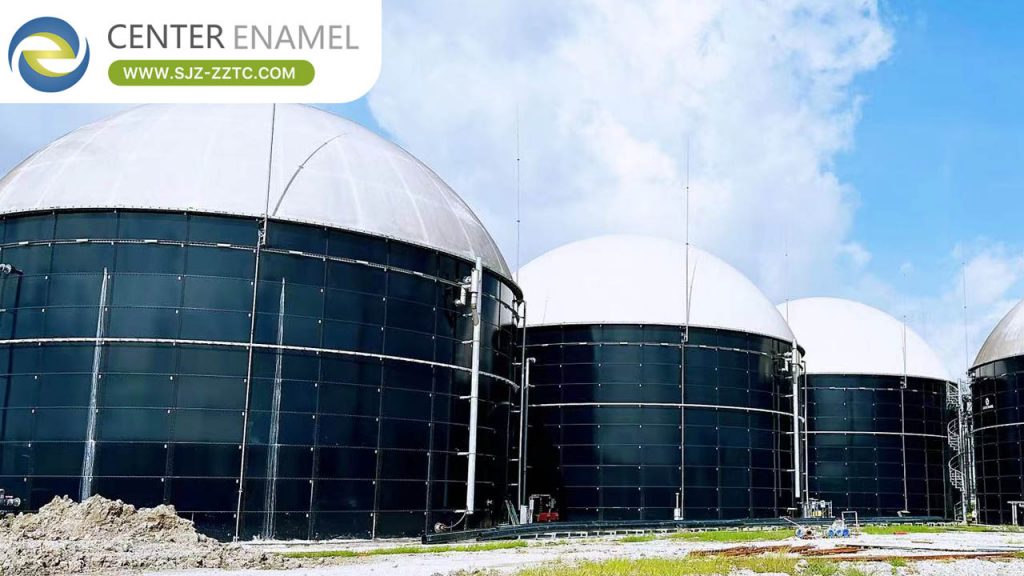
Malaysia Biogas Project — Malaysia · 2026
5 GFS Tanks · 27,000 m³ Total Volume · 22,000 m³ Biogas/Day
A large-scale biogas project in Malaysia featuring 5 Glass-Fused-to-Steel (GFS) tanks. The project achieves approximately 80% digestibility, with each single tank producing about 4,400 m³ of biogas daily, totaling 22,000 m³ per day across all 5 tanks.
Technical Specifications
Single Tank Volume: 5,400 m³ (Ø24.46 × 12 m)
Total Effective Volume: 27,000 m³ (5 tanks)
Daily Biogas Production: 22,000 m³ total
Digestibility: ≈ 80%
Gas Production Rate: 0.45 m³ / kg COD removed
Tank Type: Glass-Fused-to-Steel (GFS)
Water Quality Data
| Parameter | Inlet Water | Effluent |
| COD | ≥ 60,000 mg/L | ≥ 12,000 mg/L |
| BOD | ≤ 25,000 mg/L | ≤ 5,000 mg/L |