
Does Aerobic Treatment Cost More in Energy?
Yes—aerobic treatment costs more energy because activated-sludge aeration alone consumes 0.5–1.5 kWh per kg of COD removed, whereas anaerobic digestion consumes almost no treatment energy and instead recovers 0.30–0.45 m³ of biogas per kg COD. Over a year on high-strength waste, that gap is the difference between a net energy consumer and a net energy producer.
Where the Power Goes
Aerobic microbes need dissolved oxygen to oxidise organics, and supplying it through blowers and diffusers is the single largest energy draw in a conventional wastewater plant—often 40–60% of the site’s total electricity. Anaerobic microbes get their oxygen from the organic matter itself, so the reactor needs only gentle mixing. The sludge burden also differs sharply: aerobic makes 0.3–0.6 kg VSS per kg COD of sludge to dewater and haul, while anaerobic makes only 0.05–0.10.
Comparative Data Table: Energy and Sludge Balance
| Metric | Aerobic treatment | Anaerobic digestion |
| Electricity for aeration / mixing | 0.5–1.5 kWh/kg COD | near zero (mixing only) |
| Energy balance | net consumer | net producer (biogas) |
| Sludge yield | 0.3–0.6 kg VSS/kg COD | 0.05–0.10 kg VSS/kg COD |
| Biogas output | none | 0.30–0.45 m³/kg COD |
| OPEX driver | power + sludge hauling | gas cleanup + CHP O&M |
Why Anaerobic Wins—and When Aerobic Still Earns Its Keep
Anaerobic wins on energy whenever the organic load is high enough to yield useful biogas, because it turns a cost centre into a fuel source. Aerobic still earns its place for low-strength streams where anaerobic granulation will not establish, for polishing to very low effluent COD (85–95% removal), and where the site has no use for biogas. The smart design is often anaerobic first to eat the load and recover energy, then a small aerobic stage only for the polish.
Frequently Asked Questions (FAQ)
Q1: Does aerobic treatment cost more in energy?
A: Yes. Aeration alone consumes 0.5–1.5 kWh per kg COD removed, while anaerobic digestion uses almost no treatment energy and recovers biogas—so aerobic is a net consumer and anaerobic a net producer.
Q2: How much power does aeration use?
A: Typically 0.5–1.5 kWh per kg COD, and it is usually 40–60% of a conventional plant’s total electricity, making blowers the dominant energy cost.
Q3: Why is anaerobic lower?
A: Anaerobic microbes draw oxygen from the organic matter itself, so the reactor needs only gentle mixing, and the process yields 0.30–0.45 m³ biogas per kg COD plus only 0.05–0.10 kg VSS/kg COD of sludge.
Q4: When is aerobic still needed?
A: For low-strength streams where anaerobic will not establish, for polishing to very low effluent COD (85–95%), and where there is no use for biogas—often as a small stage after anaerobic.
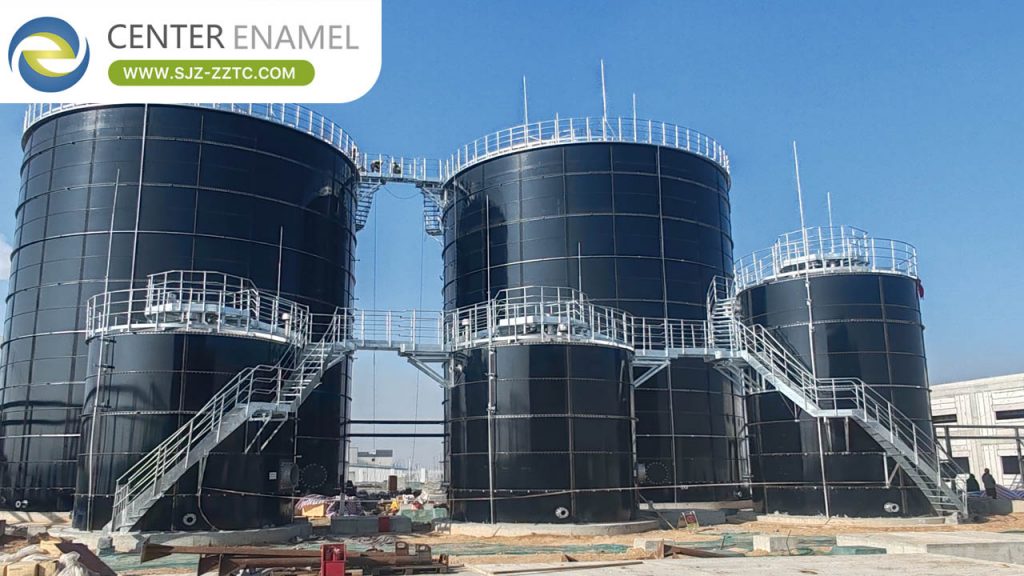
Project Case Reference
Malaysia Biogas Project — Malaysia · 2026
5 GFS Tanks · 27,000 m³ Total Volume · 22,000 m³ Biogas/Day
A large-scale biogas project in Malaysia featuring 5 Glass-Fused-to-Steel (GFS) tanks. The project achieves approximately 80% digestibility, with each single tank producing about 4,400 m³ of biogas daily, totaling 22,000 m³ per day across all 5 tanks.
Technical Specifications
Single Tank Volume: 5,400 m³ (Ø24.46 × 12 m)
Total Effective Volume: 27,000 m³ (5 tanks)
Daily Biogas Production: 22,000 m³ total
Digestibility: ≈ 80%
Gas Production Rate: 0.45 m³ / kg COD removed
Tank Type: Glass-Fused-to-Steel (GFS)
Water Quality Data
| Parameter | Inlet Water | Effluent |
| COD | ≥ 60,000 mg/L | ≥ 12,000 mg/L |
| BOD | ≤ 25,000 mg/L | ≤ 5,000 mg/L |