
Does Co-Digestion Increase Manure Biogas?
co-digestion reliably increases manure biogas. Blending manure with a complementary substrate such as food waste or crop residue balances the carbon-to-nitrogen ratio toward the 20–30:1 optimum, supplies easily degradable organics, and typically raises methane yield by 15–40% per unit of reactor versus manure alone, while also stabilizing loading.
What Co-Digestion Is
Co-digestion is simply feeding a digester two or more substrates together. Manure alone is usually nitrogen-rich and carbon-poor (high C:N), which caps how fast methanogens work. Adding a carbon-rich, readily degradable co-substrate corrects that imbalance and uses the reactor’s capacity more fully.
Why C:N Ratio Matters
Methanogens need both carbon (energy) and nitrogen (building blocks). Manure’s excess nitrogen ends up as free ammonia, which at high levels inhibits the culture. Bringing C:N toward 20–30:1 uses that nitrogen productively, raises VS conversion, and keeps ammonia in the safe band—so more of the manure’s own potential is realized, not just the co-substrate’s.
| Feed mix | C:N | Typical yield effect |
| Manure only | high (N-rich) | baseline |
| Manure + food waste | ~20–30:1 | +15–30% |
| Manure + crop residue | ~20–30:1 | +10–25% |
| Manure + glycerin | balanced | +20–40% |
Which Co-Substrate Is Best
Food waste is the strongest performer—high degradability and often delivered with a gate fee. Crop residues / grass are steady but slower. Glycerin (biodiesel by-product) is energy-dense but must be dosed carefully. The best choice is the cleanest, nearest, highest-VS stream you can secure year-round.
Applications
Co-digestion fits farms near cities, food processors, or abattoirs; it is also the backbone of municipal organic-waste biogas. The same GFS or CSTR digester handles the mix if receiving and screening are designed for the extra substrate.
Technical Considerations
Introduce co-substrates gradually and keep OLR in the 2–4 kg VS/m³·day band for manure mixes. Watch free ammonia (target <~200–300 mg/L NH₃-N for sensitivity) and trace elements (Ni, Co, Mo) that food waste can lack. Screen plastics/glass from waste streams, and meter by VS, not volume.
How to Co-Digest Well
Start with a small co-substrate share (~10–20% of VS), confirm stable VFA and gas, then ramp. Keep a TS/VS profile of every stream, and size receiving for the dirtiest one. Document the mix so yields are repeatable and bankable.
Project Case Study
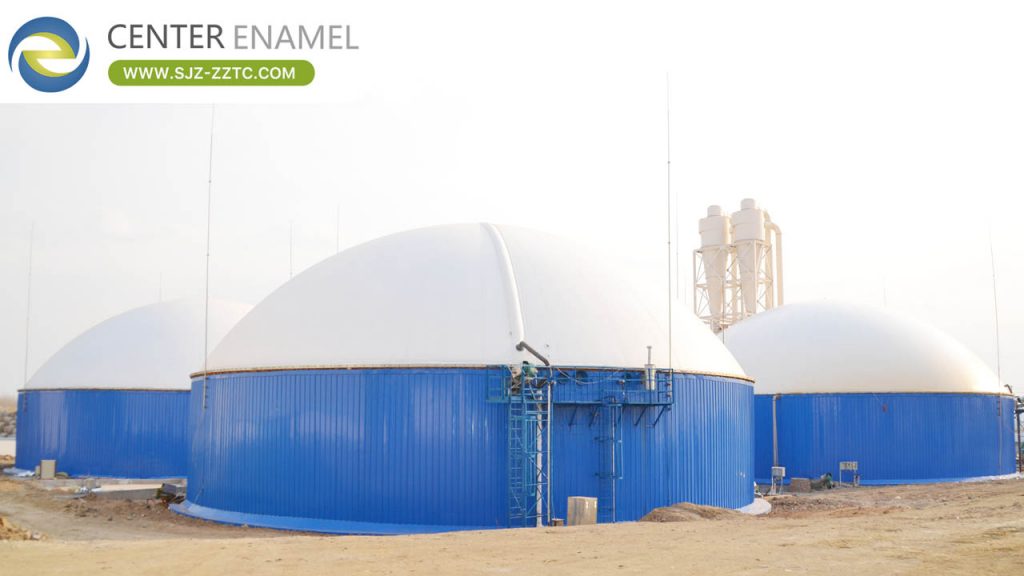
Zhenyuan Group Biogas Project — Xinzheng, Henan, China. A vehicle-grade methane project treating 650 T/D of farm animal manure and washing wastewater via medium-temperature CSTR (3 primary + 1 secondary reactors, two-stage digestion). The large, mixed manure feed demonstrates co-digestion at industrial scale, producing 3,000,000 m³/year of vehicle-grade methane.
| Project | Zhenyuan Group Biogas Project |
| Location | Xinzheng, Henan, China |
| Industry | Agriculture / Renewable transport fuel |
| Application | Manure + washing wastewater digestion |
| Product | CSTR anaerobic digester tanks |
| Capacity | 650 T/D; 3,000,000 m³/yr CH₄ |
| Quantity | 3 primary + 1 secondary reactors |
| Material | Glass-Fused-to-Steel (GFS) |
| Standards | ISO 28765, AWWA D103 |
| Status | Delivered reference project |
About Center Enamel
For co-digestion plants, Center Enamel applies its application experience in manure and organic-waste digestion: GFS and CSTR digester tanks sized for mixed, higher-VS feeds, with receiving and mixing provisions for food waste or residues. The gas-tight, acid-resistant GFS shell (enamel-fired 820–930°C, ISO 28765 / AWWA D103, ISO 9001, CE/EN 1090) handles the more corrosive, variable gas from co-digestion, and modular bolted panels let a plant add co-substrate capacity as feed contracts grow.
Advantages and Limitations
Co-digestion lifts yield and revenue and stabilizes loading, but adds intake, screening, and ammonia-management duty. Limits: contamination from waste streams and the need for gradual ramp-up; both are manageable with design discipline.
Comparison: Manure vs Manure + Co-Substrate
| Metric | Manure only | Manure + co-substrate |
| Methane / reactor | baseline | +15–40% |
| C:N | off-optimum | 20–30:1 |
| Loading stability | seasonal | more stable |
| Revenue | energy | energy + gate fee |
Co-digestion increases manure biogas by balancing C:N toward 20–30:1 and adding degradable VS, typically raising yield 15–40% per reactor versus manure alone. It also adds gate-fee revenue—provided intake, ammonia, and trace elements are managed.
Frequently Asked Questions (FAQ)
Q1: Does co-digestion increase manure biogas?
A: Yes—blending manure with food waste or residue balances C:N toward 20–30:1 and typically raises methane yield 15–40% per reactor.
Q2: Why does C:N ratio matter?
A: Manure is nitrogen-rich; excess becomes inhibitory ammonia. A 20–30:1 balance uses that nitrogen, raises VS conversion, and protects the culture.
Q3: Which co-substrate is best?
A: Food waste—high degradability and often a gate fee; crop residue is steady but slower; glycerin is energy-dense but needs careful dosing.
Q4: How much gain is realistic?
A: Roughly +15–40% methane per unit reactor for well-managed mixes; exact gain depends on the co-substrate VS and how close the base C:N was to optimum.
Q5: What can go wrong?
A: Ammonia inhibition, trace-element deficits, and physical contamination (plastics/glass) from waste—managed by gradual ramp-up, dosing, and screening.
Q6: Do I need a different digester?
A: Usually not—the same GFS/CSTR works if receiving and screening are sized for the co-substrate; modular tanks allow later capacity growth.
Tell us your manure volume and any available co-substrate (type, TS/VS, distance). We will model the C:N balance, estimate the yield gain, and size GFS digester tanks and receiving for your co-digestion plant.