
Does Feeding Change Daily Biogas Output?
feeding rate and consistency are the single biggest control on daily biogas output. Biogas is produced in proportion to the volatile solids actually digested, so changing how much and how steadily you feed shifts gas day to day. Holding the organic loading rate (OLR) at a steady 2–4 kg VS/m³·day for manure mixes is the main lever for stable, predictable output.
What Drives Daily Output
Daily biogas = (VS fed that day × BMP × conversion efficiency). The digester does not instantly turn feed into gas—there is a lag of days tied to hydraulic retention time (15–30 days for manure). So today’s gas reflects recent feeding, smoothed by the reactor volume.
What Is OLR?
Organic Loading Rate (OLR) is the volatile solids added per unit reactor volume per day, kg VS/m³·day. Below ~2 the reactor is underfed (wasted capital); above ~4 for manure, acids can outpace methanogens and cause instability. The sweet spot keeps methanogens fed without acid accumulation.
| Feeding pattern | Effect on daily biogas | Risk |
| Steady OLR 2–4 | stable, predictable | low |
| Over-feeding (>4) | spike then crash | acidification |
| Under-feeding (<2) | low, steady | wasted volume |
| Batch / irregular | saw-tooth swings | instability |
Why Gas Swings Happen
Common causes: skipped or doubled feed batches (lagoon pump-out), TS/VS variation in manure by season and diet, temperature drift away from 35–38°C, and toxic shocks (cleaning chemicals, antibiotics). A swing in feed VS of 20% moves gas by a similar amount within the retention window.
Applications
Continuous-feed CSTR plants (the manure standard) are built precisely to smooth these swings. Farms with irregular collection benefit from a feed buffer or equalization tank so the digester sees constant VS input even when trucks arrive in bursts.
Technical Considerations
Monitor OLR, pH, and the VFA:alkalinity ratio daily; a rising VFA signal means you are over-feeding before gas crashes. Keep temperature stable (insulated GFS tanks help in cold climates), and meter feed by VS, not by volume, since manure TS varies.
How to Stabilize Output
Feed by measured VS, not bucket counts; use an equalization/feed buffer; hold mesophilic temperature tightly; introduce any co-substrate gradually; and keep a settled, healthy inoculum. Stable input → stable OLR → stable gas.
Project Case Study
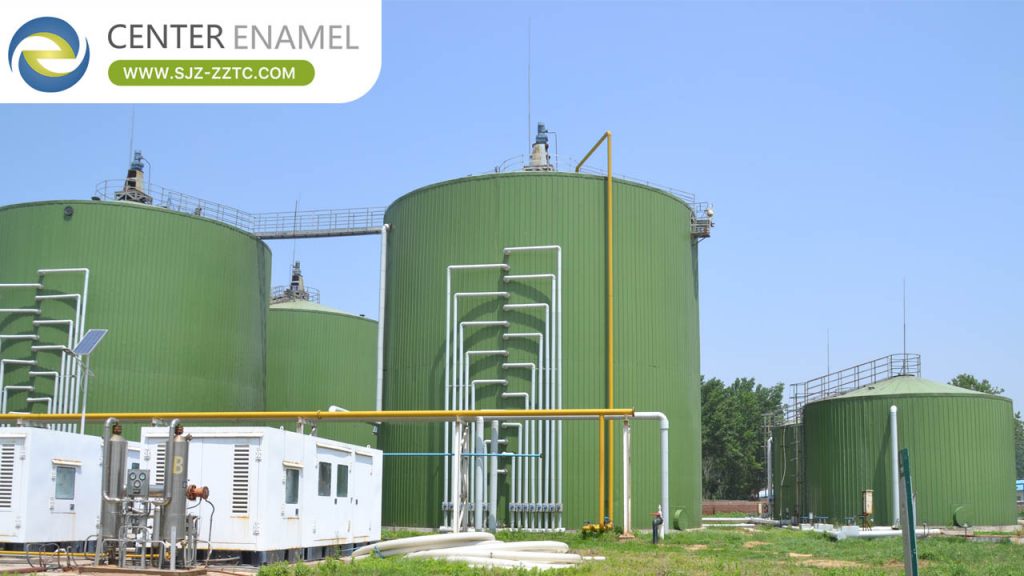
Zhaqi Biogas Project — Xing’an, Inner Mongolia, China. Processing 900 m³/day of manure plus agricultural waste through four CSTR reactors, the project delivers a steady 20,000 m³/day of biogas. Constant feeding of a mixed, buffered feed stream under medium-temperature operation is what keeps that output predictable through seasonal swings.
| Project | Zhaqi Biogas Project |
| Location | Xing’an, Inner Mongolia, China |
| Industry | Agriculture / Biogas |
| Application | Continuous manure + residue feed |
| Product | CSTR anaerobic digester tanks |
| Capacity | 900 m³/D; 20,000 m³/day biogas |
| Quantity | 4 Ø 25.98 × 8.4 m reactors |
| Material | Glass-Fused-to-Steel (GFS) |
| Standards | ISO 28765, AWWA D103 |
| Status | Delivered reference project |
About Center Enamel
Stable feeding needs stable, insulated, gas-tight reactors—exactly what Center Enamel builds. Its GFS digester tanks are enamel-fired at 820–930°C for a corrosion-resistant, gas-tight shell, and the bolted panel system supports insulation jacketing for cold-climate mesophilic operation (as on the Inner Mongolia projects). With international reference projects across Asia, Africa, and the Middle East, the company pairs tank manufacture (ISO 9001, ISO 28765, AWWA D103, CE/EN 1090) with installation support so feeding control systems integrate cleanly.
Advantages and Limitations
Controlling feed is cheap and high-impact—it is the fastest way to steady gas. Limits: you cannot exceed reactor OLR without risking instability, and feed quality still varies with the herd; a buffer tank and metering solve most of it.
Comparison: Feeding Controls
| Control | Cost | Impact on stability |
| Metered VS feeding | low | high |
| Equalization buffer | medium | high |
| Temperature hold | medium | medium–high |
| Inoculum management | low | medium |
Feeding absolutely changes daily biogas output—rate and consistency are the dominant control. Keep OLR steady at 2–4 kg VS/m³·day for manure, meter by VS, and buffer irregular intake to turn feeding from a source of swings into a source of predictability.
Frequently Asked Questions (FAQ)
Q1: Does feeding change daily biogas output?
A: Yes—biogas tracks the volatile solids digested, so the rate and consistency of feeding are the biggest daily drivers of gas volume.
Q2: What is OLR?
A: Organic Loading Rate, kg VS added per m³ of digester per day; for manure mixes the stable band is about 2–4 kg VS/m³·day.
Q3: Why does my gas swing day to day?
A: Irregular batches, TS/VS variation by season/diet, temperature drift, and occasional toxic shocks; watch VFA:alkalinity to catch over-feeding early.
Q4: How do I stabilize output?
A: Feed by measured VS, add an equalization buffer, hold mesophilic temperature, and meter co-substrate gradually.
Q5: Is there a lag between feeding and gas?
A: Yes—gas reflects feeding over the retention window (15–30 days for manure), which is why a buffer smooths bursts.
Q6: Can I over-feed for more gas?
A: Only to a point; above ~4 kg VS/m³·day for manure, acids can outpace methanogens and crash the digester.
Send your feeding schedule, manure TS/VS, and reactor volume. We will check your OLR headroom, recommend buffer and insulation provisions, and size GFS digester tanks for stable daily output.