
Does Fresh or Dry Dung Yield More Biogas?
Fresh, wet dung yields more biogas than dry dung. Drying manure before digestion almost always reduces the degradable volatile solids through spontaneous aerobic breakdown and volatilization, so the BMP drops. The trade-off only flips in favor of drier feed when you must ship or store the material and drying protects it from rotting—not for boosting gas.
What “Fresh” and “Dry” Mean Here
Fresh dung is as-excreted or shortly collected slurry (10–18% total solids). Dry dung is sun- or mechanically dried cake or powder (often 50–90% TS, or fully dry). Both still contain the same carbon chemistry, but the *degradable* share changes with handling.
Why Fresh Wins on Yield
Anaerobic digestion converts the volatile solids that are still intact. Fresh manure reaches the digester before its easily degraded organics are lost. Dry, stockpiled, or windrowed manure sits exposed to air and microbes; even without visible rot, a fraction of VS respires away or leaches out, lowering the BMP you can recover (from ~0.25 toward 0.18–0.20 m³/kg VS).
| Form | Total solids | Typical BMP (m³/kg VS) | Note |
| Fresh slurry | 10–18% | 0.22–0.30 | intact VS, best yield |
| Slightly dried | 25–40% | 0.20–0.26 | minor loss |
| Dry cake / powder | 50–90% | 0.16–0.22 | VS lost to storage |
| Fully dry | >90% | 0.15–0.20 | handle as solid AD |
Where Dry Feed Has a Use
Drying is justified when the alternative is spoilage or when transport cost dominates—dry, stable manure ships far more cheaply per kg VS. Some plants deliberately run dry anaerobic digestion (solid-state, 20–40% TS) for bedding-heavy or separated solids, where a higher TS feed suits the reactor even if BMP is a touch lower. The point: dry feed is a *logistics* choice, not a yield boost.
Applications
Wet, continuous CSTR digesters (the manure norm) want fresh slurry under ~15% TS; if dung is too thick, operators add process water. Dry AD tunnels suit separated or bedded solids. Matching TS to reactor type matters more than squeezing a few percent of BMP.
Technical Considerations
Watch free ammonia and盐分 in concentrated dry feed if you re-slurry it—high TS re-wetted can spike ammonium and inhibit methanogens. Keep fresh manure cool and covered to limit pre-degradation, and measure TS/VS after any drying step so design BMP reflects reality.
How to Choose the Right Form
Default to fresh collection with minimal lagoon storage. Only dry if you must stabilize for shipping or run a dedicated dry-AD line. If you dry, size the digester to the *post-drying* BMP and budget the drying energy (see the drying-energy article) against the gas you recover.
Project Case Study
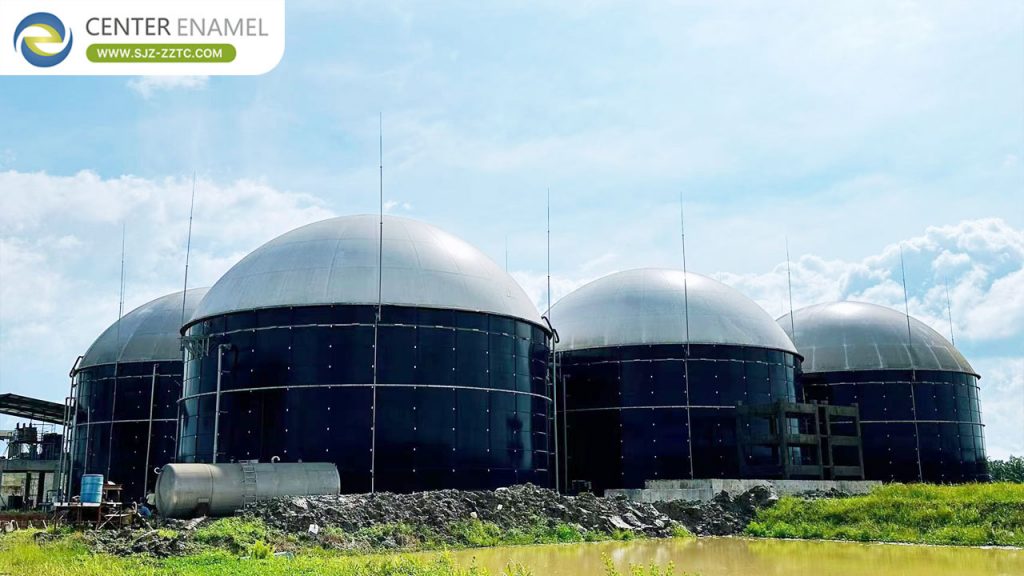
Inner Mongolia Wushenqi Cattle Farm — Ordos City, Inner Mongolia, China. CSTR process with a dedicated insulation system for cold-climate cattle-manure digestion. The project handles fresh cattle manure directly, avoiding dry-storage losses and maintaining steady biogas output through winter.
| Project | Inner Mongolia Wushenqi Cattle Farm |
| Location | Ordos City, Inner Mongolia, China |
| Industry | Livestock / Agriculture |
| Application | Fresh cattle manure biogas |
| Product | GFS anaerobic digester tanks |
| Capacity | CSTR, cold-climate insulated |
| Quantity | Insulated tank system |
| Material | Glass-Fused-to-Steel (GFS) |
| Standards | ISO 28765, AWWA D103 |
| Status | Delivered reference project |
About Center Enamel
For manure-fed biogas, Center Enamel supplies Glass-Fused-to-Steel (GFS) digester tanks engineered for fresh, abrasive, and corrosive slurry. The glass-to-steel composite is fired at 820–930°C, giving a smooth, inert, gas-tight internal surface that resists H₂S and ammonia attack better than bare steel. Tanks are bolted from factory-enameled panels (ISO 28765 / AWWA D103 design, ISO 9001 manufacture) and can be relocated or expanded—useful when a farm switches between wet and dry feed streams.
Advantages and Limitations
Fresh feed maximizes BMP and is simplest for wet CSTR; dry feed eases logistics and enables dry AD but lowers recoverable gas and adds an energy penalty. Limits of fresh feed: higher transport water weight and the need to collect frequently to avoid pre-degradation.
Comparison: Fresh vs Dry for a Manure Digester
| Criterion | Fresh slurry | Dry / separated |
| Recoverable BMP | higher | lower |
| Transport weight | high (water) | low |
| Reactor type | wet CSTR | dry AD tunnel |
| Pre-degradation risk | if lagooned | if stockpiled wet |
| Best when | on-site, frequent | shipping / solid AD |
Fresh, wet dung yields more biogas than dry dung because it preserves volatile solids; drying should be a logistics or dry-AD decision, never a yield strategy. Match the total-solids level to the reactor type and design BMP to the actual, post-handling feed.
Frequently Asked Questions (FAQ)
Q1: Does fresh or dry dung yield more biogas?
A: Fresh wet dung yields more—drying loses degradable volatile solids to aerobic breakdown, dropping BMP from ~0.25 toward 0.18–0.20 m³/kg VS.
Q2: Why does moisture content matter?
A: Digestion recovers the volatile solids that remain intact; drier, stockpiled manure has already lost some VS to air and microbes before it reaches the digester.
Q3: Is drying ever useful?
A: Yes—when you must ship or store manure long-term, or run dry (solid-state) anaerobic digestion; it is a logistics choice, not a yield boost.
Q4: What TS is best for a CSTR?
A: Fresh slurry around 10–15% TS feeds a wet CSTR best; thicker feed is diluted with process water rather than dried.
Q5: Can drying hurt the digester?
A: Re-wetting very dry, concentrated manure can spike ammonium and inhibit methanogens; re-slurry gradually and test TS/VS after drying.
Q6: What reactor suits dry manure?
A: Dry (solid-state) anaerobic digestion in tunnels or silos at 20–40% TS, rather than a wet CSTR.
Tell us your manure collection method, target TS, and whether you plan wet or dry digestion. We will recommend a GFS digester configuration and confirm tank capacity, coating, and delivery for your site.