
Domestic Sewage Treatment: From Preliminary To Nutrient Removal
Domestic sewage treatment runs in four tiers: preliminary (screen and grit), primary (settling), secondary (biological organics and nutrients), and tertiary (polishing and disinfection). Each tier removes a defined fraction of solids, carbon, nitrogen, phosphorus, and pathogens before the water is returned to the environment.
Preliminary And Primary Stages
Preliminary treatment removes rags, grit, and large solids that would damage equipment. Primary settling then lets heavier suspended solids drop out by gravity, cutting the load that the biological stage must handle. Together they protect the reactors and reduce aeration energy downstream.
Secondary Biological Treatment
Secondary treatment is where microbes consume dissolved and colloidal organics. Activated sludge, sequencing batch reactors (SBR), and biofilm systems such as UBF (upflow blanket filter) remove most of the carbon (COD and BOD). For nutrient limits, an anoxic and aerobic sequence strips nitrogen, while controlled sludge age or chemical addition captures phosphorus.
| Stage | Removes | Typical Equipment |
| Preliminary | Grit, rags, coarse solids | Screen, grit chamber |
| Primary | Settleable solids | Clarifier |
| Secondary | COD, BOD, nitrogen | Activated sludge, SBR, UBF |
| Tertiary | Remaining N, P, pathogens | Filter, disinfection |
Tertiary Polishing
When the permit is tight, tertiary steps polish the effluent: sand or membrane filtration and disinfection bring nitrogen, phosphorus, and pathogens down to the final limit. Tertiary is sized only after the secondary train is defined, not as a generic add-on.
Where Tankage Fits
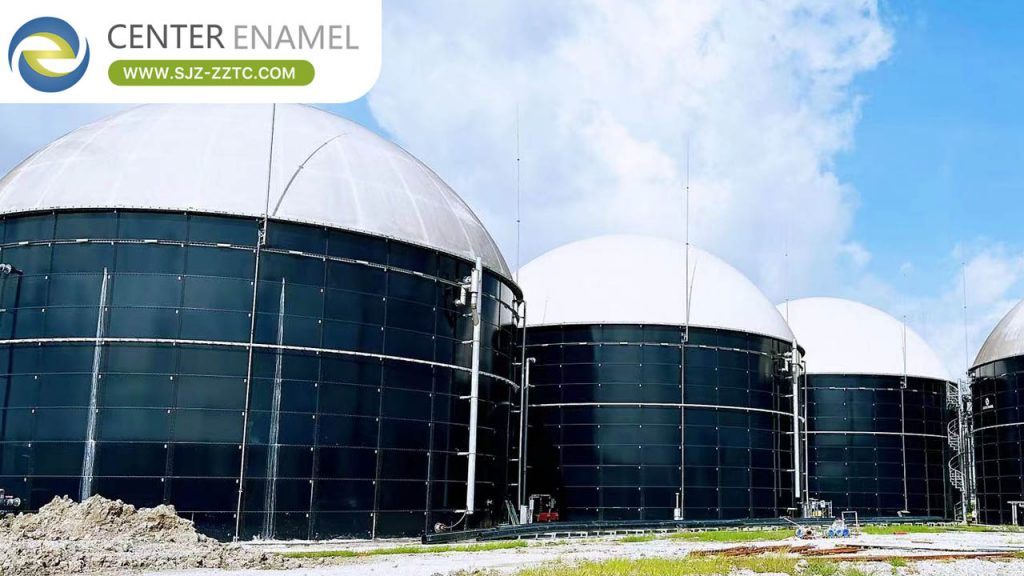
Every biological and settling stage needs a vessel. Bolted Glass-Fused-to-Steel tanks give corrosion-resistant, factory-coated reactors and clarifiers that assemble faster than concrete, which matters when a treatment train must be built on a fixed schedule.
Project Case Study: Domestic Sewage Treatment Project In Ghana
Project / Application: Municipal domestic sewage treatment, Ghana. Industry: Municipal. Tank Type: Glass-Fused-to-Steel (GFS). Key Requirements: Reliable nitrogen and phosphorus removal at community scale.
| Field | Value | Source / Evidence |
| Daily Treatment Volume | 1,800 m3/day | Company project reference |
| Reactor Types | UBF + A2/O + Sedimentation | Company project reference |
| UBF Tank | 1 set, O11.46 x 9.6 m | Company project reference |
| Secondary Sedimentation | 1 set, O14.52 x 4.8 m | Company project reference |
| A2/O Tanks | 2 sets, Outer O20.64 x 6.6 m | Company project reference |
| Installation Year | 2021 | Company project reference |
| Parameter | Influent | Effluent |
| COD Cr | 1,000 mg/L | 100 mg/L |
| BOD5 | 500 mg/L | 25 mg/L |
| Ammonia N | 30 mg/L | 10 mg/L |
| SS | 400 mg/L | 25 mg/L |
| Total P | 10 mg/L | 2 mg/L |
| pH | not stated | 6.5 to 9.0 |
About The Supplier
Shijiazhuang Zhengzhong Technology Co., Ltd (Center Enamel) manufactures Glass-Fused-to-Steel tanks rated for domestic and municipal sewage duty, with enamel firing at 820-930 C and certifications including ISO 9001, NSF/ANSI 61, and CE-EN 1090. The bolted system supports rapid overseas deployment and factory-controlled quality.
Comparison: Secondary Technologies
| Technology | Best For | Note |
| Activated sludge | Steady municipal flows | Needs aeration energy |
| SBR | Variable loads, batch sites | Flexible cycle |
| UBF / biofilm | High-strength or compact sites | Compact footprint |
Domestic sewage treatment is a chain of defined removals, not a single box. Design each stage to the load it receives, and choose tankage that lets the whole train be built and commissioned on schedule.
Frequently Asked Questions
Q1: What are the stages of domestic sewage treatment? A1: Preliminary, primary, secondary, and tertiary, each removing defined solids, organics, and nutrients.
Q2: What does secondary treatment remove? A2: Most dissolved organics (COD, BOD) and a large part of nitrogen.
Q3: What is tertiary treatment for? A3: Polishing nitrogen, phosphorus, and pathogens to meet tight discharge limits.
Q4: How are nutrients removed? A4: Anoxic-aerobic sequencing removes nitrogen; controlled sludge age or chemicals capture phosphorus.
Q5: Which tank suits each stage? A5: GFS reactors and clarifiers resist corrosion and assemble faster than concrete.
Q6: What is a UBF? A6: An upflow blanket filter, a compact biofilm reactor for carbon and nutrient removal.
Q7: How fast can tankage be built? A7: One overseas municipal plant installed several GFS tanks for a 1,800 m3/day train.
Q8: Do all plants need tertiary? A8: Only when the permit requires it; many plants stop at secondary.
Describe your influent and permit to an engineer, or request a staged domestic sewage treatment and tankage plan.