
Advanced USR Process with Durable GFS Tanks for Demanding Palm Oil Wastewater Treatment Project Applications
The core challenges of industrial wastewater treatment center on the "three highs"-high difficulty, high cost, and high energy consumption. Wastewater from new energy, chemical, and pharmaceutical industries is complex in composition with numerous characteristic pollutants, and traditional treatment processes are difficult to remove effectively. Chinese companies have significant price advantages in the mid- to low-end equipment segment. The industry also faces continuous technological upgrade pressure from increasingly stringent emission standards, as well as new requirements for digitalization and low-carbon transformation on operational refinement management capabilities.
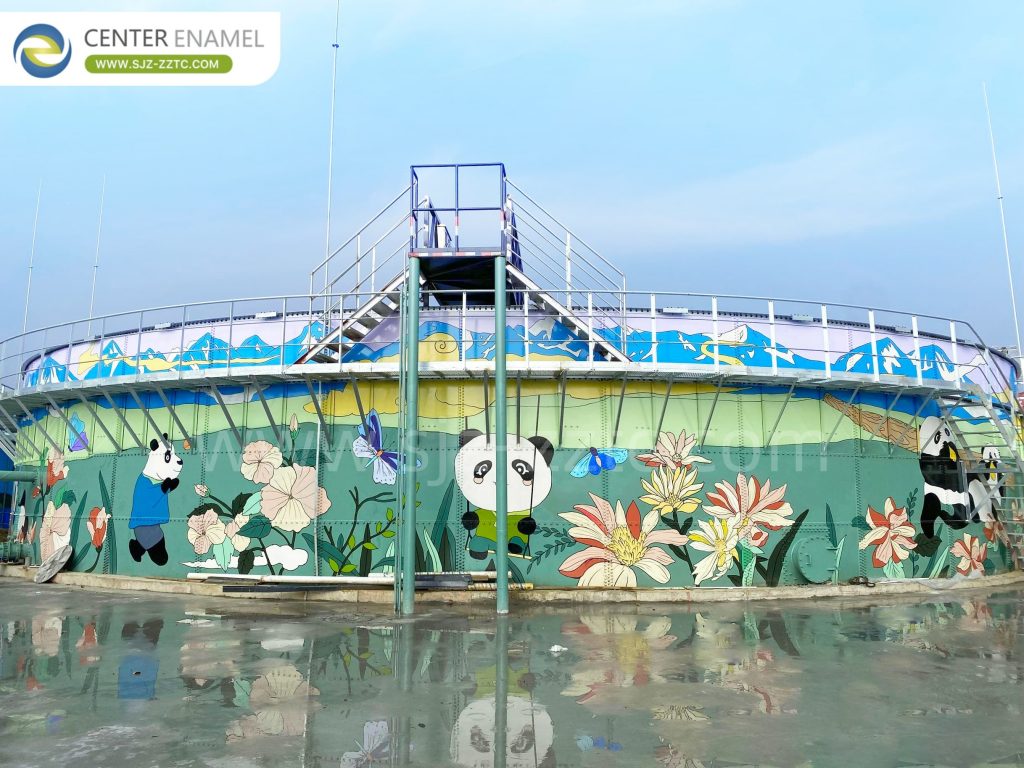
These pressures are especially acute in agricultural processing sectors, where high-strength organic wastewater demands treatment trains that are simultaneously robust, cost-effective, and capable of resource recovery. The USR Process has emerged as a direct engineering response to these challenges-particularly for high-solids streams that defeat conventional anaerobic systems. Pairing this process with corrosion-resistant GFS Tanks creates a complete solution architecture now being deployed across numerous Palm Oil Wastewater Treatment Project developments.
GFS Tanks: Adaptable to Complex Operating Conditions Across All Industries
Center Enamel has independently developed over 200 specialized enamel frit formulations and supporting patents, capable of customizing anti-corrosion enamel based on customer storage media, with adaptability comprehensively superior to concrete tanks. Concrete tanks use a single material, only suitable for neutral clean water storage. When storing corrosive materials such as livestock manure, palm oil mill effluent, chemical wastewater, food waste digestate, high-salinity wastewater, etc., additional anti-corrosion linings must be applied. These linings are prone to failure, preventing long-term stable operation and cannot adapt to alternating high/low concentration storage conditions.
GFS Tanks can be specifically formulated with specialized enamels resistant to strong acids, strong alkalis, high organic content, and high salinity. A single tank can switch between multiple wastewater and fermentation feedstock storage requirements. They are universally applicable across biogas anaerobic digestion, municipal wastewater, livestock farming, food processing, and industrial water treatment scenarios, eliminating the need to rebuild tanks for media changes, perfectly meeting the needs of diversified, multi-condition environmental protection projects. This material versatility is precisely what makes GFS Tanks the preferred containment solution for USR Process reactors handling aggressive palm oil effluent.
USR Reaction Process: How High-Solids Organic Wastewater Is Treated
High-solids organic wastewater, after simple pretreatment to remove large debris, is uniformly fed into the reactor through the bottom distribution system. The upward flow drives solid substrates and anaerobic sludge to slowly rise and thoroughly mix. In the sealed anaerobic environment, microorganisms sequentially hydrolyze/acidify and then methanogenically ferment, degrading macromolecular organic pollutants and generating biogas and treated water. Without complex separation structures, gentle hydraulic disturbance prevents clogging. The mixed liquor rises to the upper portion of the reactor where natural gas-liquid-solid separation occurs. Biogas is collected, effluent overflows, and solid sludge and unreacted substrate settle back to the lower reaction zone for continued reaction, with a small amount of aged sludge periodically discharged-continuous stable operation.
This elegant hydraulic design is why the USR Process tolerates suspended solids levels that would rapidly clog conventional anaerobic reactors. The process becomes especially valuable in a Palm Oil Wastewater Treatment Project, where fruit pulp residues, shell fibers, and colloidal proteins would otherwise cause operational failure. Containing this aggressive environment requires tank materials that can match the process's durability-which is where GFS Tanks prove indispensable.
Palm Oil Mill Effluent Key Water Quality Characteristics
Prominent "five highs and one low"-high COD, high BOD, high oil and grease, high suspended solids, high temperature, low pH-pollution load far exceeding conventional industrial wastewater, one of the highest concentration wastewater categories in agricultural processing. Very high COD-combined wastewater 45,000-100,000 mg/L, oil separation wastewater peaking above 150,000 mg/L-dozens to hundreds of times higher than municipal wastewater. High BOD-25,000-65,000 mg/L, BOD/COD 0.5-0.6-excellent biodegradability with very high anaerobic digestion efficiency.
High oil and grease-combined 2,000-8,000 mg/L, oil separation above 10,000 mg/L-oil readily adheres and scales on pipe/equipment surfaces, affecting heat transfer and causing blockages. High suspended solids-10,000-20,000 mg/L-primarily fruit pulp residues, fruit shell fibers, colloidal proteins-readily settling and clogging equipment. Moderate total nitrogen-ammonia 500-1,500 mg/L with abundant organic nitrogen but low inorganic nitrogen. High total phosphorus-200-800 mg/L. Very low pH-raw water pH 4.0-5.0-requires alkali neutralization before biological treatment.
High temperature-discharge 60-80°C-requires cooling to 35-38°C before anaerobic digestion. Water quality varies significantly with palm oil mill processing seasons-peak production during fresh fruit bunch harvest season (March-September annually) with full-load operation, wastewater volume and organic concentration at maximum; off-season (October-February) with reduced or halted production-water quality fluctuations require high shock load resistance.
These extreme characteristics explain why any Palm Oil Wastewater Treatment Project must be engineered around corrosion resistance, solids tolerance, and seasonal load flexibility. The USR Process addresses the biological and hydraulic challenges, while GFS Tanks address the material durability challenges-together forming a treatment architecture capable of decades of reliable service under the harshest conditions.
Smart Manufacturing Base Scale: Capacity Behind Every Project
Center Enamel's core intelligent manufacturing base is located in Hebei Province, China, covering a total area of over 150,000 m², with Phase I mature manufacturing facility and Phase II high-end environmental equipment industrial park-dual-base synergy ensures stable production capacity. The base includes dedicated R&D office buildings, proprietary material laboratories, and finished product testing centers, with full-process quality control systems meeting ISO, NSF, CE, and other international standards. The facility operates to green manufacturing standards, certified as a Provincial Green Factory-balancing efficient production with energy conservation and emission reduction. The company has 6 marketing service centers across China, establishing a nationwide production-sales network ensuring stable delivery.
This manufacturing scale is what allows Center Enamel to supply GFS Tanks at volume for large-scale Palm Oil Wastewater Treatment Project deployments across Southeast Asia and beyond. It also ensures that every USR Process reactor is built with consistent material quality and dimensional precision-critical factors for long-term anaerobic performance.
Design Team: Engineering Excellence Tailored to Local Conditions
The design team includes senior engineers registered in the Hebei Provincial Science and Technology Expert Database, with design standards aligned with strict European/American high-end equipment safety standards. The team can provide complete integrated design for differentiated overseas projects in livestock biogas, POME, municipal wastewater, hazardous waste storage, seawater desalination, etc. -covering tank structure, anti-corrosion/sealing systems, biogas piping, and anaerobic process integration.
Pre-design thoroughly investigates local seismic zone, wind pressure, soil bearing capacity, water quality corrosion, and local environmental discharge standards-applying thickened panels, reinforced anchored bases, and optimized sealing/corrosion structures as needed. Complete customized equipment solutions can be tailored to customer plant area, wastewater load, treatment targets, and budget-balancing safety, economics, and local adaptation-providing compliant, stable, and highly adaptable equipment structural design support for global environmental projects. This design capability ensures every USR Process and GFS Tanks system is optimized for its specific site-whether a Palm Oil Wastewater Treatment Project in tropical Malaysia or a biogas facility in temperate Europe.
FRP Roof Cover Solution: Economical Protection for Atmospheric Storage Tanks
FRP Roof is a general-purpose economical roof for atmospheric pressure storage tanks without air-tightness requirements, suitable for drinking water storage, agricultural irrigation water, firewater reserve, and general production wastewater temporary storage. It is available in two styles: flat and dome, allowing flexible selection based on tank specifications and site aesthetic requirements. The roof is integrally molded from resin and fiberglass, lightweight, with natural water resistance and mild acid/alkali corrosion resistance.
It will not rust or rot in long-term humid environments, eliminating the frequent anti-corrosion maintenance required for metal roofs. The dome style features excellent drainage performance due to its curved structure, resisting water accumulation, dust buildup, snow load, and strong winds. The flat style facilitates the installation of maintenance walkways, level gauges, and vents on top, making inspection and operation convenient. The product is fully insulated with no risk of galvanic corrosion, will not contaminate drinking water quality, and meets environmental standards for domestic water storage.
The modular design with low individual component weight allows for simple on-site hoisting and assembly, offering high construction efficiency and affordable procurement and installation costs. It is only suitable for atmospheric pressure water storage tanks without biogas collection or pressurization requirements, and is not recommended for anaerobic fermentation gas-producing conditions. It is widely used in rural agricultural water storage tanks, industrial park firewater tanks, waterworks buffer tanks, and small to medium-sized domestic wastewater temporary storage facilities, making it a cost-effective general-purpose roof choice for conventional water storage applications.
While the FRP Roof serves non-pressurized storage needs, GFS Tanks equipped with gas-tight enamel roofs remain the correct choice for USR Process anaerobic reactors and biogas collection in any Palm Oil Wastewater Treatment Project.
Ready to discuss your Palm Oil Wastewater Treatment Project? Contact Center Enamel today for a free consultation and customized USR Process + GFS Tanks solution tailored to your specific wastewater challenges. Our engineering team is available to provide technical guidance, project feasibility assessment, and competitive quotations-reach out now and let us help you turn palm oil effluent into valuable resources.
FAQ
What makes the USR Process suitable for Palm Oil Wastewater Treatment Project applications?
The USR Process tolerates high suspended solids (10,000-20,000 mg/L) without clogging, requires no granular sludge formation, and handles the "five highs and one low" characteristics of POME effectively. Paired with GFS Tanks, it delivers stable long-term anaerobic treatment.
Why are GFS Tanks preferred over concrete for USR Process reactors?
GFS Tanks resist pH 1-14 corrosion without linings, install faster, and last 30+ years. Concrete cracks and requires coatings that fail in high-sulfide, high-oil POME environments.
How does Center Enamel support full Palm Oil Wastewater Treatment Project delivery?
We provide integrated design, USR/CSTR anaerobic systems, GFS Tanks manufacturing, installation, commissioning, and operator training-delivering complete EPC solutions with typical 5-8 year payback through biogas recovery.