
Efficient Biogas Power Plant and UASB Process Integration for Livestock Waste
The livestock manure treatment market is transitioning from environmental compliance-driven to dual-value-driven by energy and fertilizer valorization. The European digestate concentration fertilizer market is mature, and large-scale biogas projects in North America commonly include digestate processing centers. In terms of business model innovation, the asset-light model of farmers paying per volume treated has been piloted successfully in some countries. China's "biogas operation outsourcing" model is beginning to penetrate county-level projects.
Digital technology-driven precision nutrient management platforms are emerging as new industry links connecting farms, treatment centers, and agricultural end-users. In terms of process equipment, CSTR is the mainstream anaerobic digestion process for treating livestock manure. After anaerobic digestion, manure produces biogas for power generation or grid-injection purification, while digestate is processed into organic fertilizer for farmland application. GFS tanks, with strong corrosion resistance and low maintenance costs, are widely used in manure treatment projects on large-scale farms in North America, Europe, and China, particularly suited to the corrosive environments of high ammonia-nitrogen and high hydrogen sulfide in manure.
As the industry shifts toward high-efficiency energy recovery, the demand for optimized infrastructure continues to grow. A well-designed Biogas Power Plant not only ensures compliance but also maximizes the financial return from waste-to-energy conversion. Implementing robust technology at the core of these facilities is essential for long-term operational excellence.
UASB Process Advantages
No mechanical mixing equipment is required, with sludge suspension achieved through hydraulic action, resulting in very low overall energy consumption. High-concentration anaerobic granular sludge can be cultivated, with high sludge concentration, strong activity, excellent settleability, low sludge washout, and low sludge yield, significantly reducing sludge disposal costs. The integrated design combines reaction, sedimentation, and separation simultaneously, with small footprint and moderate capital investment. Simple structure with low failure rates and convenient maintenance. High volumetric loading rate with excellent organic pollutant degradation efficiency and good shock load resistance. Stable biogas production with high resource recovery value. The UASB Process is mature and widely adopted, with well-established construction, commissioning, and O&M systems, suitable for large-scale industrial wastewater treatment.
The efficiency of the anaerobic process is heavily dependent on the influent quality, making it crucial to understand the nature of the wastewater being treated. By accurately characterizing the waste streams, engineers can refine the treatment train to prevent system instability. This analytical approach supports the broader goal of environmentally responsible waste management.
Livestock Wastewater Environmental Toxicity of Pollutants
No synthetic chemical toxicity, no hazardous substances-very low risk of acute or chronic toxicity. Pollution impacts are primarily biological and nutrient pollution. All pollutants are natural organics from livestock metabolites and feed residues, with no inhibition of microbial activity and no toxicity to soil, water, or aquatic organisms. However, they are rich in nitrogen, phosphorus, and suspended impurities, carrying E. coli, parasite eggs, and pathogens. Direct discharge without treatment rapidly causes eutrophication, black-odor conditions, mosquito breeding, and disease transmission. Long-term discharge causes soil compaction and elevated nutrient levels in groundwater-persistent ecological pollution, but no hazardous substance accumulation or carcinogenic/mutagenic risks.
Real-world deployments demonstrate the practical success of integrating advanced reactors with durable storage solutions. When managed correctly, these projects serve as benchmarks for the entire industry. The following case study highlights how customized engineering transforms operational challenges into sustainable energy assets.
Indonesia Palm Oil Biogas Project
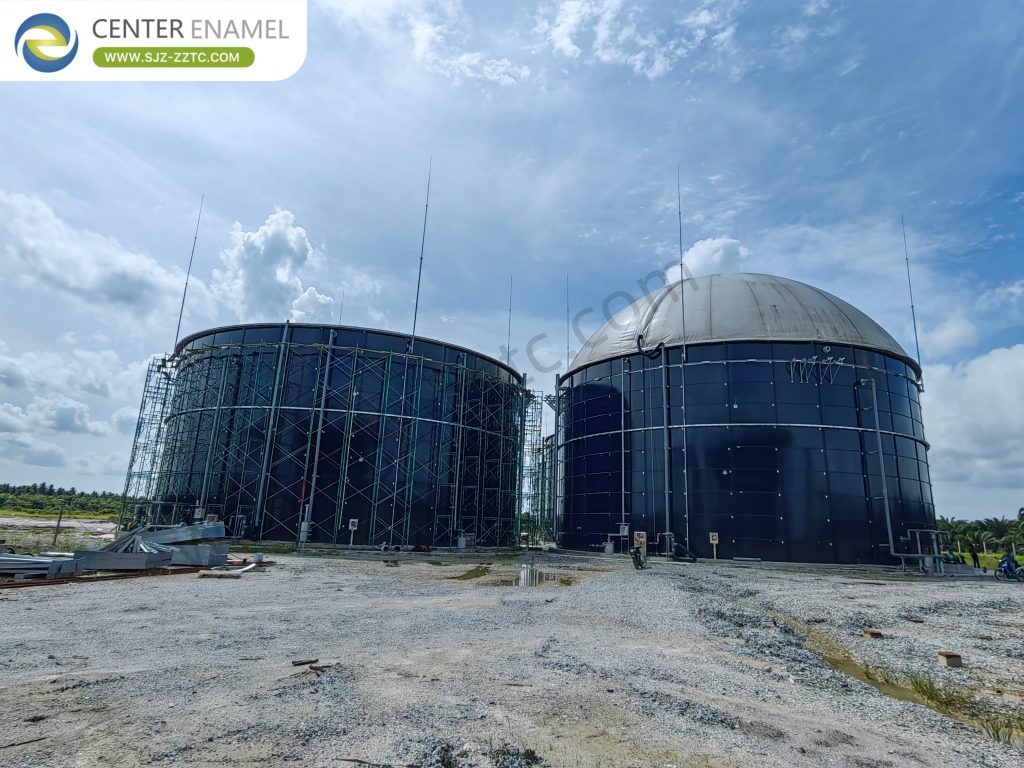
Specifically designed for high-concentration palm oil wastewater treatment with 3 GFS fermentation tanks, each 19.86 m diameter × 8.4 m height. Installation began November 2009 with only 7 construction personnel, completing all tank assembly in 40 days-highly efficient and time-saving. Tanks are fitted with dual-membrane gas storage covers for POME anaerobic digestion-degrading organics and recovering biogas energy while eliminating palm industry pollution. This is an early benchmark POME biogas treatment project in Southeast Asia.
Achieving this level of performance requires a strong foundation in research, development, and international quality standards. By maintaining rigorous control over materials and manufacturing, we provide our clients with equipment that competes with the best in the world. Our commitment to excellence is backed by decades of experience and global recognition.
Center Enamel's Core R&D Capabilities and Global Authoritative Certifications
Technology R&D is Center Enamel's core competitive advantage. The company independently masters over 200 differentiated anti-corrosion enamel formulations, with full self-control over the enamel raw material chain, holding nearly 100 invention and utility patents. Products have passed NSF, WRAS, ASME, BSCI, CE, ISO9001, and other global certifications.
Company certifications and honors include: National High-Tech Enterprise, National Specialized and Sophisticated "Little Giant," Hebei Manufacturing Single Champion, Provincial Smart Factory, Provincial Green Factory; complete environmental engineering and special equipment manufacturing compliance qualifications. The company maintains long-term collaborative research with multiple universities through joint materials laboratories-continuously iterating anti-corrosion coatings and large bolted tank structural design technologies. The proprietary material technology barrier creates an irreplaceable competitive advantage, with product performance comparable to high-end imported European/American storage equipment.
The combination of proprietary technology and global experience ensures that we can handle projects of any scale, regardless of regional challenges. By leveraging our vast project history, we deliver solutions that are not only customized but also proven in diverse climates and regulatory environments. We look forward to setting new standards for industrial and agricultural waste management.
Center Enamel's Extensive Global Benchmark Project Cases
Center Enamel's project portfolio covers over 100 countries across Southeast Asia, Africa, Europe, and the Americas-30,000+ mature projects-accumulating complete industry solutions across palm oil, livestock, municipal, brewing, and food waste biogas-rapidly matching customized solutions for different regional climates, water quality, and regulations.
For ancillary applications, our portfolio includes cost-effective roofing solutions tailored for clean water storage. These designs complement our main reactor systems, ensuring that every part of your facility meets the highest standards of durability and functionality. Maintaining water quality is simple with our integrated structural solutions.
Aluminum Alloy Trough Deck Roof
Aluminum Alloy Trough Deck Roof is a cost-effective economical tank cover solution for clean water and wastewater storage scenarios, primarily designed for drinking water, production wastewater, and firewater reserve tanks, balancing practicality and cost advantages. The main body is integrally formed from anti-corrosion aluminum alloy plates, paired with aluminum support trusses. Its lightweight design imposes less load on the tank foundation, reducing civil construction investment. A naturally formed dense oxide protective layer on the surface resists rain and mild wastewater corrosion, withstands outdoor sun and rain exposure, and effectively blocks wind, rain, insects, fallen leaves, and odor volatilization, protecting water quality by preventing dust and debris from falling in and causing secondary contamination.
The flat roof structure is neat and orderly, allowing installation of maintenance walkways, guardrails, vents, and level monitoring ports on top, facilitating daily inspection and equipment maintenance. The simple sealing structure enables straightforward installation with short construction timelines, and virtually eliminates the need for anti-corrosion painting maintenance, resulting in extremely low operational costs. It is suitable for various small, medium, and large atmospheric pressure water storage tanks, and has been widely implemented in waterworks clear water tanks, industrial circulating water tanks, park firewater tanks, and domestic wastewater temporary storage facilities. It is highly compatible with water storage applications that do not require biogas collection or high-pressure sealing.
FAQ
1.Why is professional design essential for a Biogas Power Plant?
Professional design ensures that a Biogas Power Plant operates at maximum efficiency by optimizing anaerobic digestion, gas collection, and energy recovery. Expert planning reduces operational downtime, ensures compliance with environmental regulations, and maximizes the financial return on investment through superior engineering and durable equipment selection.
2.What makes the UASB Process ideal for industrial wastewater?
The UASB Process is highly effective due to its compact design, low energy consumption, and lack of mechanical mixing. It efficiently degrades high-concentration organic matter using granular sludge, providing a stable, scalable, and low-maintenance solution for diverse industrial and agricultural wastewater treatment requirements.
3.What are the advantages of choosing Center Enamel for biogas projects?
Center Enamel combines proprietary enamel coating technology with over 30,000 global projects to provide durable, corrosion-resistant solutions. Our commitment to international certifications (NSF, CE, etc.) and deep R&D capabilities ensures high-performance, compliant, and long-lasting infrastructure for demanding global biogas and wastewater environments.