
Why Does EGSB Technology Lead Chemical Wastewater Treatment?
Anaerobic reactors have become the default front-end solution for high-strength industrial effluent, and among them, EGSB Technology has emerged as the most versatile option for plants that cannot afford process failure. For Chemical Wastewater Treatment, where composition shifts with every production batch and toxicity can wipe out a biomass population overnight, that versatility is not a luxury-it is a design requirement. Center Enamel has built its anaerobic portfolio around this reality, pairing reactor engineering with glass-fused-to-steel tank construction and full-chain installation control.
The Anaerobic Reactor Landscape: Where EGSB Fits
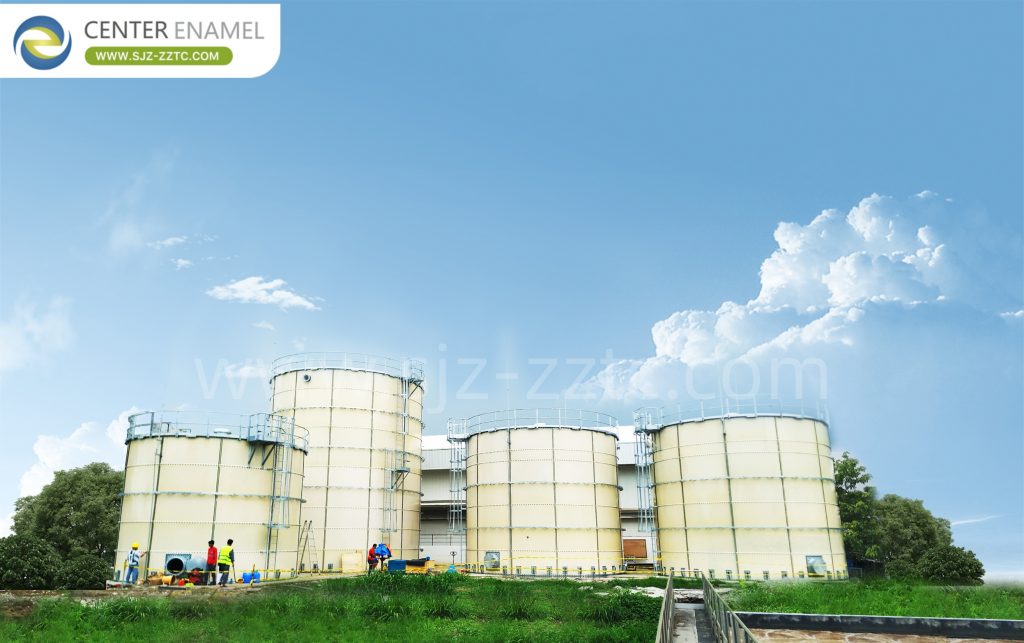
The market for anaerobic pretreatment has consolidated around three reactor families: UASB, EGSB, and IC. All three offer high loading rates, compact footprints, and stable operation, and all are widely deployed for high-concentration organic wastewater in food processing, pharmaceutical fermentation, alcohol brewing, and chemical production. Each uses a steel tank shell, which means corrosion resistance and gas-tightness directly determine long-term operational stability. This is precisely where tank material selection becomes inseparable from process performance-and where glass-fused-to-steel construction has gained prominence. In the anaerobic segment, EGSB Technology occupies the middle ground between the simplicity of UASB and the intensity of IC, making it the preferred choice for streams that are toxic, variable, or dilute.
Inside the EGSB Process: Mass Transfer as the Core Advantage
EGSB Technology solves a problem that has constrained anaerobic treatment for decades. In a conventional UASB reactor, the sludge bed can accumulate and develop localized mass transfer deficiencies, leaving portions of the biomass inactive. The EGSB configuration addresses this through elevated upflow velocity, which fully expands the granular sludge bed and forces intimate contact between biomass and pollutants. The result is industry-leading mass transfer efficiency and significantly improved degradation of organic pollutants. The expanded bed also widens the range of suitable conditions: EGSB Technology handles not only medium- and high-concentration organic wastewater but also performs well with low-temperature, low-concentration streams and wastewater containing trace recalcitrant pollutants-overcoming the low-temperature efficiency limitations of traditional anaerobic processes. Granular sludge in an EGSB reactor maintains high activity and excellent settleability, with low washout and low sludge yield, which translates directly into low O&M costs. There are no mechanical mixing components, energy consumption is low, and the simple structure delivers stable operation with strong shock-load resistance and uniform effluent quality. For Chemical Wastewater Treatment, this combination of robustness and adaptability is difficult to match.
The Chemical Effluent Challenge: Toxicity at the Forefront
No discussion of Chemical Wastewater Treatment is complete without confronting environmental toxicity. Chemical wastewater carries the strongest ecological risk of any industrial stream, combining acute toxicity, chronic toxicity, and environmental persistence. Benzene series compounds, phenols, cyanides, and halogenated hydrocarbons at high concentrations are strongly inhibitory and lethal to aquatic organisms and microbial communities-even trace discharge can cause irreversible ecosystem damage. Halogenated hydrocarbons and polycyclic aromatic hydrocarbons are persistent organic pollutants that resist biodegradation, bioaccumulate, and carry carcinogenic, teratogenic, and mutagenic risks. High-salinity discharge triggers soil salinization and groundwater mineralization. Heavy metals accumulate in sediments and magnify through the food chain. Some streams contain endocrine disruptors that interfere with aquatic reproduction at trace levels. This toxicity profile is why EGSB Technology must be paired with equalization, pH control, and aerobic polishing-and why the reactor's shock-load resistance matters so much in practice.
Glass-Fused-to-Steel Tanks: The Vessel Behind the Process
Process design means little if the containment fails. Center Enamel's core competitive advantage rests on materials science: the company independently masters over 200 differentiated anti-corrosion enamel formulations, controls the full enamel raw material chain, and holds nearly 100 invention and utility patents. Products carry NSF, WRAS, ASME, BSCI, CE, and ISO9001 certifications. Corporate honors include National High-Tech Enterprise, National Specialized and Sophisticated "Little Giant," Hebei Manufacturing Single Champion, Provincial Smart Factory, and Provincial Green Factory, alongside complete environmental engineering and special equipment manufacturing qualifications. Long-term collaborative research with multiple universities through joint materials laboratories continuously iterates anti-corrosion coatings and large bolted tank structural design. The proprietary material technology barrier creates an advantage that is difficult to replicate, with product performance comparable to high-end imported European and American storage equipment. For Chemical Wastewater Treatment projects, this means reactor shells and storage tanks that resist aggressive chemistry for decades rather than years.
Installation Quality: Where Global Project Performance Is Proven
Even the best materials fail without disciplined installation. Center Enamel has established full-chain quality control across four dimensions: factory protection, on-site assembly, completion inspection, and long-term warranty. At the factory stage, all enameled panels, seals, and structural components receive rust-proof and moisture-proof independent packaging with dedicated protective supports, preventing transport damage to the enamel coating. On-site construction follows unified assembly specifications-panel-by-panel tightening and layered leak testing, with air-tightness and verticality testing after each tank section, plus simultaneous pressure testing of dual-membrane covers and anaerobic piping.
| Control Stage | Standard Practice | Regional Adaptation |
| Factory Protection | Independent rust/moisture-proof packaging, dedicated supports | Uniform global standard |
| On-Site Assembly | Panel-by-panel tightening, layered leak testing | EU/US: CE/NSF criteria |
| Section Testing | Air-tightness and verticality per tank section | SE Asia: enhanced corrosion/sealing |
| Completion Acceptance | Inspection reports, pressure records, photo/video archives | Africa: foundation settlement re-inspection |
| Long-Term Warranty | Full documentation retention | Region-specific acceptance standards |
Over 10,000 tanks delivered globally have operated long-term without large-scale leakage or structural deformation, preventing O&M problems at the source. The installation team brings practical experience from these projects, with full control over mobilization, civil coordination, tank assembly, piping, and commissioning. The team is proficient in standardized installation for GFS tanks, dual-membrane gas storage covers, USR/CSTR/IC anaerobic reactors, and biogas desulfurization and piping systems-adaptable to large farms, industrial parks, remote mountainous sites, and coastal high-corrosion locations. For overseas projects, complete units deploy for on-site construction, technical training, and local worker instruction, ensuring timely commissioning through standardized delivery.
Global Footprint: Benchmarks Across 100 Countries
Center Enamel's project portfolio spans more than 100 countries across Southeast Asia, Africa, Europe, and the Americas, with 30,000+ mature projects and complete industry solutions across palm oil, livestock, municipal, brewing, and food waste biogas. This breadth allows rapid matching of customized solutions to different regional climates, water quality profiles, and regulatory frameworks.
| Portfolio Metric | Figure | Coverage |
| Total Projects | 30,000+ | Global |
| Countries Served | 100+ | SE Asia, Africa, Europe, Americas |
| GFS Tanks Delivered | 10,000+ | No large-scale leakage or deformation |
| Enamel Formulations | 200+ | Proprietary, self-controlled chain |
| Patents Held | ~100 | Invention and utility |
| Core Manufacturing Base | 150,000+ m² | Hebei Province, China |
For EGSB Technology deployments and broader Chemical Wastewater Treatment programs, this track record provides the reference base that shortens design cycles and reduces execution risk.
Frequently Asked Questions
What makes EGSB Technology suitable for chemical wastewater?
Its expanded sludge bed delivers high mass transfer efficiency, tolerates shock loads and salinity swings, and performs across low-temperature and low-concentration conditions-critical where chemical effluent composition changes with every production batch.
How do GFS tanks improve anaerobic reactor reliability?
Glass-fused-to-steel construction resists acidic and alkaline attack, maintains gas-tightness, and eliminates repainting cycles. With 10,000+ tanks in service without large-scale leakage, containment is no longer the weak link.
Can Center Enamel support projects outside China?
Yes. Complete installation units deploy for overseas construction, technical training, and local worker instruction, following region-specific acceptance standards for EU/US, Southeast Asian, and African sites.
Tell us about your effluent profile and let our engineers map an EGSB-based treatment train to your plant's actual operating conditions.
Reach out to Center Enamel for a delivered-scope proposal covering reactor design, tank manufacturing, and installation-backed by 30,000+ projects worldwide.