
End-to-End Papermaking Wastewater Treatment: EPC Contractor with Proven GFS Tanks
Global industrial wastewater policy has moved decisively beyond simple discharge compliance. The EU's Circular Economy Action Plan requires member states to raise industrial wastewater reuse rates and now extends carbon footprint accounting across the full treatment life cycle. China continues tightening discharge standards, with increasingly strict limits on total nitrogen, total phosphorus, and characteristic pollutants for chemicals, pharmaceuticals, printing and dyeing, and other sectors.
Water-scarce regions and highly polluting industries are being mandated toward zero or near-zero liquid discharge. Germany has built a differentiated pretreatment standard system by industry, requiring wastewater to meet specific quality thresholds before entering municipal plants-a clear model of strict source control. For pulp and paper operators, these converging rules mean the choice of a papermaking wastewater treatment project EPC contractor is no longer just a procurement decision. It determines whether a facility can meet today's limits and adapt to tomorrow's.
Why Papermaking Effluent Demands a Specialized Approach
Papermaking wastewater originates across the entire production chain-chemical pulping via alkaline and sulfate processes, mechanical pulping, recycled fiber pulping, and papermaking itself-making it the largest-volume, highest-suspended-solids wastewater in the light industry sector. Pollution arises at multiple stages: raw material preparation through chipping and washing, cooking where high-concentration black liquor is generated, washing and screening, multistage bleaching, sheet forming, pressing and drying, and white water recirculation. Cooking black liquor is the core pollution source, carrying extremely high COD and strong alkalinity. White water, by contrast, has large volume but low pollutant concentration and can be recycled. Recycled fiber pulping wastewater contains inks, adhesives, and fillers that require deinking treatment. Large paper mills discharge tens of thousands of tons daily, placing them among the largest-volume industrial wastewater sectors anywhere. Handling this complexity requires process depth and containment durability working together-which is why an experienced EPC contractor matters from the earliest design stage.
IC Process: The Anaerobic Core of Modern Papermaking Treatment
Within a well-designed treatment train, the IC (Internal Circulation) reactor does the heavy lifting on organic load. It is the third-generation high-efficiency anaerobic technology built upon UASB, and its core innovation is a built-in gas-lift internal circulation system that enables autonomous wastewater recirculation without external return pumps. The reactor uses a dual-zone configuration-a lower main reaction zone and an upper polishing zone. Biogas gas-lift creates hydraulic internal circulation, significantly increasing upflow velocity and enhancing sludge-wastewater contact. The result is extremely high compactness, specifically engineered for high-concentration, high-flow industrial organic wastewater. For papermaking facilities, the IC process combines high efficiency, energy savings, and minimal footprint-the core process for modern industrial high-strength wastewater treatment. When specified by a capable papermaking wastewater treatment project EPC contractor, it reduces downstream aerobic burden while generating biogas that offsets operating energy costs.
GFS Tanks: Containment Built for Complex Operating Conditions
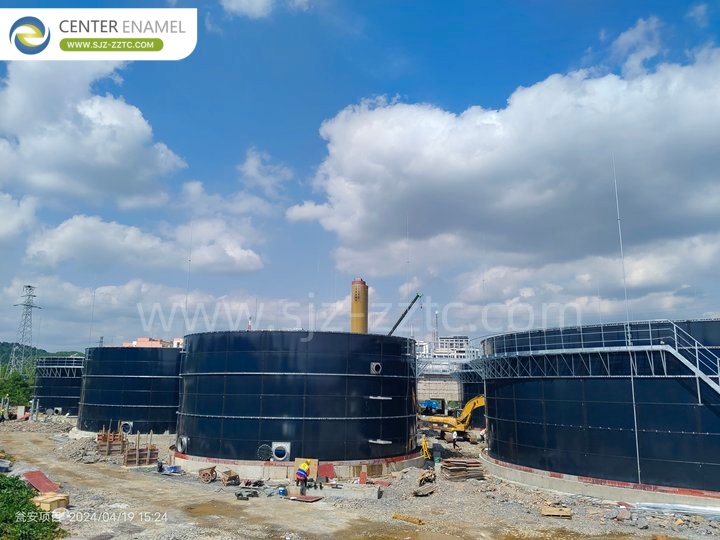
Process performance depends on what holds it. Center Enamel has independently developed over 200 specialized enamel formulations and supporting patents, capable of customizing anti-corrosion enamel based on the customer's storage media-adaptability comprehensively superior to concrete tanks. Concrete tanks use a single material and are only suitable for neutral clean water storage. When storing corrosive media such as livestock manure, palm oil mill effluent, chemical wastewater, food waste digestate, or high-salinity wastewater, additional anti-corrosion linings must be applied-linings that are prone to failure, preventing long-term stable operation and struggling with alternating high and low concentration conditions. GFS tanks can be specifically formulated with specialized enamels resistant to strong acids, strong alkalis, high organic content, and high salinity. A single tank can switch between multiple wastewater and fermentation feedstock storage requirements, making GFS tanks universally applicable across biogas anaerobic digestion, municipal wastewater, livestock farming, food processing, and industrial water treatment. This eliminates the need to rebuild tanks when media changes-perfectly meeting the needs of diversified, multi-condition environmental protection projects.
| Tank Type | Corrosion Resistance | Media Flexibility | Long-Term Stability |
| Concrete tank | Neutral clean water only | Requires added linings for corrosive media; linings prone to failure | Limited under alternating concentrations |
| GFS tank | 200+ enamel formulations for acids, alkalis, high organics, high salinity | Single tank handles multiple media and feedstock changes | Designed for long-term stable operation |
Proof in Practice: South Africa Brewery High-Strength Wastewater Project
The combination of anaerobic digestion and GFS tanks is validated beyond papermaking. In South Africa's brewing industry, a high-concentration organic wastewater treatment project featured both Center Enamel GFS tanks and stainless steel tanks as core equipment. GFS tanks served as the primary anaerobic digestion system, suited to brewery wastewater's high-COD, high-sugar, readily decomposable characteristics for efficient organic pollutant degradation. Stainless steel tanks handled wastewater transfer and chemical storage supporting processes. The complete equipment package delivered excellent corrosion resistance and flexible assembly, providing long-term stable treatment of brewery production and cleaning wastewater while solving local brewing industry pollution challenges. This mature African brewery case demonstrates how the right EPC partnership translates process design into reliable, day-to-day operation.
| Project Parameter | Specification |
| Location | South Africa |
| Industry | Brewery |
| Application | High-strength organic wastewater treatment |
| Core Equipment | GFS tanks (anaerobic digestion), stainless steel tanks (transfer/storage) |
| Key Challenge | High-COD, high-sugar, readily decomposable wastewater |
| Outcome | Long-term stable treatment, corrosion-resistant, flexible assembly |
Thirty Years of Integrated Capability
Delivering projects of this complexity requires depth beyond a single product line. Center Enamel has been deeply engaged in the environmental bolted storage equipment field for over 30 years. Starting with proprietary enamel anti-corrosion material technology, the company has completed a full-industry-chain upgrade from a single tank manufacturer to a comprehensive environmental EPC service provider. Throughout its 30+ year history, the company has been recognized as a National High-Tech Enterprise, National Specialized and Sophisticated "Little Giant," Manufacturing Single Champion, and Provincial Green Factory. It has successfully delivered over 30,000 environmental projects globally, establishing itself as a leading enterprise in the global GFS tank storage industry. The company has fully integrated the chain from enamel frit R&D through intelligent environmental equipment manufacturing to EPC project contracting-every business breakthrough achieved through proprietary core anti-corrosion technology. For owners evaluating a papermaking wastewater treatment project EPC contractor, this integration means one accountable partner from feasibility through commissioning.
Construction Capacity That Keeps Projects on Schedule
Design excellence means little without reliable field execution. Center Enamel has established its own domestic and international certified construction teams, with regular practical training on GFS tank installation and overseas construction standards for various countries. Domestically, regional construction teams cover multiple zones and can simultaneously deploy multiple crews for large tank farm projects. Internationally, cross-border professional installation teams are equipped to the construction standards of each host country. Sufficient manpower reserves ensure uninterrupted construction delivery for remote African sites, high-standard European and American facilities, and projects everywhere in between. For time-sensitive papermaking wastewater treatment project EPC Contractor engagements, this dedicated capacity reduces schedule risk and keeps commissioning on track.
Frequently Asked Questions
Q: What does a papermaking wastewater treatment project EPC contractor typically handle?
Scope usually covers process design, equipment manufacturing, GFS tank supply, installation, commissioning, and operator training-ideally from a single integrated provider.
Q: Are GFS tanks suitable for black liquor and other corrosive papermaking streams?
Yes. Specialized enamel formulations resist strong alkalinity, high organics, and salinity, outperforming concrete tanks that require failure-prone linings.
Q: Can one contractor deliver both IC reactors and tank infrastructure?
Center Enamel integrates anaerobic process expertise with in-house GFS tank manufacturing, removing interface risk between process and containment.
Planning a papermaking wastewater treatment project and weighing process options against tightening discharge limits? Send us your effluent data and our engineers will outline a tailored IC process and GFS tanks configuration for your site. Talk to Center Enamel today and secure an EPC contractor who stands behind every stage-from design and fabrication to installation and long-term service.