
How a Papermaking Wastewater Treatment EPC Contractor Combines IC Reactors with 30-Year GFS Tanks
Papermaking generates the largest volume of high-suspended-solids wastewater in the light industry sector, and mills discharge tens of thousands of tons daily. For plant owners, the challenge is not simply meeting discharge limits-it is doing so with containment that survives decades of alkaline, lignin-bearing effluent. As a Papermaking Wastewater Treatment EPC Contractor, Center Enamel pairs high-rate anaerobic process design with GFS Tanks engineered for exactly this corrosive service.
Policy Pressure Is Reshaping Every Mill's Treatment Strategy
Global industrial wastewater policy has escalated from "compliance discharge" toward mandatory resource recovery and zero liquid discharge. The EU, through its Circular Economy Action Plan, requires member states to increase industrial wastewater reuse rates and extends carbon footprint accounting to the full life cycle of treatment. China continuously tightens discharge standards for total nitrogen, total phosphorus, and characteristic pollutants across chemicals, pharmaceuticals, and printing and dyeing-with some water-scarce regions mandating zero or near-zero liquid discharge. Germany has established a differentiated pretreatment standard system by industry, requiring wastewater to meet specific quality thresholds before entering municipal plants.
For paper mills, this regulatory trajectory means the treatment train must recover fiber and alkali, minimize sludge, and demonstrate stable long-term performance-not merely pass a one-time compliance test.
Where Papermaking Wastewater Comes From
Papermaking wastewater originates across the entire production chain: chemical pulping (alkaline and sulfate processes), mechanical pulping, recycled fiber pulping, and papermaking itself. Key pollution stages include raw material preparation (chipping and washing), cooking (the core chemical pulping stage producing high-concentration black liquor), washing and screening, bleaching, papermaking (sheet forming, pressing, drying), and white water recirculation from the wire and press sections.
Cooking black liquor is the core pollution source, with extremely high COD and strong alkalinity. White water has large volume but low pollutant concentration and can be recycled. Recycled fiber pulping wastewater contains inks, adhesives, and fillers requiring deinking treatment. Understanding this stream-by-stream profile is the starting point for any effective Papermaking Wastewater Treatment EPC Contractor engagement-because treating all streams identically wastes capital and undermines biological stability.
The IC Reactor: Built for High-Strength Mill Effluent
The IC, or Internal Circulation Anaerobic Reactor, is the third-generation high-efficiency anaerobic treatment technology built upon UASB. Its core innovation is the built-in gas-lift internal circulation system, enabling autonomous wastewater recirculation without external return pumps. The reactor features a dual-zone configuration-a lower main reaction zone and an upper polishing zone. Biogas gas-lift creates hydraulic internal circulation, significantly increasing upflow velocity and enhancing sludge-wastewater contact.
With extremely high compactness, the IC reactor is specifically designed for high-concentration, high-flow industrial organic wastewater, combining high efficiency, energy savings, and minimal footprint. It is the core process for modern industrial high-strength wastewater treatment and fits naturally into papermaking trains where black liquor and concentrated streams must be degraded quickly in limited space.
GFS Tanks: Containment That Outlasts Concrete
Process design is only half the delivery. Papermaking effluent-particularly black liquor-attacks conventional concrete through high alkalinity and lignin content. Concrete tank interiors are riddled with pores, allowing wastewater and acid/alkaline media to penetrate and corrode the structural layer. Long-term use leads to internal wall spalling, water seepage, and rebar corrosion-problems that are difficult to repair and cannot be fundamentally resolved.
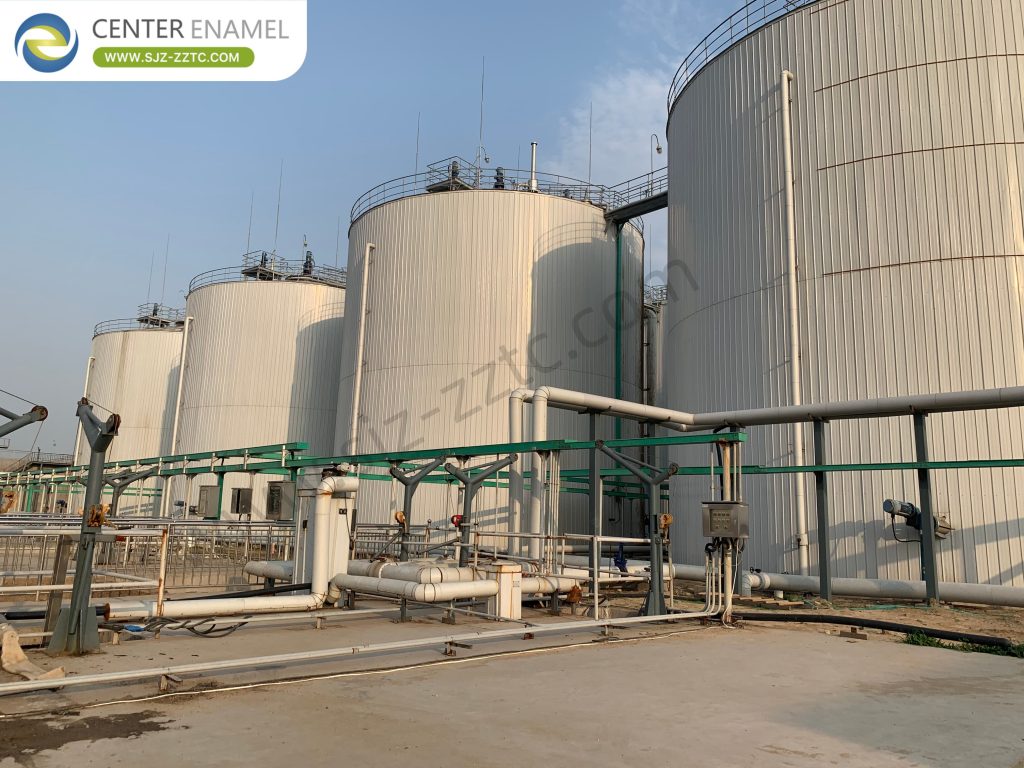
Center Enamel's independently developed double-sided double-layer enameling technology applies high-temperature enamel to both interior and exterior surfaces of steel panels, creating a dense, non-porous finish that blocks corrosive liquids and biogas permeation. The enamel layer has extremely strong chemical stability, resisting acids, alkalis, salts, and microbial corrosion. Compared with traditional concrete and FRP tanks, GFS Tanks carry no risk of peeling or blistering and are adaptable to highly corrosive conditions such as palm oil mill effluent, livestock manure, and chemical high-salinity wastewater.
Concrete vs. GFS Tank Performance:
| Criterion | Concrete Tank | Center Enamel GFS Tank |
| Surface structure | Porous, permeable | Dense, non-porous enamel |
| Failure onset | 5–8 years (spalling, seepage, rebar corrosion) | No lining repair needed |
| Anti-corrosion service life | Limited, repair-dependent | 30+ years |
| Chemical resistance | Moderate | Acids, alkalis, salts, microbial corrosion |
| Coating failure modes | Cracking, delamination | No peeling or blistering |
| Leakage risk to groundwater | Significant over time | Fundamentally eliminated |
Material Science Behind the 30-Year Service Life
That service-life figure is not a marketing estimate-it comes from formulated chemistry. Center Enamel has independently developed over 200 anti-corrosion enamel formulations, with proprietary double-sided double-layer enameling technology. The R&D team is led by national-level materials technology experts specializing in enamel frit and tank anti-corrosion core technologies, supported by external senior environmental engineering and mechanical structure engineers. Proprietary laboratories operate alongside university research collaboration, conducting year-round new material and process durability pilot testing and long-term corrosion simulation.
Specialized enamel formulations are iteratively developed for extreme conditions-high-salinity wastewater, strong acid/alkali POME, and high-organic livestock manure-providing core technical support for annual new invention and utility patents. For papermaking service, this means the enamel specification can be matched to black liquor alkalinity rather than applied as a generic coating.
A Delivered Reference in High-Strength Brewery Wastewater
South Africa Brewery High-Strength Wastewater Treatment Project:
| Aspect | Detail |
| Industry | Brewing |
| Core equipment | Center Enamel GFS Tanks as primary anaerobic digestion system; stainless steel tanks for wastewater transfer and chemical storage |
| Wastewater profile | High COD, high sugar, readily decomposable brewery production and cleaning wastewater |
| Outcome | Efficient organic pollutant degradation with long-term stable treatment; a mature brewery wastewater treatment case in Africa |
The complete equipment package offers excellent corrosion resistance and flexible assembly, solving local brewing industry pollution challenges while supporting transfer and chemical storage processes-the same equipment logic applied to papermaking anaerobic trains.
FAQ
Why are GFS Tanks preferred over concrete for papermaking wastewater?
Concrete develops spalling, seepage, and rebar corrosion within 5–8 years under alkaline black liquor. GFS Tanks use dense enamel resisting acids, alkalis, and microbial corrosion, with a service life exceeding 30 years.
What role does the IC reactor play in papermaking treatment?
The IC reactor's gas-lift internal circulation delivers high-rate anaerobic degradation of concentrated streams in a footprint far smaller than conventional reactors, with strong shock-load tolerance.
Does Center Enamel provide full EPC scope?
Yes. As a Papermaking Wastewater Treatment EPC Contractor, Center Enamel covers process design, GFS Tank manufacturing, installation, commissioning, and operator training across 100+ countries.
Send us your mill's stream data and discharge targets, and our engineers will map the anaerobic train and GFS Tank specification that fit your site. Talk to Center Enamel about your Papermaking Wastewater Treatment project today-we will return a process configuration and delivery schedule built around your production profile.