
What Does an EPC Contractor Deliver for Food Waste Water Treatment?
The competitive landscape shows divergence, with leading companies building integrated service capabilities through technical integration and capital operations, and industry concentration gradually increasing. Chinese companies continue to consolidate their advantages in mid-tier equipment exports. International giants target high-end customers and complex industrial wastewater markets, while local players occupy the mid- to low-end and industrial park centralized treatment markets with service responsiveness and cost advantages.
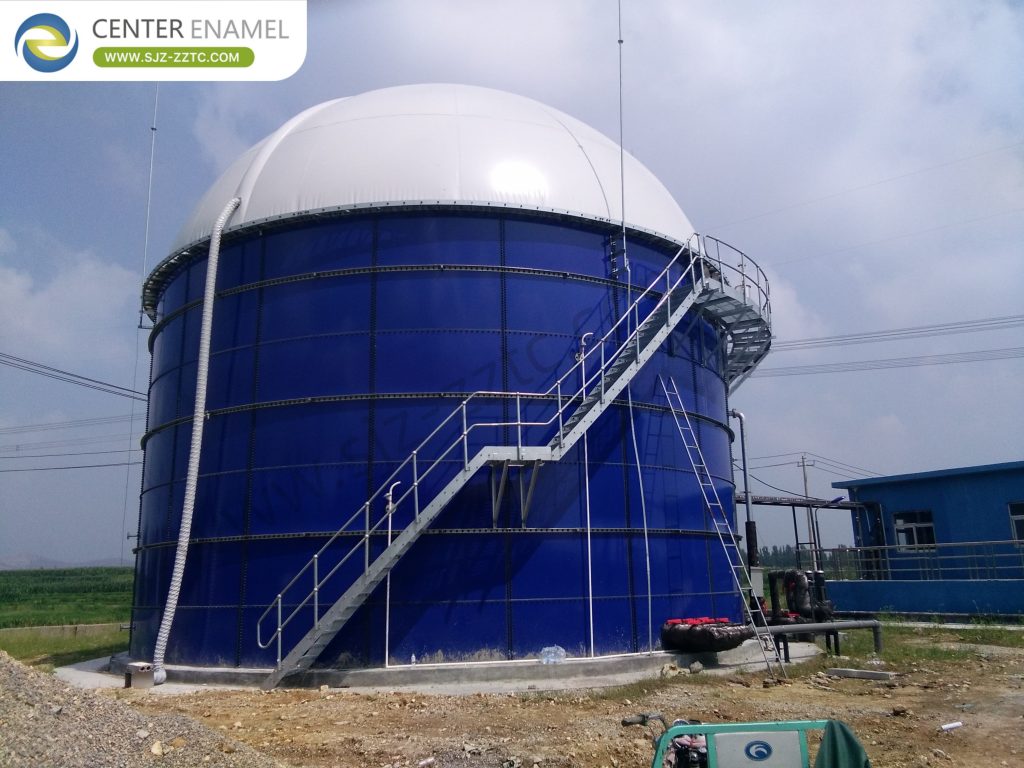
In the anaerobic process segment, UASB, EGSB, and IC anaerobic reactors-with advantages of high loading rates, small footprints, and stable operation-are widely used in high-concentration organic wastewater pretreatment in food processing, pharmaceutical fermentation, alcohol brewing, chemical, and other industries. These reactors use steel tank shells, and their corrosion resistance and gas-tightness directly determine long-term operational stability. This is precisely why GFS Tanks have become increasingly prominent in such scenarios-the tank shell is no longer a commodity but a determinant of project lifespan.
Corrosion Resistance Far Beyond Concrete Tanks
Corrosion performance is where tank selection is won or lost. Center Enamel's independently developed double-sided double-layer enameling technology is the industry's leading coating anti-corrosion technology, with corrosion resistance completely surpassing concrete tanks. Concrete tank interiors are riddled with pores, allowing wastewater and acid or alkaline media to easily penetrate and corrode the structural layer. Long-term use leads to irreversible problems such as internal wall spalling, water seepage, and rebar corrosion, which are difficult to repair and cannot be fundamentally resolved.
GFS Tanks feature high-temperature enameling on both the interior and exterior surfaces of steel panels, with a dense, non-porous enamel finish that completely blocks corrosive liquids and biogas permeation. The enamel layer has extremely strong chemical stability, resisting acids, alkalis, salts, and microbial corrosion. Concrete tanks will develop extensive corrosion and leakage after 5-8 years of use, while GFS tank anti-corrosion service life can exceed 30 years, with no need for frequent internal lining repairs throughout the service life-significantly reducing long-term anti-corrosion maintenance investment and fundamentally eliminating environmental risks of medium leakage contaminating sites and groundwater. Compared to traditional concrete and FRP tanks, GFS tank coatings have no risk of peeling or blistering, and are adaptable to highly corrosive conditions such as palm oil mill effluent, livestock manure, and chemical high-salinity wastewater, with outstanding long-term comprehensive cost advantages.
GFS Tanks vs Concrete Tanks
| Criteria | GFS Tanks | Concrete Tanks |
| Corrosion Life | 30+ years | 5-8 years |
| Surface Structure | Dense non-porous enamel | Porous, permeable |
| Leakage Risk | Minimal | High after years of use |
| Maintenance | No lining repairs needed | Frequent repairs |
| Relocation | Fully disassemblable | Permanent structure |
The USR Process Explained
With the right tank platform in place, process selection determines treatment performance. USR, or Upflow Solids Reactor, is an upflow anaerobic process modified for high-suspended-solids, high-solids organic wastewater, specifically designed to solve problems of clogging, sludge washout, and uneven reaction common in traditional anaerobic processes for high-solids wastewater.
The USR Process eliminates complex three-phase separators, simplifies internal structure, and relies on upflow hydraulics to promote thorough mixing of solid materials and anaerobic sludge. No strict granular sludge formation conditions are required-flocculent sludge can operate stably. The key feature is high solids tolerance and impurity resistance, with very high influent suspended solids tolerance. It is a dedicated high-efficiency anaerobic process for livestock manure, agricultural organic waste, and high-solids livestock wastewater, specifically developed for agricultural and environmental applications.
Where Food Waste Water Originates
Understanding the feedstock is essential before selecting any process. Food waste wastewater originates from the resource recovery process of kitchen waste from catering services, canteens, and food processing and distribution-a typical high-concentration organic wastewater in urban solid waste resource recovery.
Major sources include food waste pretreatment sorting wastewater from bag breaking, crushing, and sorting operations; oil separation wastewater from three-phase oil extraction; anaerobic digestion digestate, the residual liquid after food waste anaerobic digestion; and equipment and vehicle wash water. Food waste consists primarily of food residues, rich in animal and vegetable oils, starches, proteins, cellulose, salts, and seasoning residues. After pretreatment crushing and sorting, organics are solubilized forming high-concentration wastewater. Large and medium-sized cities' centralized food waste treatment facilities handle hundreds of tons daily with large continuous wastewater production; smaller facilities produce less volume but with higher concentrations-oil and salt accumulation issues are prominent.
Bangladesh Poultry Farm Manure Recovery Success
Theory becomes credible when backed by measurable results. In Bangladesh, a large-scale poultry farm manure resource recovery project targets daily treatment of 47 tons. Influent COD, BOD, and SS reach as high as 50,000 mg/L, 25,000 mg/L, and 50,000 mg/L respectively. After CSTR + UASB anaerobic treatment, all three parameters are reduced to below 200 mg/L, 100 mg/L, and 100 mg/L-effluent fully compliant with local environmental discharge standards.
The project produces approximately 4,900 m³ of biogas daily. Each cubic meter of biogas can generate 2 kWh of electricity, yielding daily power generation of 9,800 kWh-simultaneously achieving pollutant reduction and clean energy recovery. This stands as a benchmark project for livestock waste recycling in Southeast Asia.
Bangladesh Poultry Farm Project Performance
| Parameter | Influent | Effluent | Reduction |
| COD | 50,000 mg/L | <200 mg/L | >99.6% |
| BOD | 25,000 mg/L | <100 mg/L | >99.6% |
| SS | 50,000 mg/L | <100 mg/L | >99.8% |
| Biogas Production | - | 4,900 m³/day | - |
| Power Generation | - | 9,800 kWh/day | - |
Three Decades of Environmental Equipment Leadership
Delivering these results consistently requires deep engineering roots. Center Enamel has been deeply engaged in the environmental bolted storage equipment field for over 30 years. Starting with proprietary enamel anti-corrosion material technology, the company has gradually completed the full-industry-chain upgrade from a single tank manufacturer to a comprehensive environmental EPC service provider.
Throughout its 30+ year history, the company has been recognized as a National High-Tech Enterprise, National Specialized and Sophisticated "Little Giant," Manufacturing Single Champion, and Provincial Green Factory. It has successfully delivered over 30,000 environmental projects globally, establishing itself as a leading enterprise in the global GFS tank storage industry. The company has fully integrated the entire chain from enamel frit R&D, intelligent environmental equipment manufacturing, to EPC project contracting-every business breakthrough has been achieved through proprietary core anti-corrosion technology.
Construction Team Manpower Reserve
Behind every installation stands a trained workforce. Center Enamel has established its own domestic and international certified construction teams, with regular practical training on GFS tank installation and overseas construction standards for various countries. Domestically, regional construction teams cover multiple zones, capable of simultaneously deploying multiple teams for large tank farm projects. Internationally, cross-border professional installation teams are equipped to various country construction standards-sufficient manpower reserves ensure uninterrupted construction delivery for remote African sites, high-standard European and American facilities, and other projects.
Partner with Center Enamel
Dealing with food waste water that corrodes conventional tanks within a few years? Send us your water quality data today and our engineers will match the right tank and process configuration to your site.
From first assessment to final commissioning, contact Center Enamel for a solution backed by 30+ years of enamel expertise and 30,000+ global installations.
FAQ
Why are GFS Tanks better than concrete for food waste water?
GFS Tanks use dense, non-porous enamel that resists acids, salts, and microbial corrosion for 30+ years. Concrete develops pores, leakage, and rebar corrosion within 5-8 years.
What does the USR Process handle best?
The USR Process treats high-solids organic wastewater such as livestock manure and slaughterhouse waste. It eliminates three-phase separators and operates stably with flocculent sludge.
Can GFS Tanks be relocated if a plant moves?
Yes. GFS Tanks assemble from bolted panels and can be fully disassembled, transported, and reassembled at a new site-unlike permanent concrete structures.