
Dairy Wastewater Treatment Project EPC Contractor Delivering 30-Year GFS Tanks
Global industrial wastewater policy is shifting decisively from simple compliance discharge toward mandatory resource recovery and zero liquid discharge. The EU's Circular Economy Action Plan requires member states to raise industrial reuse rates and extends carbon footprint accounting across the full treatment lifecycle. China keeps tightening total nitrogen, total phosphorus, and characteristic pollutant limits for chemicals, pharmaceuticals, and printing and dyeing.
Germany enforces sector-specific pretreatment standards before municipal acceptance. For dairy processors, where effluent is intermittent, high-strength, and highly biodegradable, meeting these demands requires an integrated approach-one best delivered by an experienced Dairy Wastewater Treatment Project EPC Contractor deploying durable GFS Tanks at the core of the process.
What Makes Dairy Effluent a Distinctive Challenge
Dairy wastewater pollutants are entirely natural dairy components-lactose, milk proteins, and milk fats-containing no synthetic toxic chemicals, heavy metals, bacteriostats, or persistent organics. Chemical toxicity to aquatic organisms and microorganisms is extremely low, and environmental safety is good. The core risk is oxygen demand: high-COD/BOD wastewater discharged directly undergoes rapid aerobic decomposition, severely depleting dissolved oxygen and suffocating fish. Milk fats form surface oil films blocking oxygen exchange, while protein decomposition releases ammonia and fuels eutrophication.
The stream decomposes readily, producing odors and breeding bacteria and fly larvae-a public health concern-and long-term discharge causes organic sediment deposition and black-odor conditions. Crucially, the pollution is primarily oxygen-demanding organic matter with no chemical toxicity accumulation risk, meaning it degrades and recovers naturally. That profile rewards biological treatment, which is exactly what a well-scoped Dairy Wastewater Treatment Project EPC Contractor designs around.
The IC Process: Compact, Efficient, Shock-Resistant
The IC (Internal Circulation) reactor delivers top-tier treatment efficiency with a footprint only one-third that of traditional anaerobic processes at equal capacity-a decisive compactness advantage. Its built-in gas-lift internal circulation eliminates external recirculation equipment, creating autonomous forced mixing of sludge and water. Strong hydraulic mixing ensures thorough microbe–pollutant contact, greatly improving degradation efficiency and withstanding high water quality and hydraulic shock loads-ideal for dairy's variable CIP discharge.
The dual-zone configuration combines high-efficiency degradation with deep polishing for stable effluent quality. Sludge granulation is high, activity strong, and washout very low. Automation is high, operation stable, failure rates low, biogas production large, and resource recovery benefits outstanding. Long-term energy and O&M costs run far below traditional anaerobic processes, making the IC process suitable for large-flow, high-concentration industrial wastewater-and a natural fit for GFS Tanks containment.
GFS Tanks: Corrosion Resistance Beyond Concrete
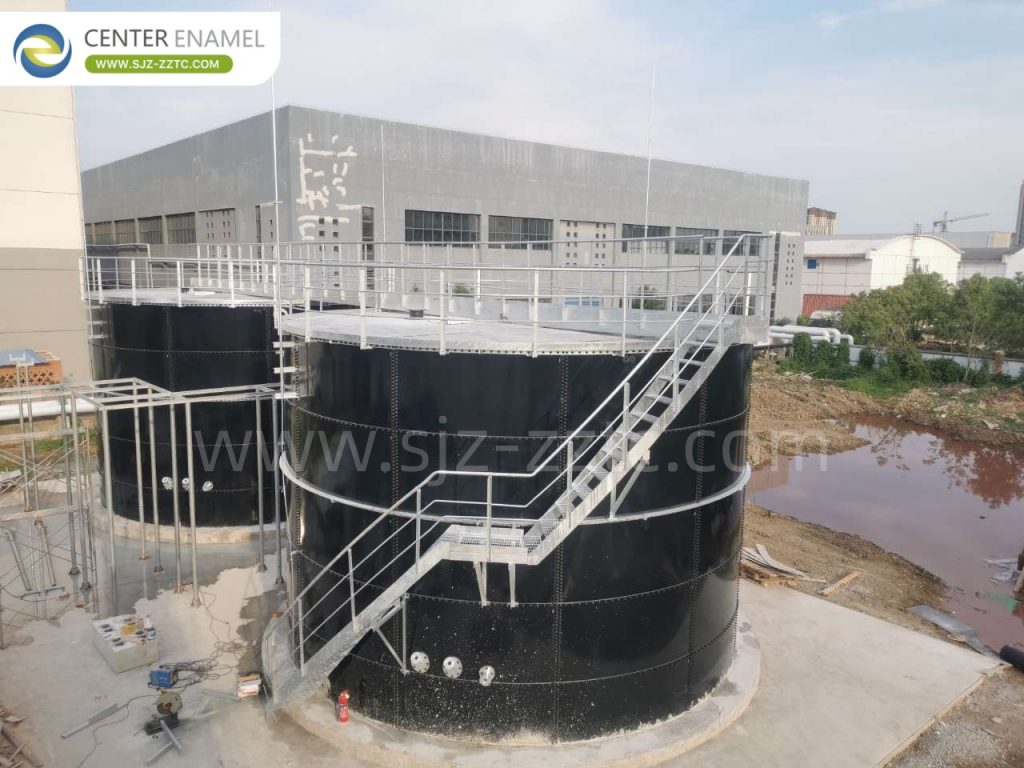
Center Enamel's independently developed double-sided, double-layer enameling technology leads the industry in coating anti-corrosion performance, completely surpassing concrete tanks. Concrete interiors are riddled with pores that let wastewater and acid/alkaline media penetrate and corrode the structural layer, causing irreversible internal wall spalling, seepage, and rebar corrosion that are difficult to repair and impossible to fundamentally resolve.
GFS Tanks apply high-temperature enamel to both interior and exterior steel panel surfaces. The dense, non-porous finish completely blocks corrosive liquids and biogas permeation, and the enamel layer offers exceptional chemical stability against acids, alkalis, salts, and microbial corrosion.
| Tank Type | Corrosion/Leak Onset | Anti-Corrosion Service Life | Maintenance Profile |
| Concrete | 5–8 years | Limited by structural decay | Frequent lining repair |
| GFS (enamel) | No permeation | 30+ years | No routine lining work |
Concrete tanks develop extensive corrosion and leakage after 5–8 years, while GFS Tanks exceed 30 years of anti-corrosion service with no frequent internal lining repairs-significantly reducing long-term maintenance investment and eliminating the environmental risk of medium leakage contaminating sites and groundwater. Unlike concrete and FRP alternatives, GFS coatings carry no peeling or blistering risk and adapt to highly corrosive conditions such as palm oil mill effluent, livestock manure, and chemical high-salinity wastewater.
Installation Quality Controlled at Every Stage
Long-term global project performance demonstrates high-standard installation quality. Center Enamel has established full-chain quality control across four dimensions: factory protection, on-site assembly, completion inspection, and long-term warranty. At the factory stage, all enameled panels, seals, and structural components receive rustproof and moisture-proof independent packaging with dedicated protective supports, preventing damage during sea and land transport. On-site construction strictly follows unified assembly specifications-panel-by-panel tightening and layered leak testing-with air-tightness and verticality testing after each tank section, plus simultaneous pressure testing of dual-membrane covers and anaerobic piping.
Acceptance standards are differentiated by region: EU/US projects follow stringent CE/NSF criteria, Southeast Asian hot-humid regions receive enhanced corrosion protection and sealing acceptance, and remote African sites add foundation settlement re-inspection. Upon completion, full construction inspection reports, pressure test records, and anti-corrosion appearance acceptance documents are issued with complete photo/video archives.
| Quality Stage | Control Measure |
| Factory protection | Rustproof/moisture-proof packaging, dedicated supports |
| On-site assembly | Panel-by-panel tightening, layered leak and verticality testing |
| Regional acceptance | CE/NSF (EU/US), enhanced sealing (SE Asia), settlement re-check (Africa) |
| Completion | Inspection reports, pressure records, photo/video archive |
Over 10,000 tanks delivered globally have operated long-term without large-scale leakage or structural deformation-preventing future O&M issues at source.
Proven Global Footprint
Center Enamel's portfolio covers over 100 countries across Southeast Asia, Africa, Europe, and the Americas-30,000+ mature projects-accumulating complete industry solutions across palm oil, livestock, municipal, brewing, and food waste biogas, rapidly matching customized solutions to different regional climates, water quality, and regulations.
Roofing Options Matched to Duty
For atmospheric pressure storage without air-tightness requirements, the FRP Roof Cover is a cost-effective general-purpose choice for drinking water, agricultural irrigation, firewater reserve, and general production wastewater temporary storage. Integrally molded from resin and fiberglass, it is lightweight, naturally water-resistant, mildly acid/alkali resistant, and will not rust or rot in humid environments. Dome style offers excellent drainage against water accumulation, dust, snow load, and wind; flat style eases walkway, level gauge, and vent installation. Fully insulated with no galvanic corrosion risk, it meets domestic water storage standards. It is not recommended for anaerobic fermentation gas-producing conditions.
Frequently Asked Questions
Why choose an EPC contractor rather than separate suppliers?
Single-point accountability across design, GFS Tanks manufacturing, installation, and commissioning-reducing interface risk and schedule gaps.
How does the IC process handle dairy's intermittent discharge?
Internal circulation and dual-zone buffering absorb shock loads, while high sludge granulation prevents washout during variable CIP flows.
What is the expected tank service life?
GFS Tanks deliver 30+ years of anti-corrosion service versus 5–8 years before concrete shows leakage.
Contact us today, send us your daily discharge volume and effluent targets, and our engineers will return a tailored process and tank specification. Let Center Enamel turn your dairy wastewater challenge into a compliant, energy-recovering asset.