
How an EPC Contractor Delivers USR Process Projects from Design to Handover
Regional biogas markets are expanding at different speeds and for different reasons-Europe chases energy output, China pursues comprehensive utilization, and emerging markets prioritize pollution control. Yet every project faces the same execution question: who takes responsibility when design, equipment, construction, and commissioning must work as one system? That responsibility falls to the EPC Contractor. When the chosen process is the USR Process-built for high-solids agricultural wastewater-the contractor's control over tank manufacturing and system integration determines whether the plant starts up on time and stays online.
Regional Development Status: Divergent Markets, One Execution Standard
The global biogas industry is in a phase of large-scale expansion, with China contributing the major share of new capacity, becoming the fastest-growing single market. Europe's mainstream model focuses on combined heat and power (CHP) and biomethane grid injection, with active biomethane certificate trading and application scenarios covering power generation, heating, and transportation fuel.
China, in contrast, emphasizes vehicle fuel and industrial heating while actively promoting the fertilizer utilization of digestate, showing significant differentiation in application scenarios. Southeast Asian emerging markets show rapidly growing food waste treatment demand, becoming key areas for global companies; while African and Latin American markets remain in the early stages, primarily relying on low-cost direct application models.
Countries show differentiated development paths in biogas resource utilization: Europe focuses on energy output, China emphasizes comprehensive utilization, and emerging markets prioritize pollution control. Regardless of region, the delivery model that consistently reduces risk is turnkey EPC-one EPC Contractor accountable for the full chain, applying proven USR Process technology adapted to local feedstock, climate, and regulations.
Regional Biogas Market Comparison
| Region | Primary Focus | Main Applications | Market Stage |
| Europe | Energy output | CHP, biomethane grid injection, transport fuel | Mature; certificate trading active |
| China | Comprehensive utilization | Vehicle fuel, industrial heating, digestate fertilizer | Fastest-growing single market |
| Southeast Asia | Pollution control + resource recovery | Food waste treatment | Rapidly emerging |
| Africa & Latin America | Low-cost treatment | Direct application models | Early stage |
USR Supporting Equipment: Engineered for High-Solids Reliability
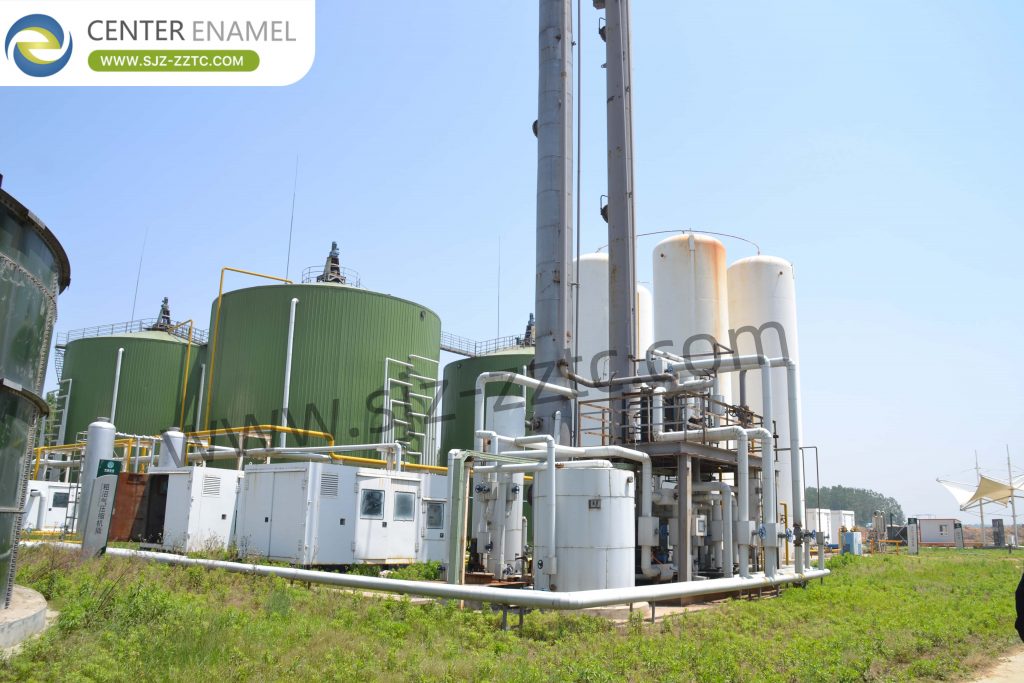
The core equipment is the GFS tank with no complex media or precision three-phase separators, featuring a rugged clog-resistant structure. The bottom large-diameter anti-clogging distribution system is suitable for high-solids wastewater, preventing pipe clogging.
Supporting equipment includes influent lift pumps, simple pretreatment screens, and equalization tanks for impurity removal and water quality balancing. Simple top gas collection devices and biogas conveying/desulfurization equipment enable biogas resource recovery. Temperature, level, and pH online monitoring equipment ensure process stability. Bottom large-diameter sludge discharge pipes and pumps facilitate rapid removal of high-concentration residual sludge, suitable for high-solids conditions.
The complete system has extremely low failure rates, outstanding wear and clog resistance, and is far easier to maintain than conventional anaerobic processes-a decisive advantage for an EPC Contractor delivering USR Process plants in remote agricultural regions where maintenance resources are limited.
USR Supporting Equipment Configuration
| Equipment Category | Components | Function |
| Core reactor | GFS tank; no three-phase separator | Rugged, clog-resistant anaerobic digestion |
| Feed system | Bottom large-diameter distribution | Prevents pipe clogging in high-solids feed |
| Pretreatment | Lift pumps, screens, equalization tanks | Impurity removal; water quality balancing |
| Gas system | Top gas collection; conveying/desulfurization | Biogas resource recovery |
| Monitoring | Temperature, level, pH online sensors | Process stability control |
| Sludge discharge | Bottom large-diameter pipes and pumps | Rapid removal of high-concentration sludge |
Biogas Plant Digestate: Environmental Toxicity of Pollutants
Overall high safety, very low toxicity, controllable ecological risks, and no high-risk pollution hazards. All pollutants are natural fermentation residues from organic materials, containing no heavy metals, synthetic toxins, bacteriostats, or persistent organics-no inhibition or toxicity to microorganisms, plants, or animals.
The anaerobic environment completely inactivates pathogenic microorganisms-no biological pollution or disease transmission risks. Humic acids and trace elements are beneficial ecological substances, improving soil quality when properly applied to farmland. Only long-term excessive discharge can cause nitrogen/phosphorus enrichment, algal blooms, and nutrient accumulation in soil-no acute toxicity.
This favorable toxicity profile is why USR Process digestate can be integrated into farmland application programs-an increasingly important revenue and compliance factor that a capable EPC Contractor should design into the project from the start.
Digestate Pollutant Risk Profile
| Parameter | Assessment | Implication |
| Heavy metals | None | No soil contamination risk |
| Synthetic toxins / bacteriostats | None | Safe for microbial and plant life |
| Persistent organics | None | No long-term accumulation |
| Pathogenic microorganisms | Inactivated by anaerobic environment | No disease transmission risk |
| Humic acids & trace elements | Beneficial | Improves soil quality when land-applied |
| Risk threshold | Long-term excessive discharge only | Nitrogen/phosphorus enrichment; no acute toxicity |
Ghana Municipal Domestic Wastewater Treatment Project
Completed installation in 2021, the Ghana project treats 1,800 m³/day of municipal wastewater using UBF anaerobic + A²/O nitrogen/phosphorus removal mature processes. It is equipped with multiple Center Enamel GFS tanks including 1 UBF anaerobic reactor, 1 secondary clarifier, and 2 internal/external double-layer A²/O biological tanks.
Influent has high COD, BOD, suspended solids, and nitrogen/phosphorus concentrations-after full treatment, effluent parameters are significantly reduced with pH stable at 6.5–9.0, fully meeting local environmental discharge standards. Corrosion-resistant, conveniently assembled GFS tanks efficiently solve urban domestic wastewater pollution while balancing treatment effectiveness and O&M economics-a mature municipal wastewater case in Africa, delivered under a single EPC Contractor scope.
Ghana Project Technical Specifications
| Parameter | Specification |
| Location | Ghana |
| Completion Year | 2021 |
| Treatment Capacity | 1,800 m³/day |
| Process Train | UBF Anaerobic + A²/O Nitrogen/Phosphorus Removal |
| GFS Tank Components | 1 UBF Anaerobic Reactor, 1 Secondary Clarifier, 2 A²/O Biological Tanks |
| Effluent pH Range | 6.5–9.0 |
| Application | Municipal Domestic Wastewater Treatment |
Global Integrated Standardized Service System
Leveraging regional sales centers in China and overseas local agent networks, Center Enamel has established a complete after-sales service loop covering all markets. The system provides four core service pillars: 24/7 rapid response mechanism, on-site domestic/overseas installation services, full-project-cycle after-sales support, and long-term warranty protection.
This forms a complete service chain from preliminary site survey, mid-term construction management, to long-term inspection and maintenance. The entire system is uniformly adapted to both domestic and international project service standards, coordinating personnel scheduling, material support, and on-site coordination for simultaneous projects across multiple regions-significantly reducing customer multi-party coordination costs and ensuring efficient domestic and overseas project delivery.
For an EPC Contractor running parallel USR Process projects across continents, this standardized service backbone is what keeps schedules intact and quality consistent.
Service System Pillars
| Pillar | Scope | Benefit |
| 24/7 rapid response | Remote diagnostics and emergency coordination | Minimal downtime |
| On-site installation | Domestic and overseas deployment | Certified construction quality |
| Full-project-cycle support | Survey → construction → inspection | Single point of accountability |
| Long-term warranty | Structural and performance protection | Reduced lifecycle risk |
Center Enamel Marketing Team: Regulatory and Investment Expertise
The marketing team brings together environmental industry multi-skilled professionals and multilingual foreign trade specialists, with deep expertise in global biogas, wastewater treatment, and biomass new energy markets-accumulating extensive practical project experience in Southeast Asia, Africa, Europe, and the Americas.
The team is proficient in various countries' wastewater discharge regulations, biogas subsidy policies, and carbon trading rules-providing one-stop preliminary site survey, solution planning, and investment return analysis consulting services. This front-end capability allows an EPC Contractor engagement to begin with bankable numbers rather than assumptions, and ensures USR Process designs align with local discharge and incentive frameworks.
Single and Double Membrane Roof Cover Solution
Single and Double Membrane Roofs are proprietary airtight tank cover systems for anaerobic digestion and biogas storage projects, specifically developed for biogas collection and odor containment, representing a benchmark lightweight sealing solution for fermentation tanks.
The single-layer membrane roof features a simple structure with economical cost, meeting basic biogas containment needs. The double-layer membrane roof consists of inner and outer corrosion-resistant membrane materials, with pressurized air in the interlayer forming rigid support, providing outstanding thermal insulation that reduces biogas condensate formation inside the tank, with enhanced wind and snow load resistance suitable for high-altitude and windy outdoor sites.
The membrane material is specialized aging-resistant and biogas-slurry-corrosion-resistant PVDF membrane, which will not leak or degrade from long-term contact with biogas or hydrogen sulfide. The flexible structure accommodates tank settlement and slight deformation without cracking or gas leakage. The lightweight design eliminates heavy steel support trusses, significantly reducing the load on the tank and foundation, saving construction costs.
The roof integrates biogas outlets, safety pressure relief valves, and access channels, fully enabling closed gas collection for anaerobic fermentation tanks, recovering biogas for power generation and heating while blocking odor diffusion to meet environmental odor control requirements. It is widely used in large-scale livestock biogas projects, municipal sludge anaerobic digestion, and food waste fermentation projects, compatible with large-volume glass-fused-to-steel anaerobic tanks, with fast construction and simple maintenance requiring only periodic membrane seal integrity checks, offering significant overall engineering advantages-and closing the gas-tight loop on every USR Process plant delivered by an experienced EPC Contractor.
Membrane Roof Options Compared
| Feature | Single-Layer Membrane Roof | Double-Layer Membrane Roof |
| Structure | Simple, single membrane | Inner + outer membrane with pressurized interlayer |
| Cost | Economical | Higher initial investment |
| Thermal Insulation | Basic | Outstanding; reduces condensate |
| Wind/Snow Load Resistance | Standard | Enhanced; suitable for high-altitude/windy sites |
| Biogas Containment | Basic needs | Full closed collection |
| Best Fit | Small to medium projects | Large livestock, municipal sludge, food waste projects |
Frequently Asked Questions
Q1: What does an EPC Contractor deliver on a USR Process project?
A: A single contract covering feedstock assessment, process design, GFS Tank manufacturing, supporting equipment supply, civil coordination, installation, commissioning, and warranty. The EPC Contractor holds full integration responsibility, eliminating interface disputes between tank suppliers and process providers.
Q2: Why is the USR Process suited to high-solids biogas projects?
A: The USR Process handles high suspended solids without three-phase separators, resists clogging through gentle upflow hydraulics, and runs on flocculent sludge without granulation. This makes it reliable for livestock manure and agricultural wastewater with fluctuating feedstock.
Q3: How does Center Enamel support projects after handover?
A: We provide 24/7 remote diagnostics, process parameter tuning, tank anti-corrosion maintenance guidance, and dispatched on-site inspection, annual service, and refurbishment-with long-term operational data tracking to optimize performance across the project lifecycle.
Let's Take Your Project from Design to Handover
One contractor, one contract, one guarantee-that is what EPC delivery should mean. Contact us today for a free feedstock assessment and a tailored USR Process scope built on our own GFS Tanks.
30,000+ projects across 100+ countries stand behind our delivery record. Talk to our engineers now and receive your USR Process and GFS Tank budget estimate within 48 hours-no obligation, no coordination burden.