
A Global EPC Contractor Delivering Robust Chemical Wastewater Treatment Process with IC Process
As regulations around the world shift from simple discharge compliance to resource recovery and zero liquid discharge, chemical producers need more than equipment-they need a single accountable partner. As an experienced EPC contractor, Center Enamel has spent 30+ years turning complex chemical effluent into manageable, recoverable streams, anchored by the IC Process and a fully integrated wastewater treatment process spanning process design, equipment supply, installation, and long-term O&M.
A Global Policy Shift Toward Resource Recovery and ZLD
Global industrial wastewater policies are escalating from "compliance discharge" to mandatory "resource recovery" and "zero liquid discharge." The EU, through its Circular Economy Action Plan, requires member states to raise industrial wastewater reuse rates and extends carbon footprint accounting across the full lifecycle of wastewater treatment. China continuously tightens industrial water pollutant discharge standards, with increasingly stringent limits on total nitrogen, total phosphorus, and characteristic pollutants for chemicals, pharmaceuticals, and printing and dyeing; water-scarce regions and highly polluting industries are mandated to adopt zero or near-zero liquid discharge technologies. Germany has built a differentiated pretreatment standard system by industry, requiring industrial effluent to meet specific quality thresholds before entering municipal plants-strict source control that raises the bar for every modern wastewater treatment process.
These regulatory pressures hit chemical manufacturers first and hardest, because their effluent spans the widest range of pollutants and process routes.
Where Chemical Wastewater Comes From-and Why It Varies So Widely
Chemical wastewater originates across the entire production chain of petrochemicals, coal chemicals, fine chemicals, fertilizers and pesticides, and consumer chemicals-making it one of the heaviest-polluting and most complex wastewater categories in industry. Key pollution stages include reaction synthesis, raw material refining and separation, product purification and crystallization, catalyst regeneration, and solvent recovery. Auxiliary discharges include equipment and pipeline washing, reactor cleaning, floor washing, cooling water, and scrubber drainage. Large petrochemical plants discharge continuously at high volume, while small and medium-sized chemical plants often release intermittently with highly unstable water quality as product lines change.
Because each segment carries a distinct pollution signature, the wastewater treatment process must be matched to source-not forced into a one-size-fits-all template.
| Industry Segment | Typical Pollutants | Discharge Pattern |
| Petrochemical | Oily wastewater, alkaline residue, hydrocarbons, phenols, sulfides | Large-volume, continuous |
| Coal chemical | Gasification scrubber water, ammonia nitrogen, cyanides, phenols, heterocyclics | Continuous, high-load |
| Fine chemical | Synthesis intermediates, residual raw materials, reaction byproducts | Variable, fluctuating |
| Pesticide | Organophosphorus and organochlorine pesticide residues | Intermittent, toxic spikes |
| Consumer chemicals | Mixed process and utility wash water | Moderate, variable composition |
Across all these segments, one high-efficiency anaerobic reactor has emerged as the reliable core of modern chemical wastewater treatment process-the IC Process.
The IC Process: Third-Generation Anaerobic Technology Built on UASB
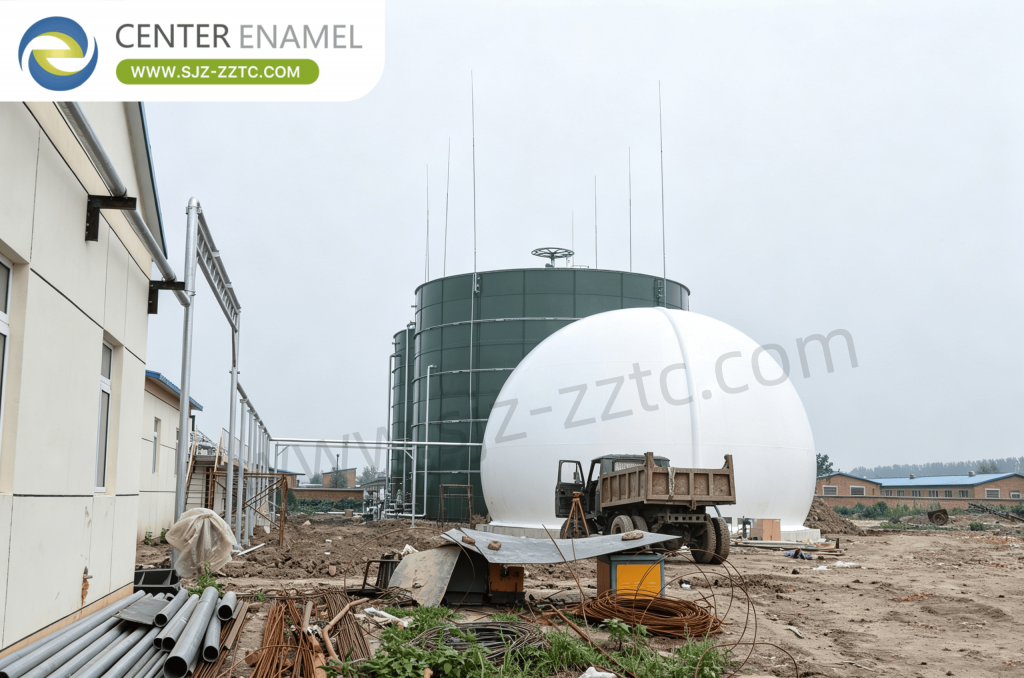
IC, or Internal Circulation Anaerobic Reactor, is the third-generation high-efficiency anaerobic treatment technology built upon UASB. Its core innovation is a built-in gas-lift internal circulation system that autonomously recirculates wastewater without external return pumps. The reactor uses a dual-zone configuration-a lower main reaction zone and an upper polishing zone. Biogas-driven gas-lift creates hydraulic internal circulation, substantially raising upflow velocity and intensifying sludge–wastewater contact. With extremely high compactness, the IC Process is purpose-designed for high-concentration, high-flow industrial organic wastewater, combining high efficiency, energy savings, and a minimal footprint into the core of modern high-strength industrial treatment.
That compact, self-recirculating design is precisely why the IC Process has become a default choice for chemical plants facing both tight site constraints and tightening effluent limits.
Why the IC Process Fits Tough Chemical Effluent
Chemical wastewater-rich in phenols, cyanides, heterocyclics, and high-salinity compounds-demands a reactor that can concentrate granular sludge, tolerate shock loads, and recover biogas energy while producing little excess sludge. The IC Process delivers all three: gas-lift internal circulation keeps biomass in constant contact with pollutants, the dual-zone layout pairs high-rate degradation with final polishing for stable effluent, and the self-powered recirculation cuts both equipment and O&M cost. As part of Center Enamel's end-to-end wastewater treatment process, the IC reactor is bundled with GFS tanks for equalization and sludge handling, corrosion-resistant piping, and integrated biogas utilization-so chemical operators receive one accountable solution rather than disconnected components.
Delivering that integrated solution globally requires more than good process design-it requires decades of field-proven engineering depth.
From Tank Maker to Full-Scope EPC Contractor
Center Enamel has been deeply engaged in environmental bolted storage equipment for over 30 years. Starting with proprietary enamel anti-corrosion material technology, the company has completed a full-industry-chain upgrade-from a single tank manufacturer to a comprehensive environmental EPC contractor. Across its 30+ year history, the company has been recognized as a National High-Tech Enterprise, National Specialized and Sophisticated "Little Giant," Manufacturing Single Champion, and Provincial Green Factory, and has delivered over 30,000 environmental projects globally. The value chain now runs from enamel frit R&D and intelligent equipment manufacturing to EPC contractor services-every breakthrough built on proprietary anti-corrosion technology.
That evolution is backed by hard credentials in materials science and construction delivery.
Material Innovation and Field-Proven Credentials
Center Enamel has independently developed over 200 anti-corrosion enamel formulations, with proprietary double-sided double-layer enameling technology that extends GFS tank anti-corrosion service life beyond 30 years-far outperforming concrete and ordinary steel equipment-and suits global high-corrosion wastewater and biogas fermentation conditions. These credentials are not confined to the factory floor; they are validated on site across every climate and effluent type.
| Dimension | Track Record |
| Industry tenure | 30+ years in environmental bolted storage |
| Global project deliveries | 30,000+ environmental projects |
| Proprietary enamel formulations | 200+ anti-corrosion recipes |
| GFS tank service life | 30+ years anti-corrosion lifespan |
| Business scope | Enamel frit R&D → equipment manufacturing → EPC contracting |
| National honors | High-Tech Enterprise, "Little Giant," Manufacturing Single Champion, Provincial Green Factory |
R&D depth alone, however, does not guarantee on-time delivery-especially on remote international sites.
R&D Team and Global Construction Capacity
Center Enamel has built a full-chain professional team covering R&D, design, marketing, installation, and after-sales. The R&D team is led by national-level materials technology experts specializing in enamel frit and tank anti-corrosion, reinforced by retained senior environmental engineering and mechanical structure engineers focused on coating formulations, specialty corrosion-resistant tanks, and integrated anaerobic supporting equipment. Proprietary laboratories, paired with long-term university collaboration, run year-round durability pilot tests and long-term corrosion simulation tests, iterating enamel recipes for extreme conditions such as high-salinity wastewater, strong acid/alkali POME, and high-organic livestock manure-feeding an annual stream of new invention and utility patents.
On the construction side, Center Enamel fields its own nationally and internationally certified installation crews, with regular practical training on GFS tank assembly and overseas construction standards. Domestic regional teams cover multiple zones and can deploy simultaneously for large tank farms, while cross-border installation crews are calibrated to various country construction standards-ensuring uninterrupted delivery from remote African sites to high-standard European and American facilities.
Together, this R-and-delivery stack positions Center Enamel as a single accountable EPC contractor for your complete wastewater treatment process.
Frequently Asked Questions
Q1. What is the IC Process and why is it used for chemical wastewater?
A1. The IC Process is a third-generation internal-circulation anaerobic reactor built on UASB. Its gas-lift recirculation intensifies sludge–wastewater contact in a dual-zone layout, delivering high-rate degradation in roughly one-third of a conventional anaerobic footprint-ideal for high-COD, high-flow chemical effluent.
Q2. What does Center Enamel deliver as an EPC contractor?
A2. Center Enamel provides end-to-end wastewater treatment process services: process design, GFS tank and IC reactor supply, biogas and dome equipment, on-site installation by certified crews, and long-term after-sales O&M support across over 100 countries.
Q3. How durable are Center Enamel tanks in corrosive chemical conditions?
A3. With 200+ proprietary enamel formulations and double-sided double-layer enameling, GFS tanks carry a 30+ year anti-corrosion service life and are field-proven for high-salinity, strong acid/alkali, and high-organic wastewater conditions.
Planning a new chemical wastewater treatment process or upgrading an existing line? Send us your effluent profile, discharge limits, and site conditions-Center Enamel's engineering team will respond with a tailored IC Process EPC proposal within 48 hours.
From process design and GFS tank fabrication to cross-border installation and lifelong O&M support, our global EPC contractor team is ready-contact Center Enamel today to turn complex chemical effluent into a stable, compliant, and recoverable resource stream.