
How Can the Right EPC Contractor Using IC Process to Deliver Papermaking Wastewater Treatment Projects?
Pulp and paper mills today are squeezed from both sides: discharge limits tighten every year, while plant land, capital budgets and energy consumption refuse to grow. The result is that a Papermaking Wastewater Treatment Project EPC Contractor can no longer win on tank volume alone-it must deliver a compact, low-energy, biogas-positive biological core inside a footprint the mill can actually spare. At Center Enamel, that core is the IC Process, wrapped in GFS tanks, aluminum dome roofs and a globally certified installation team.
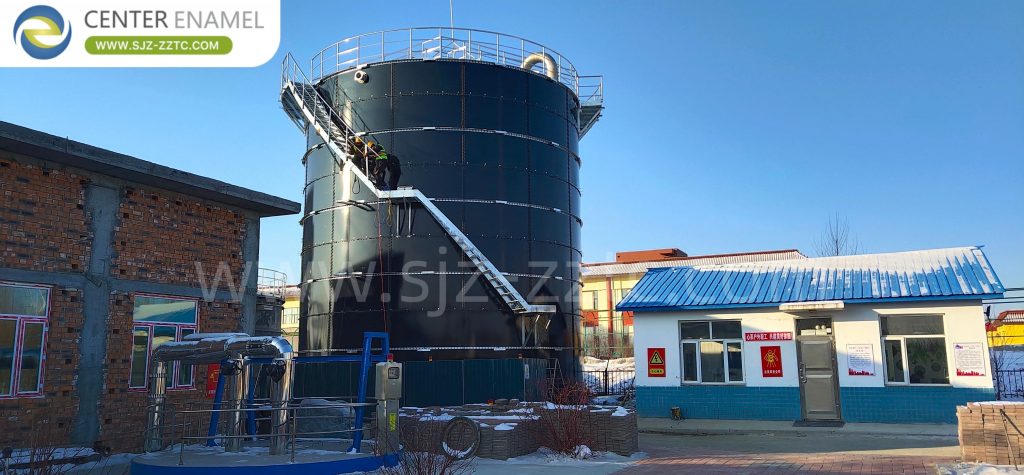
The "Three High" Challenge Shaping Industrial Wastewater
The industrial wastewater sector's core pain point is widely described as the "three highs": high treatment difficulty, high cost and high energy consumption. Effluent from new energy, chemical and pharmaceutical industries carries complex compositions with characteristic pollutants that traditional processes struggle to remove. Chinese equipment makers hold strong price advantages in mid- and low-end segments, but the industry is simultaneously pushed by tightening emission standards and pulled by new demands for digitalization, low-carbon operation and refined O&M.
For pulp and paper, this pressure is acute. A Papermaking Wastewater Treatment Project EPC Contractor must therefore select a biological process that is not merely compliant, but compact enough to fit a brownfield mill, cheap enough to run for decades, and robust enough to absorb daily load swings. That is precisely the design brief behind the IC Process.
Why Papermaking Wastewater Needs a Targeted EPC Approach
Papermaking wastewater is unusual: its pollutants are mostly natural plant extracts with relatively low chemical toxicity, but the physical and oxygen-demand impacts are severe. High-concentration fibers and fillers settle on riverbeds, smothering spawning grounds and benthic habitats. Lignin and cellulose decompose in the receiving water, consuming dissolved oxygen and suffocating fish. Strongly alkaline black liquor directly pushes pH upward, while resin acids and tannins add sublethal toxicity, and deep brown color cuts light penetration and suppresses aquatic photosynthesis. Large fiber loads also silt up rivers and reservoirs.
The good news is that, with no heavy metals or synthetic toxics, recovery periods are moderate-provided the EPC line first removes fibers and alkalinity, then degrades soluble organics biologically. A competent Papermaking Wastewater Treatment Project EPC Contractor sequences exactly this way: screening and equalization, pH and temperature correction, then a high-rate anaerobic stage built on the IC Process, with aerobic polishing reserved for residual color and lignin.
How the IC Process Outperforms on Mill Effluent
The IC Process earns its place in mill designs because its advantages map directly onto papermaking's operational reality. For the same treatment capacity, its footprint is only about one-third that of a traditional anaerobic reactor-a decisive number when land is the binding constraint. Its built-in gas-lift internal circulation needs no external recirculation pump: biogas itself drives forced mixing of sludge and water, guaranteeing thorough microbe-to-pollutant contact and strong tolerance to both water-quality and hydraulic shock loads. The dual-zone configuration pairs high-rate degradation in the lower zone with deep polishing in the upper zone for a stable effluent. Sludge granulation is advanced, activity is high and washout is minimal; automation is high, failure rates low, and biogas production large enough to deliver real resource-recovery value. Long-term energy and O&M costs sit far below conventional anaerobic systems. The table below contrasts these points directly.
| Dimension | Traditional Anaerobic Reactor | IC Process |
| Footprint for equal load | Baseline | ~1/3 of conventional |
| Internal mixing | External recirculation pump required | Self-driven by biogas gas-lift |
| Reactor zones | Single reaction chamber | Dual zone: high-load + polishing |
| Shock-load tolerance | Moderate | Strong hydraulic and organic resistance |
| Sludge retention | Prone to washout at high upflow | Highly granulated, low washout |
| Energy & O&M cost | Elevated | Low, with biogas credit |
| Best-fit effluent | General medium-strength wastewater | Large-flow, high-COD mill effluent |
GFS Tanks: The Vessel Backbone of Compact Mill EPC Delivery
A great reactor process is only as good as the tank that holds it. Poured concrete tanks cannot change volume or shape after casting: they need heavy foundations, consume large and often irregular footprints, and cannot be expanded without demolition. GFS (Glass-Fused-to-Steel) tanks flip that trade-off. Capacities are specified precisely from dozens of cubic meters up to 50,000 m³, with height and diameter freely combined to fit narrow or oddly shaped mill plots. Enamel colors can be matched to plant architecture, and when the mill debottlenecks, the tank farm can be reconfigured or extended-something monolithic concrete can never offer.
For a Papermaking Wastewater Treatment Project EPC Contractor, this flexibility is strategic. Equalization, neutralization, IC Process reactors and polishing tanks all ship as bolted GFS packages, erect in weeks rather than months, and resist the alkaline, sulfate-rich chemistry of mill effluent without recurring repainting. The result is a biological island that actually fits inside a modern intensive plant layout.
The Aluminum Geodesic Dome Roof: Sealing Odor and Biogas at the Source
Once the IC Process is running inside a GFS tank, the roof is no longer a passive weather cover-it is a gas and odor interface. Center Enamel's Aluminum Geodesic Dome Roof is stamped from high-strength aluminum alloy plates into a triangular grid spherical self-supporting structure, spanning large areas without internal columns. The design complies with international AWWA D108 standards, and plate thickness, rib sections and joints are all verified by finite element stress analysis to meet local wind and snow codes. Because aluminum weighs only one-third to one-half of a steel roof on the same span, it mounts directly on the tank wall without structural reinforcement.
Double sealing-specialized sealant strips plus mechanical interlocking between panels-makes the dome airtight enough for biogas collection and enclosed odor control, while the column-free interior leaves mixers, distributors and other internal equipment unobstructed. The material does not support microbial growth, needs no anti-corrosion repainting over decades, and lowers total life-cycle cost. For a mill struggling with odor complaints near residential areas, this roof turns the IC Process tank from a pollution source into a sealed, recoverable biogas asset.
Inside Center Enamel: R&D, Certifications and 10,000+ Installations
Process and product are credible only when backed by manufacturing depth. Center Enamel independently masters more than 200 differentiated anti-corrosion enamel formulations, controls the raw-material chain, and holds nearly 100 invention and utility patents. Products carry NSF, WRAS, ASME, BSCI, CE and ISO9001 certifications, and the company is recognized as a National High-Tech Enterprise, a National Specialized "Little Giant," a Hebei Manufacturing Single Champion, and a Provincial Smart and Green Factory. Long-term university joint laboratories keep coating and large-bolted-tank structural design iterating.
On site, the installation crew has practical experience from over 10,000 GFS tank projects worldwide, following standardized procedures across mobilization, civil coordination, tank assembly, piping and commissioning. Teams are proficient in GFS tanks, dual-membrane gas holders, USR/CSTR/IC Process anaerobic reactors, and biogas desulfurization and piping systems-adapted to large farms, industrial parks, remote mountain sites and coastal high-corrosion locations. For cross-border projects, crews deploy as complete units to handle on-site construction, technical training and local-worker instruction, enforcing unified global safety standards, air-tightness testing and corrosion protection. The table below summarizes this capability stack.
| Capability Layer | What Center Enamel Brings |
| Process know-how | IC Process, USR, CSTR, anaerobic reactors; biogas desulfurization & piping |
| Vessel product | GFS tanks, dozens to 50,000 m³; stainless steel support tanks |
| Cover system | Aluminum Geodesic Dome (AWWA D108), dual-membrane biogas holders |
| IP & materials | 200+ enamel formulations, ~100 invention/utility patents |
| Certifications | NSF, WRAS, ASME, BSCI, CE, ISO9001; National Little Giant, Manufacturing Single Champion |
| Installation track record | 10,000+ GFS projects worldwide; full cross-border crew deployment |
Reference Delivery Model Across Sectors
The same IC Process + GFS tank + aluminum dome recipe is repeatedly deployed across industrial effluent sectors. On a pulp and paper line, the emphasis is fiber removal, alkaline correction and a compact anaerobic island. On a brewery or distillery, the high-sugar, readily biodegradable load pushes biogas recovery. On a POME or livestock site, the focus shifts to high-solids digestion and odor sealing. On remote mountain or coastal sites, the EPC challenge is logistics and corrosion protection rather than process novelty. In every case, Center Enamel's role as a Papermaking Wastewater Treatment Project EPC Contractor (and parallel EPC partner for adjacent sectors) is to deliver the process, the vessel, the roof and the crew as one accountable package-never as a stack of disconnected equipment purchases.
Frequently Asked Questions
Q1. Why is the IC Process preferred over conventional anaerobic reactors for papermaking wastewater?
A. The IC Process uses roughly one-third of the footprint, drives itself by biogas gas-lift without external pumps, resists hydraulic and organic shock loads common in mills, and produces recoverable biogas-lowering both land cost and long-term O&M.
Q2. What does Center Enamel deliver as a Papermaking Wastewater Treatment Project EPC Contractor?
A. We provide process design, GFS reactors and tanks, IC Process internals, aluminum geodesic or dual-membrane roofs, and a 10,000+ project crew for on-site erection, air-tightness testing and commissioning under global safety standards.
Q3. Can the aluminum geodesic dome handle mill odor and biogas?
A. Yes. Its double-sealed, AWWA D108-compliant aluminum structure is airtight enough for biogas collection and enclosed odor control, weighs far less than a steel roof, and requires no long-term anti-corrosion maintenance.
Evaluating a new Papermaking Wastewater Treatment Project EPC Contractor for your mill? Contact to us today, our process engineers will return a tailored IC Process flowsheet with a GFS tank and roof layout within two business days. From first process drawing to air-tightness test passed on site, Center Enamel delivers one accountable, globally certified EPC package-wherever your mill stands.