
Advanced Anaerobic Technologies and Trusted EPC Contractor Services for Global Livestock Manure Projects
Global livestock inventories such as swine remain stable, yet the maturity of manure management varies widely across regions. The US has developed technical models represented by integrated crop-livestock systems with on-field application and Comprehensive Nutrient Management Plans. Denmark, the Netherlands, and others have developed centralized biogas projects with digestate application systems. China's large-scale farms still have considerable room for improvement in supporting biogas project coverage, and digestate resource utilization rates lag behind advanced European levels.
Greenhouse gas emissions from livestock account for a significant proportion of total global anthropogenic emissions, making manure management a critical battleground for agricultural carbon reduction. Latin American countries started later in manure management but are accelerating relevant infrastructure development. This uneven global landscape creates strong demand for experienced partners who can transfer proven anaerobic technologies and deliver projects under diverse regulatory and climatic conditions-precisely the role a capable EPC contractor must fill.
GFS Tanks: Flexible, Durable Fit for Modern Intensive Plant Layouts
GFS Tanks offer flexible customization of size and appearance, with higher land utilization rates ideally suited for modern compact plant layouts, delivering significant advantages over fixed poured concrete tanks. Concrete tanks cannot alter volume or shape after pouring, and their heavy bases occupy large areas, making placement difficult on narrow or irregular plots. Their rough, uniform appearance also cannot match modern facility aesthetic requirements. GFS Tank volume can be precisely customized as needed, with capacities ranging from dozens of cubic meters to 50,000 cubic meters freely selectable.
Tank height and diameter can be flexibly combined to fit narrow or irregularly shaped plots, effectively saving plant land occupation. Enamel color customization is also supported, achieving visual harmony with plant buildings and environmental facilities. During later plant expansion, GFS Tanks can be directly adjusted in layout and expanded, whereas concrete tanks, being monolithic structures, must be demolished and rebuilt-offering less flexibility in land resource utilization. This aligns well with the intensive construction and aesthetic operation and maintenance needs of industrial parks.
USR Reaction Process: How High-Solids Organic Wastewater Is Treated Step by Step
High-solids organic wastewater, after simple pretreatment to remove large debris, is uniformly fed into the reactor through the bottom distribution system. The upward flow drives solid substrates and anaerobic sludge to slowly rise and thoroughly mix. In the sealed anaerobic environment, microorganisms sequentially hydrolyze and acidify, then methanogenically ferment, degrading macromolecular organic pollutants and generating biogas and treated water. Without complex separation structures, gentle hydraulic disturbance prevents clogging. The mixed liquor rises to the upper portion of the reactor where natural gas-liquid-solid separation occurs. Biogas is collected, effluent overflows, and solid sludge and unreacted substrate settle back to the lower reaction zone for continued reaction, with a small amount of aged sludge periodically discharged-continuous stable operation. This elegant hydraulic design is one of the core anaerobic technologies that distinguishes Center Enamel's agricultural wastewater solutions.
Livestock Wastewater Key Water Quality Characteristics: The "Four Highs" Challenge
Livestock wastewater is a typical high-concentration organic wastewater with "four highs"-high COD, high ammonia nitrogen, high total phosphorus, and high suspended solids-representing a very high pollution load. Livestock wastewater COD can exceed 8,000 mg/L, with high turbidity and suspended solids. Nitrogen and phosphorus levels far exceed discharge standards, being the primary cause of eutrophication. Wastewater is rich in manure, feed residues, and metabolic waste, readily turning black and odorous. Water quality fluctuates significantly with production cycles, seasons, and washing frequency. Aquaculture wastewater has lower pollutant concentrations but significant nitrogen and phosphorus accumulation issues, causing algal blooms and water quality deterioration with long-term discharge. These characteristics dictate the selection and sizing of anaerobic technologies and downstream treatment stages in any well-designed project.
Over a Decade of Global Installation Experience: Proven Across Continents
Center Enamel offers unmatched global practical experience among domestic peers-over a decade covering multiple regions and all industry sectors. In 2009, the company completed its first overseas GFS tank installation, sending a team to Niger, Africa for drinking water storage tank installation. In 2015, it broke industry ground with China's first GFS tank export and installation to the US-passing strict US acceptance standards. All installed projects have operated stably for many years, covering livestock biogas, POME, municipal wastewater, and drinking water storage applications. Construction has covered Southeast Asia, Africa, the Americas, and other regions-accumulating specialized solutions for complex sites including mountainous terrain, coastal salt spray, tropical high temperatures, and high-standard European and American facility conditions-maturely addressing global special construction requirements. This track record is the foundation of Center Enamel's credibility as an EPC contractor for international manure treatment projects.
Full-Industry-Chain Integrated Delivery Capability: One Partner, Complete Accountability
Center Enamel is the only company globally integrating proprietary enamel frit R&D, self-manufactured tanks, and EPC general contracting-full-process self-control. This integration means clients work with a single EPC contractor from raw material formulation through tank fabrication, process design, installation, commissioning, and after-sales support, eliminating the coordination risk and quality gaps that arise when multiple vendors share responsibility. Combined with advanced anaerobic technologies and modular GFS tank construction, this delivery model shortens project timelines, reduces interface risk, and ensures consistent quality standards across every phase.
Aluminum Geodesic Dome Roof: Lightweight, Long-Life Cover for Anaerobic and Storage Tanks
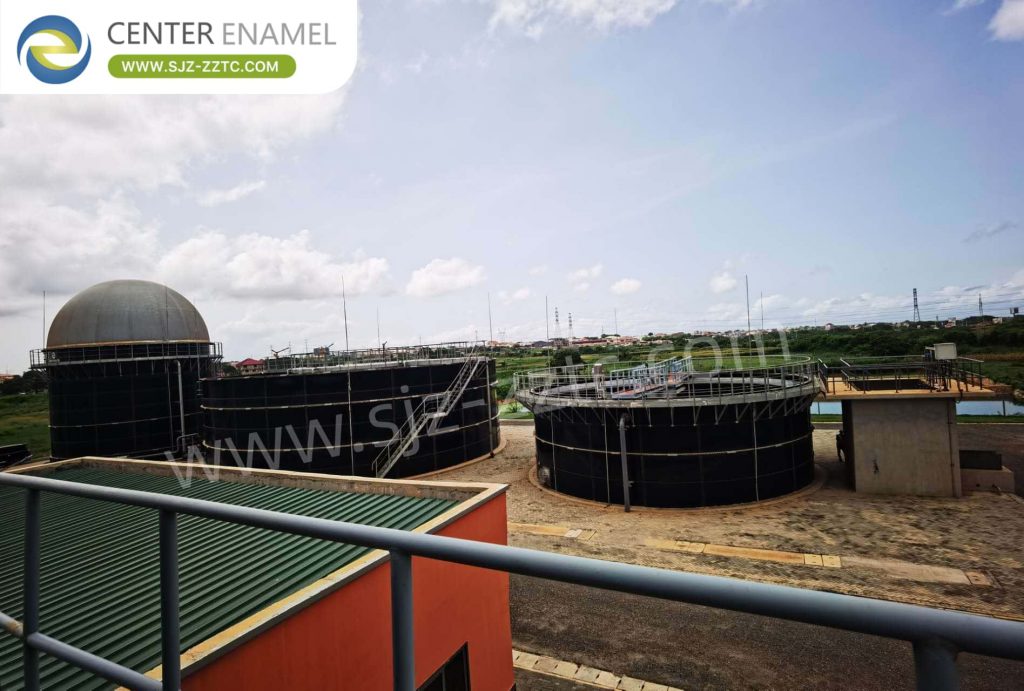
The Aluminum Geodesic Dome Roof independently developed by Center Enamel is manufactured using high-strength aluminum alloy plates through integral stamping. It features a triangular grid spherical self-supporting structure, enabling large-span full coverage without internal support columns. Made of aluminum alloy, the roof offers excellent weather resistance and corrosion resistance, capable of long-term protection against acid rain, salt spray, and UV radiation, suitable for various extreme outdoor climate conditions.
The structural design complies with international AWWA D108 standards, with aluminum plate thickness, rib cross-sections, and joint connections all verified by finite element stress analysis, ensuring wind and snow load resistance that meets building code requirements across different global regions. The weight of the Aluminum Geodesic Dome Roof is only one-third to one-half of a steel roof with the same span, significantly reducing the load on the tank top and allowing direct installation without tank wall reinforcement. The roof provides superior overall sealing performance, with double sealing between panels using specialized sealant strips and mechanical interlocking, enabling both airtight gas storage and enclosed odor control-suitable for biogas collection and storage, wastewater tank odor control, and drinking water contamination prevention. The support-column-free design does not interfere with the installation and operation of internal equipment such as mixers and water distributors. The aluminum material does not support microbial growth, requiring no anti-corrosion maintenance over long-term use, resulting in low total life-cycle costs.
Table 1: Center Enamel Global Installation Milestones
| Year / Metric | Milestone | Significance |
| 2009 | First overseas GFS tank installation (Niger, Africa) | Entry into international project delivery |
| 2015 | First GFS tank export and installation to the US | Compliance with strict US acceptance standards |
| 10+ years | Global installation experience | Multi-region, all-sector coverage |
| Regions Covered | Southeast Asia, Africa, the Americas | Solutions for diverse climates and sites |
| Site Challenges Addressed | Mountainous terrain, coastal salt spray, tropical heat, EU/US standards | Mature special construction capability |
| Applications | Livestock biogas, POME, municipal wastewater, drinking water | Cross-sector project portfolio |
Table 2: Aluminum Geodesic Dome Roof Technical Highlights
| Feature | Specification / Benefit |
| Material | High-strength aluminum alloy, integral stamping |
| Structure | Triangular grid spherical self-supporting, no internal columns |
| Design Standard | AWWA D108, finite element verified |
| Weight | One-third to one-half of equivalent steel roof |
| Corrosion Resistance | Acid rain, salt spray, UV radiation |
| Sealing | Double sealing with sealant strips and mechanical interlocking |
| Functions | Airtight gas storage and enclosed odor control |
| Maintenance | No anti-corrosion maintenance, low life-cycle cost |
Looking for an experienced EPC Contractor to deliver advanced anaerobic technologies for your livestock manure project? Contact Center Enamel today for a feasibility assessment and tailored proposal.
With 30,000+ projects delivered across Southeast Asia, Africa, and the Americas, Center Enamel is ready to support your next biogas or wastewater initiative-get in touch to start the conversation.
Frequently Asked Questions
Q1: What makes Center Enamel a reliable EPC Contractor for manure projects?
Center Enamel integrates enamel frit R&D, tank manufacturing, and EPC contracting in-house, delivering 30,000+ projects globally with full-process accountability from design through after-sales support.
Q2: Which anaerobic technologies does Center Enamel apply to livestock wastewater?
The USR Reactor is central-an upflow anaerobic process tolerating high suspended solids, using flocculent sludge without granular formation, and preventing clogging through gentle hydraulic disturbance.
Q3: Why choose an Aluminum Geodesic Dome Roof for biogas tanks?
It weighs one-third to one-half of a steel roof, needs no tank wall reinforcement, resists acid rain and salt spray, and provides airtight sealing for biogas collection and odor control.