
How an EPC Contractor Use GFS Tanks for Brewery Wastewater Treatment?
Choosing an EPC contractor for brewery wastewater treatment is ultimately a bet on what the plant is made of. Process design can be copied, but a vessel that leaks, corrodes or needs relining every few years destroys the return on investment. The answer to "what should you look for?" comes down to four things: corrosion-resistant GFS Tanks at the core, a proven high-rate anaerobic process, an installation team that has built the design at scale, and a global track record to back it. Center Enamel (Shijiazhuang Zhengzhong Technology Co., Ltd) delivers all four under one EPC contract.
Regulations Are Raising the Bar for Brewery Discharge
Global industrial wastewater policies are escalating from simple "compliance discharge" toward mandatory resource recovery and, in the strictest cases, zero liquid discharge. The EU Circular Economy Action Plan requires member states to raise industrial wastewater reuse rates and extends carbon-footprint accounting across the full lifecycle of treatment. China continues to tighten national water pollutant discharge standards, with increasingly strict limits on total nitrogen, total phosphorus and characteristic pollutants for chemicals, pharmaceuticals and dyeing, and water-scarce regions are required to adopt zero-or near-zero-liquid-discharge technologies. Germany has built a differentiated industry-by-industry pretreatment standard system, requiring industrial effluent to meet specific quality requirements before entering municipal plants. Against this backdrop, it helps to understand what brewery effluent actually is-because its nature dictates the right process.
Brewery Effluent Is Organic-Not Toxic, But Still Costly
Brewery wastewater carries no chemical toxicity. It is purely natural organic effluent with very low ecotoxicological risk and easy environmental restoration. Every pollutant is a natural organic from grain fermentation-starches, sugars, alcohols, amino acids and proteins-with no heavy metals, bacteriostats or persistent toxic organics. These compounds do not inhibit biochemical bacteria and show no acute or chronic toxicity to soil, water or plants. The core problem is simply high-concentration oxygen-demanding organic matter: discharged untreated, it rapidly depletes dissolved oxygen and triggers oxygen depletion, black-odor conditions, algal blooms and channel siltation. Fortunately, the pollutants have no bioaccumulation potential and are quickly decomposed by microorganisms and natural water bodies, so the environmental harm is manageable-but only if the treatment plant captures that oxygen demand efficiently. That profile-natural, biodegradable, but oxygen-hungry-is exactly why anaerobic digestion in the right vessel is so effective, and why the vessel material matters.
Why GFS Tanks Decide a Plant's Service Life
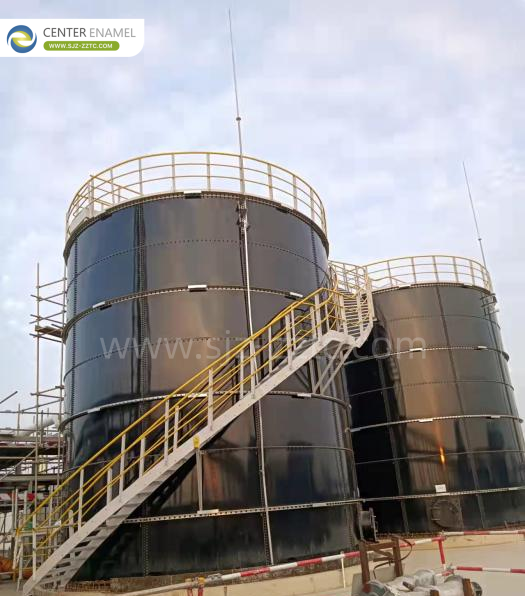
Center Enamel's independently developed double-sided, double-layer enameling is an industry-leading anti-corrosion technology whose performance completely surpasses concrete. Concrete tank interiors are riddled with pores, so wastewater and acid or alkaline media easily penetrate and corrode the structural layer, causing irreversible wall spalling, water seepage and rebar corrosion that are difficult to repair and cannot be fundamentally fixed. GFS Tanks, by contrast, use high-temperature enameling on both the interior and exterior of each steel panel, producing a dense, non-porous enamel finish that completely blocks corrosive liquids and biogas permeation. The enamel layer has exceptional chemical stability against acids, alkalis, salts and microbial corrosion. Concrete tanks develop widespread corrosion and leakage after 5–8 years, while the anti-corrosion service life of GFS Tanks can exceed 30 years-with no frequent internal lining repairs, lower long-term maintenance investment and no risk of media leaking into the site or groundwater. Compared with concrete and FRP tanks, GFS coatings never peel or blister, making them ideal for aggressive conditions such as palm-oil mill effluent, livestock manure and chemical high-salinity wastewater.
| Aspect | Concrete Tanks | Center Enamel GFS Tanks |
| Surface structure | Porous; media penetrates through | Dense, non-porous double-layer enamel |
| Corrosion behavior | Acid/alkali ingress, spalling, rebar rust | Resists acids, alkalis, salts and microbes |
| Typical service life | Corrosion and leakage within 5–8 years | Anti-corrosion life exceeds 30 years |
| Maintenance burden | Hard to repair; repeated lining work | No frequent internal lining repairs |
| Environmental risk | Leaching into site soil and groundwater | No peeling, blistering or leakage |
| Best fit | Mild neutral media | Brewery effluent, POME, manure, high-salinity |
Once the vessel is solved, the process inside it has to be equally efficient-and the IC Process is where GFS Tanks show their full value.
The IC Process Pairs Naturally with GFS Tanks
The IC Process delivers top-tier treatment efficiency in a footprint only one-third that of traditional anaerobic systems for the same capacity-a significant compactness advantage on constrained brewery sites. Its built-in gas-lift internal circulation needs no external recirculation equipment and provides autonomous forced mixing of sludge and water; the strong hydraulic mixing ensures thorough contact between microbes and pollutants, greatly improving degradation efficiency and letting the reactor withstand high water-quality and hydraulic shock loads. A dual-zone configuration combines high-efficiency degradation with deep polishing for stable effluent quality, while a high degree of sludge granulation means highly active biomass with very low washout. The result is high automation, stable operation, low failure rates, large biogas output and outstanding resource-recovery benefits-with long-term energy and O&M costs far below traditional anaerobic processes, perfectly suited to large-flow, high-concentration industrial wastewater. Great process and a great vessel still have to be built correctly on site, and that is where installation experience separates suppliers.
A Deployment Team That Has Built 10,000+ Plants
Center Enamel's installation team draws on practical experience from more than 10,000 GFS tank projects worldwide, strictly following standardized construction procedures and keeping full control over mobilization, civil coordination, tank assembly, piping, commissioning schedules and quality. The team is proficient in the complete standardized installation of GFS tanks, dual-membrane gas-storage covers, USR/CSTR/IC anaerobic reactors and biogas desulfurization and piping systems-adaptable to large-scale farms, industrial parks, remote mountainous sites and coastal high-corrosion locations under unified global safety construction standards. For large overseas cross-border projects, the team can deploy as complete units for on-site construction, technical training and practical instruction of local workers, keeping tight control over construction details, air-tightness testing and corrosion protection. That standardized delivery capability is what ensures timely, stable commissioning of global environmental projects. Scale in the field is only credible when it is spread across markets, climates and regulatory regimes.
A Global Footprint Across 100+ Countries
Center Enamel's project portfolio covers more than 100 countries across Southeast Asia, Africa, Europe and the Americas, with 30,000+ mature projects delivered over the years. That footprint has built complete industry solutions across palm oil, livestock, municipal, brewing and food-waste biogas, so the company can rapidly match customized solutions to different regional climates, water qualities and regulatory requirements. One reference in particular illustrates how this capability translates into operating results.
Proven in the Field-the Pakistan Biogas Demonstration
In the Food Waste + Napier Grass Biogas Demonstration Project in Pakistan, Center Enamel acted as EPC and general contractor. The plant uses a CSTR (Continuous Stirred-Tank Reactor) as its core anaerobic process, co-digesting food waste with Napier grass. A mechanical mixing system keeps the feedstock and anaerobic microorganisms in thorough contact, degrades organic matter efficiently and sustains a stable biogas output of about 100 m³ per day. Because this is the local official demonstration project, its purpose is to validate gas-production efficiency and long-term continuous operating stability; after successful pilot operation, several large-scale Napier grass biogas projects are planned in the region. The same corrosion-resilient, high-loading, gas-recovery principles scale directly to brewery anaerobic digesters built in GFS Tanks.
| Parameter | Project Details |
| Project | Food Waste + Napier Grass Biogas Demonstration |
| Location | Pakistan |
| Center Enamel role | EPC / general contractor |
| Core anaerobic process | CSTR (Continuous Stirred-Tank Reactor) |
| Feedstock | Food waste co-digested with Napier grass |
| Mixing system | Mechanical agitation |
| Stable biogas output | Approximately 100 m³/day |
| Significance | Official local demonstration; larger follow-up projects planned |
Whether you are greenfield engineering a new plant or retrofitting a failing concrete digester, our engineers can scope an EPC package built on GFS Tanks and the IC Process. Reach out to Center Enamel today for a preliminary process scheme, tank proposal and fixed-scope budget for your brewery.
Frequently Asked Questions
What should an EPC contractor for brewery wastewater treatment be responsible for?
A single accountable scope covering pre-design investigation, process design (IC/UASB anaerobic digestion), supply of GFS Tanks, dual-membrane biogas roofs and ancillary equipment, on-site erection, air-tightness testing and commissioning-backed by long-term after-sales support, rather than left to multiple separate vendors.
Why are GFS Tanks preferred over concrete for brewery digesters?
Concrete develops pores, acid penetration, wall spalling and rebar corrosion within 5–8 years, while GFS Tanks use double-sided double-layer enameling that blocks corrosive liquids and biogas for 30+ years, with no peeling, blistering or frequent relining-which lowers whole-life ownership cost.
How much space does the IC Process save?
For the same treatment capacity, the IC Process needs only about one-third the footprint of traditional anaerobic systems, thanks to built-in gas-lift internal circulation, a dual-zone configuration and highly active granular sludge-ideal for large-flow, high-concentration brewery effluent.