
How an EPC Contractor Delivers USR Process Solutions for High-Solids Biogas Projects
The global biogas industry competitive landscape shows divergence. Leading companies dominate major project market shares through the "EPC + Operation" integrated model, while small and medium-sized enterprises focus on county-level distributed projects and specialized equipment segments. China's biogas equipment exports continue to expand, with generator sets primarily flowing to emerging markets. Business model innovation is accelerating, with carbon asset development becoming a standard feature of large projects, converting methane emission reductions into tradable carbon credits.
Some countries have piloted digestate fertilizer carbon credit trading, encouraging the integration of digestate application to farmland with carbon accounting. The "biogas operation outsourcing" service model is emerging, improving operational efficiency of county-level projects through professional management.
From a technology and equipment perspective, anaerobic digestion is the core process of biogas engineering. Glass-fused-to-steel (GFS) tanks, with their excellent sealing, corrosion resistance, and construction convenience, have become the mainstream choice for large anaerobic digestion tanks. Their modular design can be combined with membrane gas holders to form an integrated "fermentation + gas storage" solution, with penetration rates continuing to rise in new projects in biogas industry clusters.
For project owners, this convergence of technology and business model innovation points to one clear need: an EPC Contractor capable of integrating proven anaerobic processes with reliable containment infrastructure. Where high-solids organic wastewater is involved, the USR Process has become the process of choice-and delivering it successfully depends on the engineering depth behind it.
USR Process Definition: What Makes It Different from Conventional Anaerobic Digestion
USR, or Upflow Solids Reactor, is an upflow anaerobic process modified for high-suspended-solids, high-solids organic wastewater, specifically designed to solve problems of clogging, sludge washout, and uneven reaction common in traditional anaerobic processes for high-solids wastewater.
The process eliminates complex three-phase separators, simplifies internal structure, and relies on upflow hydraulics to promote thorough mixing of solid materials and anaerobic sludge. No strict granular sludge formation conditions are required-flocculent sludge can operate stably. The key feature is high solids tolerance and impurity resistance, with very high influent suspended solids tolerance. It is a dedicated high-efficiency anaerobic process for livestock manure, agricultural organic waste, and high-solids livestock wastewater, specifically developed for agricultural and environmental applications.
Key Water Quality Characteristics in Biogas Plants
Stable water quality, simple composition, with high ammonia nitrogen, high total phosphorus, high salinity, and low COD as core characteristics-prominent eutrophication concerns.
Through thorough anaerobic digestion, most macromolecular organics have been converted to methane and carbon dioxide, resulting in significantly reduced and stable COD with no easily decomposable pollutants. Nitrogen, phosphorus, and potassium nutrients are concentrated during fermentation, with ammonia nitrogen and total phosphorus far exceeding conventional discharge standards-these are the key control parameters. Moderate to high salinity with strong acid/base buffering, slightly alkaline. Clear, low-turbidity liquor with minimal odor, very low suspended solids. Moderate biodegradability, no major fluctuations, without the high pollution load characteristics of conventional organic wastewater. Understanding these parameters is essential for any EPC Contractor designing a downstream treatment train that matches USR Process effluent.
Center Enamel Development History: From Tank Manufacturer to Environmental EPC Contractor
Center Enamel has been deeply engaged in the environmental bolted storage equipment field for over 30 years. Starting with proprietary enamel anti-corrosion material technology, the company has gradually completed the full-industry-chain upgrade from a single tank manufacturer to a comprehensive environmental EPC service provider.
| Milestone | Achievement |
| Years in Industry | 30+ years |
| Projects Delivered | Over 30,000 environmental projects globally |
| Recognition | National High-Tech Enterprise, National Specialized and Sophisticated "Little Giant," Manufacturing Single Champion, Provincial Green Factory |
| Core Technology | Proprietary enamel anti-corrosion material technology |
| Value Chain | Enamel frit R&D → intelligent equipment manufacturing → EPC project contracting |
Center Enamel Innovative Material Technology
Center Enamel has independently developed over 200 anti-corrosion enamel formulations, with proprietary double-sided double-layer enameling technology-creating a material technology barrier that supports the long-term durability of GFS tanks in aggressive anaerobic environments. This in-house control over the enamel raw material chain is what allows the company to function as a complete EPC Contractor rather than simply an equipment supplier.
Single and Double Membrane Roof Cover Solutions
Single and Double Membrane Roofs are proprietary airtight tank cover systems for anaerobic digestion and biogas storage projects, specifically developed for biogas collection and odor containment, representing a benchmark lightweight sealing solution for fermentation tanks.
The single-layer membrane roof features a simple structure with economical cost, meeting basic biogas containment needs. The double-layer membrane roof consists of inner and outer corrosion-resistant membrane materials, with pressurized air in the interlayer forming rigid support, providing outstanding thermal insulation that reduces biogas condensate formation inside the tank, with enhanced wind and snow load resistance suitable for high-altitude and windy outdoor sites.
The membrane material is specialized aging-resistant and biogas-slurry-corrosion-resistant PVDF membrane, which will not leak or degrade from long-term contact with biogas or hydrogen sulfide. The flexible structure accommodates tank settlement and slight deformation without cracking or gas leakage. The lightweight design eliminates heavy steel support trusses, significantly reducing the load on the tank and foundation, saving construction costs.
The roof integrates biogas outlets, safety pressure relief valves, and access channels, fully enabling closed gas collection for anaerobic fermentation tanks, recovering biogas for power generation and heating while blocking odor diffusion to meet environmental odor control requirements. It is widely used in large-scale livestock biogas projects, municipal sludge anaerobic digestion, and food waste fermentation projects, compatible with large-volume glass-fused-to-steel anaerobic tanks, with fast construction and simple maintenance requiring only periodic membrane seal integrity checks, offering significant overall engineering advantages.
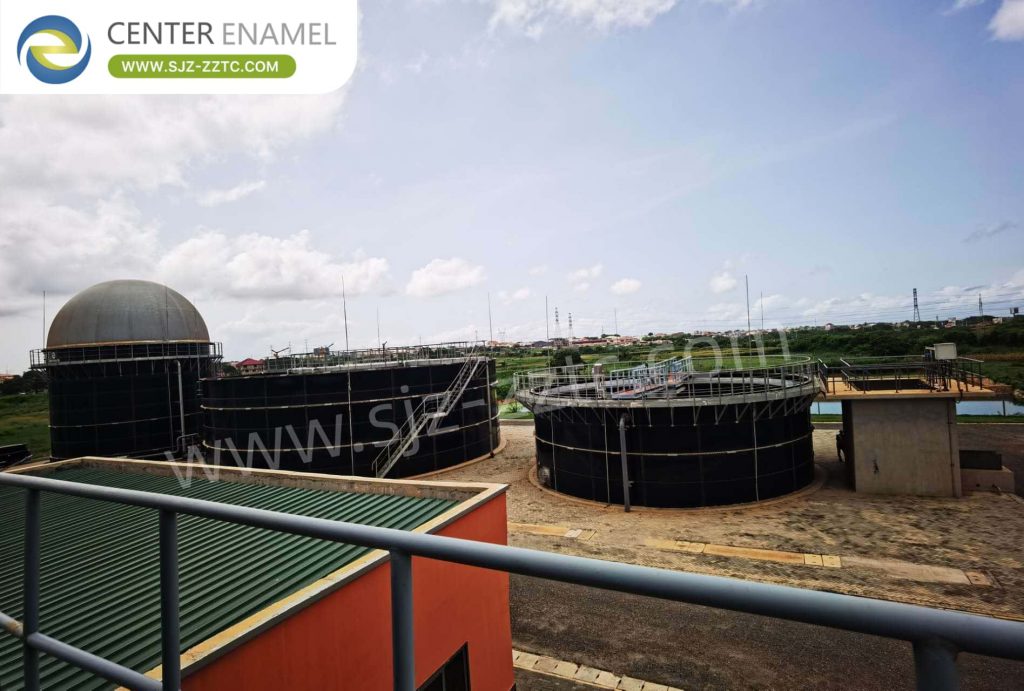
Case Study: Ghana Municipal Domestic Wastewater Treatment Project
| Parameter | Specification |
| Location | Ghana |
| Completion Year | 2021 |
| Treatment Capacity | 1,800 m³/day |
| Process | UBF Anaerobic + A²/O Nitrogen/Phosphorus Removal |
| GFS Tanks | 1 UBF Anaerobic Reactor, 1 Secondary Clarifier, 2 Internal/External Double-Layer A²/O Biological Tanks |
| Influent Characteristics | High COD, BOD, Suspended Solids, Nitrogen/Phosphorus |
| Effluent Quality | pH Stable at 6.5–9.0; Meets Local Environmental Discharge Standards |
| Key Advantage | Corrosion-Resistant, Conveniently Assembled GFS Tanks Solve Urban Domestic Wastewater Pollution |
Ready to start your biogas project? Contact Center Enamel today for a customized USR Process solution-our team will respond within 24 hours.
Frequently Asked Questions
Q1: Why choose Center Enamel as your EPC contractor for USR Process projects?
A: Center Enamel combines 30+ years of environmental engineering, in-house GFS tank manufacturing, 200+ enamel formulations, and 30,000+ delivered projects-covering design, equipment, installation, and commissioning under one contract.
Q2: What makes the USR Process suitable for high-solids biogas wastewater?
A: The USR Process tolerates very high suspended solids, eliminates complex three-phase separators, resists clogging, and operates stably with flocculent sludge-ideal for livestock manure and agricultural organic waste.
Q3: Can Center Enamel handle both the reactor and gas storage scope?
A: Yes. We supply GFS anaerobic tanks, USR/CSTR reactors, single and double membrane roofs, and independent gas holders-delivering a complete fermentation-to-storage solution.