
How EPC Solutions and Anaerobic Technologies Transform Food Waste Treatment
The industrial wastewater treatment market is shifting. Leading companies are building integrated service capabilities, Chinese manufacturers are consolidating mid-tier equipment exports, and international giants are targeting high-end complex wastewater markets. In the anaerobic segment, UASB, EGSB, and IC reactors dominate high-concentration organic wastewater pretreatment-yet their steel tank shells demand corrosion resistance and gas-tightness that directly determine long-term stability.
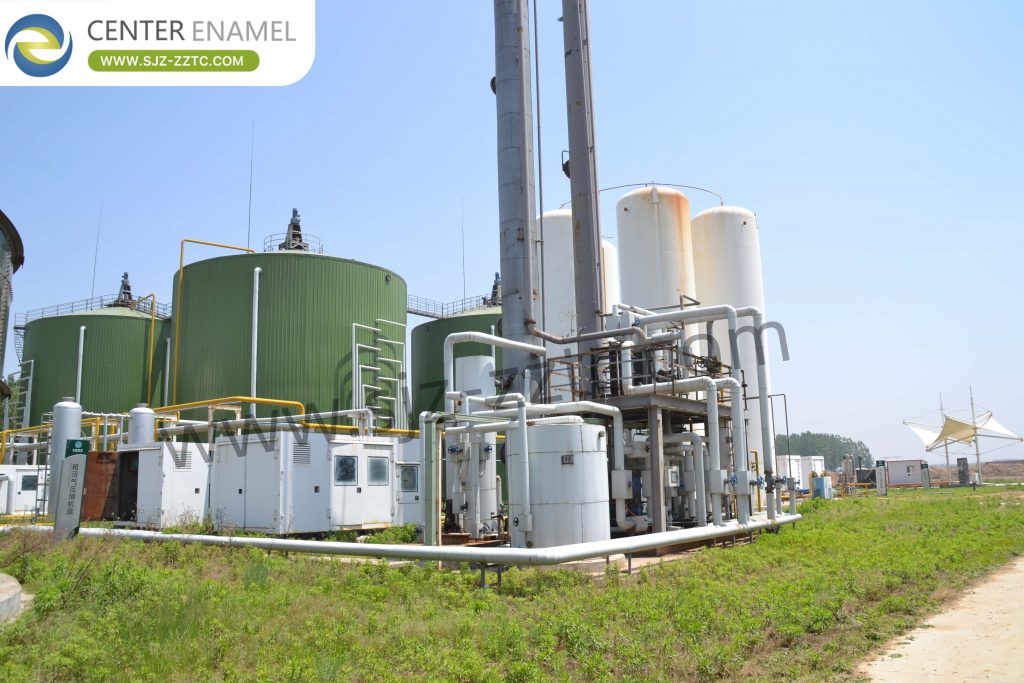
Delivering reliable results at this scale requires more than equipment. It requires complete EPC Solutions backed by proven Anaerobic Technologies and adaptable tank systems. This article explores how Center Enamel integrates market insight, GFS tanks, the USR process, and certified construction teams into a single delivery capability.
Competitive Landscape and the Rise of Integrated EPC Solutions
The competitive landscape shows divergence, with leading companies building integrated service capabilities through technical integration and capital operations, and industry concentration gradually increasing. Chinese companies continue to consolidate their advantages in mid-tier equipment exports. International giants target high-end customers and complex industrial wastewater markets, while local players occupy the mid- to low-end and industrial park centralized treatment markets with service responsiveness and cost advantages.
In the anaerobic process segment, UASB, EGSB, and IC anaerobic reactors-with advantages of high loading rates, small footprints, and stable operation-are widely used in high-concentration organic wastewater pretreatment in food processing, pharmaceutical fermentation, alcohol brewing, chemical, and other industries. These reactors use steel tank shells, and their corrosion resistance and gas-tightness directly determine long-term operational stability. The application value of glass-fused-to-steel tanks in such scenarios is increasingly prominent.
This convergence of process complexity and material demands is precisely why integrated EPC Solutions have become the preferred delivery model for large industrial projects.
Anaerobic Reactor Comparison for High-Concentration Organic Wastewater
| Reactor Type | Key Advantages | Typical Applications | Tank Shell Requirement |
| UASB | High loading rate, stable operation | Food processing, pharmaceutical fermentation | Corrosion-resistant, gas-tight |
| EGSB | Small footprint, high loading rate | Alcohol brewing, chemical | Corrosion-resistant, gas-tight |
| IC | High loading rate, compact design | High-concentration organic wastewater | Corrosion-resistant, gas-tight |
GFS Tanks Adaptable to Modern Intensive Plant Layouts
GFS tanks offer flexible customization of size and appearance, with higher land utilization rates, ideally suited for modern compact plant layouts, with significant advantages over fixed poured concrete tanks. Concrete tanks cannot alter volume or shape after pouring, with heavy bases occupying large areas, making placement difficult on narrow or irregular plots. Their rough, uniform appearance cannot match modern facility aesthetic requirements.
GFS tank volume can be precisely customized as needed, with capacities ranging from dozens of cubic meters to 50,000 cubic meters freely selectable. Tank height and diameter can be flexibly combined to fit narrow or irregularly shaped plots, effectively saving plant land occupation. Enamel color customization is also supported, achieving visual harmony with plant buildings and environmental facilities. During later plant expansion, GFS tanks can be directly adjusted in layout and expanded; concrete tanks, being monolithic structures, must be demolished and rebuilt, offering less flexibility in land resource utilization. This aligns well with the intensive construction and aesthetic operation and maintenance needs of industrial parks.
For EPC Solutions providers, this flexibility means layouts can be optimized during design and adapted during operation-without the costly demolition cycles that concrete imposes.
USR Process Definition for High-Solids Wastewater
USR, or Upflow Solids Reactor, is an upflow anaerobic process modified for high-suspended-solids, high-solids organic wastewater, specifically designed to solve problems of clogging, sludge washout, and uneven reaction common in traditional anaerobic processes for high-solids wastewater.
The process eliminates complex three-phase separators, simplifies internal structure, and relies on upflow hydraulics to promote thorough mixing of solid materials and anaerobic sludge. No strict granular sludge formation conditions are required-flocculent sludge can operate stably. The key feature is high solids tolerance and impurity resistance, with very high influent suspended solids tolerance. It is a dedicated high-efficiency anaerobic process for livestock manure, agricultural organic waste, and high-solids livestock wastewater, specifically developed for agricultural and environmental applications.
As a specialized branch of Anaerobic Technologies, the USR process extends treatment capability to waste streams that conventional reactors cannot handle reliably-making it a critical component of any comprehensive EPC scope.
Wastewater Sources of Food Waste
Food waste water originates from the resource recovery process of kitchen waste from catering services, canteens, and food processing/distribution-a typical high-concentration organic wastewater in urban solid waste resource recovery. Major sources include food waste pretreatment sorting wastewater (from bag breaking, crushing, sorting operations), oil separation wastewater (oily wastewater from three-phase oil extraction), anaerobic digestion digestate (residual liquid after food waste anaerobic digestion), and equipment/vehicle wash water.
Food waste consists primarily of food residues, rich in animal/vegetable oils, starches, proteins, cellulose, salts, and seasoning residues. After pretreatment crushing and sorting, organics are solubilized forming high-concentration wastewater. Large and medium-sized cities' centralized food waste treatment facilities handle hundreds of tons daily with large continuous wastewater production; smaller facilities produce less volume but with higher concentrations-oil and salt accumulation issues are prominent.
These characteristics demand robust Anaerobic Technologies paired with corrosion-resistant tanks-where GFS construction and integrated EPC design provide the needed durability.
Center Enamel Professional Construction Team Manpower Reserve
Center Enamel has established its own domestic and international certified construction teams, with regular practical training on GFS tank installation and overseas construction standards for various countries. Domestically, regional construction teams cover multiple zones, capable of simultaneously deploying multiple teams for large tank farm projects. Internationally, cross-border professional installation teams are equipped to various country construction standards-sufficient manpower reserves ensure uninterrupted construction delivery for remote African sites, high-standard European/American facilities, and other projects.
This manpower depth is what allows Center Enamel to execute EPC Solutions at scale-coordinating multiple sites, standards, and timelines without compromising delivery quality.
Center Enamel Construction Capability Overview
| Capability Area | Domestic | International |
| Team Structure | Regional construction teams across multiple zones | Cross-border professional installation teams |
| Deployment Capacity | Multiple simultaneous teams for large tank farms | Teams equipped to various country standards |
| Training | Regular GFS tank installation training | Overseas construction standards for various countries |
| Coverage | Full domestic zones | Remote African sites, European/American facilities |
| Delivery Assurance | Uninterrupted construction delivery | Uninterrupted construction delivery |
Aluminum Alloy Trough Deck Roof for Clean Water and Wastewater Storage
Aluminum Alloy Trough Deck Roof is a cost-effective economical tank cover solution for clean water and wastewater storage scenarios, primarily designed for drinking water, production wastewater, and firewater reserve tanks, balancing practicality and cost advantages.
The main body is integrally formed from anti-corrosion aluminum alloy plates, paired with aluminum support trusses. Its lightweight design imposes less load on the tank foundation, reducing civil construction investment. A naturally formed dense oxide protective layer on the surface resists rain and mild wastewater corrosion, withstands outdoor sun and rain exposure, and effectively blocks wind, rain, insects, fallen leaves, and odor volatilization, protecting water quality by preventing dust and debris from falling in and causing secondary contamination.
The flat roof structure is neat and orderly, allowing installation of maintenance walkways, guardrails, vents, and level monitoring ports on top, facilitating daily inspection and equipment maintenance. The simple sealing structure enables straightforward installation with short construction timelines, and virtually eliminates the need for anti-corrosion painting maintenance, resulting in extremely low operational costs. It is suitable for various small, medium, and large atmospheric pressure water storage tanks, and has been widely implemented in waterworks clear water tanks, industrial circulating water tanks, park firewater tanks, and domestic wastewater temporary storage facilities. It is highly compatible with water storage applications that do not require biogas collection or high-pressure sealing.
Ready to implement complete EPC Solutions powered by advanced Anaerobic Technologies for your wastewater project? Contact Center Enamel today for a customized plan covering design, manufacturing, installation, and long-term O&M support.
With certified global construction teams and proven GFS tank systems, we deliver reliable results across every climate and regulatory environment. Reach out now and let's build your next project together.
FAQ
1. What are EPC Solutions in industrial wastewater treatment?
EPC Solutions cover engineering, procurement, and construction as a single integrated contract. Center Enamel delivers complete EPC scope-tank design, equipment manufacturing, anaerobic process integration, installation, and commissioning-reducing coordination costs and ensuring single-point accountability.
2. Why is the USR process important within Anaerobic Technologies?
The USR process handles high-suspended-solids wastewater without complex three-phase separators or granular sludge cultivation. It prevents clogging, tolerates high impurity loads, and operates stably with flocculent sludge-making it essential for livestock manure, agricultural waste, and food waste streams.
3. How does Center Enamel support large-scale projects across multiple regions?
Center Enamel maintains certified domestic and cross-border construction teams trained to various national standards. Regional teams handle simultaneous domestic projects, while international teams deploy to remote African sites and high-standard European/American facilities-ensuring uninterrupted delivery.