
Expert Biogas Plant Design and UASB Process Integration by Center Enamel
The global livestock manure treatment policy system, with the US and EU as typical representatives, is shifting from end-of-pipe treatment to full-process nutrient management. The US establishes a manure management framework covering the entire livestock production process through Comprehensive Nutrient Management Plans. The EU, through the Nitrates Directive, strictly limits manure application amounts, with Germany and the Netherlands using tax instruments to mandate nitrogen and phosphorus recovery rates, and Denmark demonstrating distinctive features in livestock regulation and ecological compensation. The Netherlands uses a management mechanism linking manure treatment with phosphate quotas. China has issued a series of environmental regulations, with the current legal system providing comprehensive regulation of pollution from large-scale livestock operations.
As regulatory requirements tighten globally, industries are increasingly looking for scalable and compliant infrastructure to manage waste. Effective Biogas Plant Design has become the cornerstone for enterprises aiming to meet these stringent environmental standards. By prioritizing robust engineering, facilities can transform operational challenges into valuable energy resources.
Superior Corrosion Resistance of GFS Tanks Over Traditional Concrete
Center Enamel's independently developed double-sided double-layer enameling technology is the industry's leading coating anti-corrosion technology, with corrosion resistance completely surpassing concrete tanks. Concrete tank interiors are riddled with pores, allowing wastewater and acid/alkaline media to easily penetrate and corrode the structural layer. Long-term use leads to irreversible problems such as internal wall spalling, water seepage, and rebar corrosion, which are difficult to repair and cannot be fundamentally resolved.
GFS tanks feature high-temperature enameling on both the interior and exterior surfaces of steel panels, with a dense, non-porous enamel finish that completely blocks corrosive liquids and biogas permeation. The enamel layer has extremely strong chemical stability, resisting acids, alkalis, salts, and microbial corrosion. Concrete tanks will develop extensive corrosion and leakage after 5-8 years of use, while GFS tank anti-corrosion service life can exceed 30 years, with no need for frequent internal lining repairs throughout the service life, significantly reducing long-term anti-corrosion maintenance investment and fundamentally eliminating environmental risks of medium leakage contaminating sites and groundwater. Compared to traditional concrete and FRP tanks, GFS tank coatings have no risk of peeling or blistering, and are adaptable to highly corrosive conditions such as palm oil mill effluent, livestock manure, and chemical high-salinity wastewater, with outstanding long-term comprehensive cost advantages.
Selecting the right tank material is only the first step in creating a high-performance system. The biological heart of the plant must also be expertly engineered to ensure maximum pollutant degradation. Integrating specialized anaerobic technologies is essential for achieving superior treatment efficiency in complex wastewater environments.
Advanced UASB Process Technology
UASB, or Upflow Anaerobic Sludge Blanket Reactor, is the benchmark mainstream technology for medium-to-high concentration soluble organic wastewater treatment. It requires no mechanical mixing or media carriers, relying on the upward flow of wastewater to suspend and expand granular sludge within the reactor, forming a stable sludge bed layer. Highly active anaerobic granular sludge efficiently degrades pollutants, with excellent settleability and high microbial concentration. UASB innovatively integrates reaction, sedimentation, and gas-liquid-solid separation functions, simplifying the anaerobic treatment process with advantages of high efficiency, energy savings, and compactness. It is widely used in various medium-to-high concentration soluble organic wastewater treatment applications. The UASB Process stands out as a reliable and compact solution for modern anaerobic digestion systems.
With the core technology in place, it is vital to understand the source and composition of the waste being treated to optimize plant performance. Precise characterization of influent allows engineers to fine-tune the system for long-term operational success. Understanding these inputs helps in scaling the facility to meet specific throughput and treatment needs.
Characterizing Livestock Wastewater Sources
Livestock wastewater is the core agricultural pollution wastewater from large-scale poultry, livestock, and aquaculture operations, generated primarily during farming operations and facility cleaning. Poultry and livestock wastewater is the main component, including wash water from pig, cattle, and poultry housing, manure and urine seepage, and facility washdown-rich in livestock metabolic residues. Aquaculture wastewater comes from periodic pond water exchange and pond cleaning, with feed residues and metabolic waste as pollutants. Wastewater is primarily generated in peri-urban and rural farming areas. Small-scale farmers lack adequate collection facilities, with wastewater discharged directly to land and water. Large-scale farms have collection systems for centralized treatment, with water production varying with production cycles and cleaning frequency.
Proven success in the field confirms the efficacy of these integrated solutions in real-world environments. By examining successful implementations, we can see how theoretical designs translate into tangible benefits for the agricultural and industrial sectors. Such projects highlight the potential of high-quality equipment to solve large-scale pollution issues.
Case Study: Indonesia Palm Oil Biogas Project
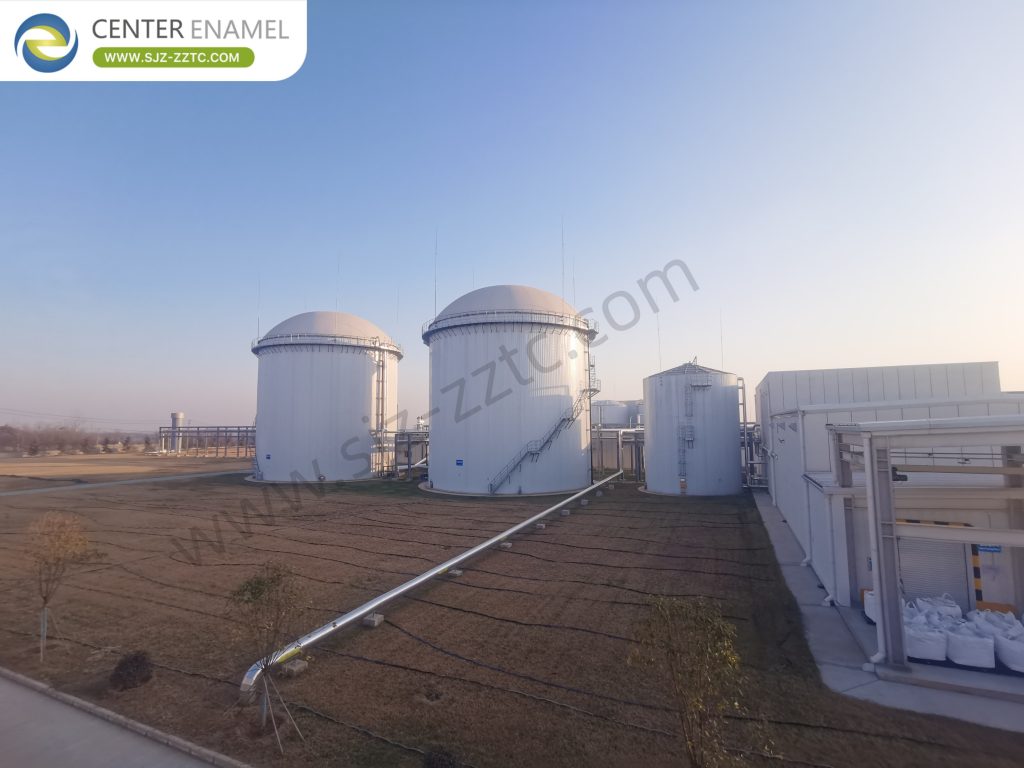
Specifically designed for high-concentration palm oil wastewater treatment with 3 GFS fermentation tanks, each 19.86 m diameter × 8.4 m height. Installation began November 2009 with only 7 construction personnel, completing all tank assembly in 40 days-highly efficient and time-saving. Tanks are fitted with dual-membrane gas storage covers for POME anaerobic digestion-degrading organics and recovering biogas energy while eliminating palm industry pollution. This is an early benchmark POME biogas treatment project in Southeast Asia.
To maintain this level of innovation, a dedicated team is required to continuously push the boundaries of materials science and engineering. Advanced research and development are the engines that drive our ability to provide cutting-edge solutions for our clients. Continuous improvement is our commitment to the global environmental sector.
Center Enamel R&D Team Expertise
Center Enamel has built a full-chain professional team covering R&D, design, marketing, installation, and after-sales. The R&D team is led by national-level materials technology experts, specializing in enamel frit and tank anti-corrosion core technologies. External senior environmental engineering and mechanical structure engineers are retained to strengthen R&D capabilities, focusing on anti-corrosion coating formulations, specialty corrosion-resistant tanks, and anaerobic supporting integrated equipment-continuously breaking through industry technological barriers.
The team operates through proprietary laboratories with external university research collaboration-conducting year-round new material and new process durability pilot testing and long-term corrosion simulation testing. Specialized enamel formulations are iteratively developed for extreme conditions such as high-salinity wastewater, strong acid/alkali POME, and high-organic livestock manure-providing core technical support for the company's annual new invention and utility patents-building a proprietary material technology barrier.
The culmination of this research is a suite of proprietary technologies that set our products apart in the global marketplace. By leveraging these innovations, we ensure that our clients receive the most durable and efficient infrastructure currently available. We are committed to evolving alongside the changing needs of the environment.
Innovative Material Technology
Center Enamel has independently developed over 200 anti-corrosion enamel formulations, with proprietary double-sided double-layer enameling technology-GFS tank anti-corrosion service life exceeds 30 years-far surpassing concrete and ordinary equipment-suitable for global high-corrosion wastewater and biogas fermentation conditions.
FAQ
1.Why is professional Biogas Plant Design critical for energy projects?
Professional Biogas Plant Design ensures that anaerobic digestion systems are optimized for maximum gas yield and waste treatment efficiency. By carefully planning layout, material selection, and process integration, designers can minimize maintenance costs and ensure long-term regulatory compliance, ultimately improving the project's overall return on investment.
2.How does the UASB Process improve wastewater treatment?
The UASB Process efficiently degrades medium-to-high concentration organic pollutants without needing mechanical agitation. By forming a stable sludge bed that promotes microbial activity, it simplifies treatment into a compact, energy-saving system. This makes it an ideal choice for industries requiring robust, reliable, and cost-effective wastewater degradation solutions.
3.What makes GFS tanks the preferred choice for biogas projects?
GFS tanks feature a dense, high-temperature enamel finish that is highly resistant to acids, alkalis, and microbial corrosion. With a service life exceeding 30 years and no need for frequent lining repairs, they provide a reliable, low-maintenance solution that fundamentally eliminates leakage risks compared to traditional concrete tanks.