
Expert Biogas Plant Project Design: High-Performance GFS Tanks Solutions
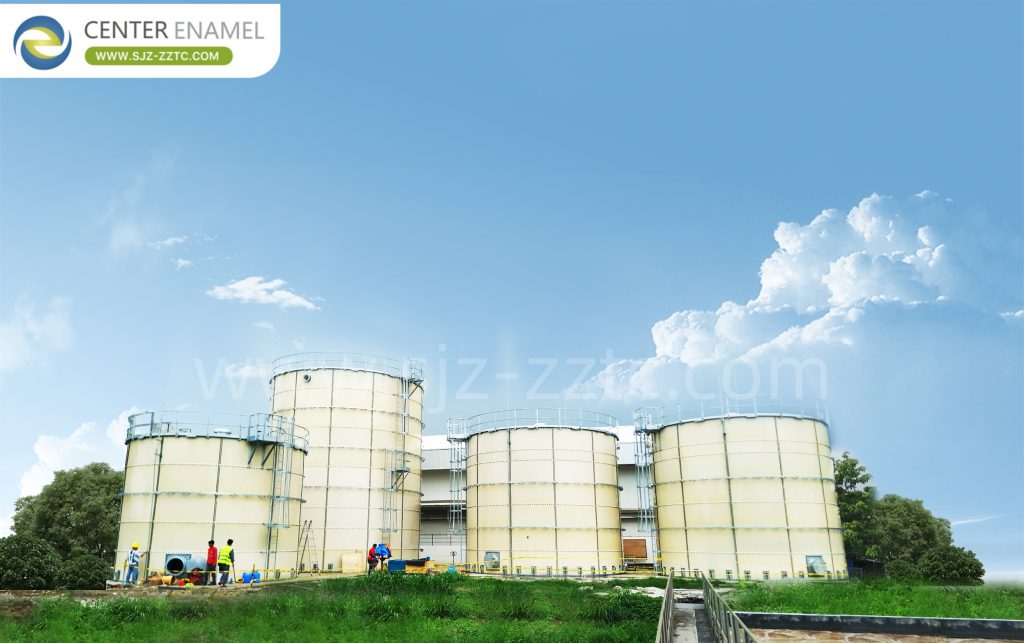
The competitive landscape shows divergence, with leading companies building integrated service capabilities through technical integration and capital operations, and industry concentration gradually increasing. Chinese companies continue to consolidate their advantages in mid-tier equipment exports. International giants target high-end customers and complex industrial wastewater markets, while local players occupy the mid-to-low-end and industrial park centralized treatment markets with service responsiveness and cost advantages. In the anaerobic process segment, UASB, EGSB, and IC anaerobic reactors, with advantages of high loading rates, small footprints, and stable operation, are widely used in high-concentration organic wastewater pretreatment in food processing, pharmaceutical fermentation, alcohol brewing, chemical, and other industries. These reactors use steel tank shells, and their corrosion resistance and gas-tightness directly determine long-term operational stability. The application value of GFS Tanks in such scenarios is increasingly prominent.
As the industry shifts toward high-efficiency treatment, the demand for precise engineering has never been higher. A professional Biogas Plant Project Design approach ensures that every structural element is optimized for long-term reliability. By focusing on superior material standards from the outset, projects can successfully mitigate the risks associated with complex, high-corrosion industrial environments.
Full-Process Factory Standardized for GFS Tanks
GFS tanks are fully factory-prefabricated to standardized specifications, with finished product quality stability far exceeding cast-in-place concrete tanks. All concrete tank processes are completed in the open air, with rebar tying, concrete pouring, and curing heavily influenced by worker skill, temperature, and rainfall. Wall thickness, density, and strength vary significantly between batches, with hidden defects like honeycombing, voids, and insufficient wall thickness common-quality cannot be uniformly controlled. Center Enamel's GFS Tanks steel panels, seals, and reinforcement components are all mass-produced in automated factories. Steel stamping, high-temperature enameling, and dimensional cutting are all controlled by CNC equipment, with each panel's parameters and enamel thickness strictly following unified national standards. All components are uniformly packaged and transported to site, with assembly strictly following standardized construction drawings. Full-process quality inspection from raw materials to finished components ensures highly consistent product performance parameters, completely eliminating the uncontrollable quality risks of on-site concrete construction, with every tank delivering stable, consistent performance.
While high-quality containment systems provide the physical foundation, the choice of internal processes determines the ultimate success of the facility. Advanced reactors are engineered to handle the most challenging waste streams while maximizing output. Implementing these technologies requires a deep understanding of site-specific requirements and operational flow.
CSTR Applicable Scenarios
Primarily for high-solids organic pollutant treatment, widely used in food waste leachate, large-scale livestock manure, slaughterhouse wastewater, and food processing high-strength wastewater. Also suitable for municipal sludge and industrial organic sludge anaerobic digestion. In the agricultural and environmental sector, it is used for large-scale farm manure resource recovery, achieving wastewater reduction, harmless treatment, and energy recovery. In the food and brewing industry, it is suitable for high-oil, high-protein, high-suspended-solids wastewater. It is also suitable for small to medium-sized wastewater treatment projects, township decentralized wastewater treatment, and as a pretreatment process for high-strength organic wastewater in large industrial parks to reduce downstream load. It is particularly suitable for difficult-to-treat organic wastewater with complex composition, high solids content, and easy crusting.
Beyond operational mechanics, project success is fundamentally tied to economic viability and life-cycle costs. When planning, it is crucial to analyze how initial capital investment is balanced against recovered energy and maintenance savings. This holistic view of the project lifecycle is essential for modern environmental infrastructure.
Food Waste Operation and Maintenance Cost Analysis
O&M costs are moderate to high, but resource recovery benefits are substantial-good overall economics. Pretreatment oil removal equipment and three-phase separators have high capital investment, but recovered oil can be sold-biodiesel feedstock oil has good market value, providing core revenue for food waste treatment. Stable biogas from anaerobic digestion can be used for power generation or heating, offsetting energy costs. CSTR process has simple equipment with no precision wear parts-low maintenance costs. High-salt, high-oil conditions require premium corrosion protection (GFS Tanks), with higher initial investment but long service life and low maintenance. Chemical consumption is mainly flocculants and desulfurizers-moderate expenditure. Oil and salt cause pipe fouling and membrane pollution, requiring periodic cleaning-moderate labor requirements. Overall resource recovery revenues (oil sales + biogas energy + digestate fertilizer) generally cover O&M costs-good overall economics.
With a clear understanding of costs and operational goals, developers can leverage global expertise to execute their vision. Center Enamel’s international experience demonstrates that tailored design and reliable support are the cornerstones of successful implementation. Scaling these benefits globally requires a partner who understands both local conditions and international standards.
Center Enamel's Global Market Presence
Center Enamel's global business covers over 100 countries and regions, with 30,000+ successful overseas projects. Products are exported to all major regions including Europe, the Americas, the Middle East, Africa, Southeast Asia, and Latin America, with a well-established global localized service network. Domestically, the company is organized into North, South, Central, East, and Southwest marketing regions, covering environmental, water utility, livestock, and petrochemical customers nationwide. Internationally, the company adopts a "standardized products + localized adaptation" model-adjusting tank corrosion protection, sealing, and pressure standards for different national water quality and environmental regulations-with multiple global landmark projects: large-volume GFS Tanks in Italy, 20 m tower water supply tanks in Colombia, coastal seawater treatment tanks in Costa Rica, large municipal wastewater aluminum dome projects in Saudi Arabia, etc. The company has established long-term stable strategic partnerships with many Fortune 500 companies.
Every project requires ongoing support to maintain peak performance and address technical complexities. Our service model ensures that high-level engineering support is always available, transforming potential challenges into smooth operations. This continuous cycle of support and innovation is how we guarantee project success for the long term.
After-Sales and Technical Support Team
The after-sales team adheres to the service principles of rapid response, professional efficiency, and full-cycle support-providing 24/7 full-lifecycle O&M support to global clients. Standard remote services include fault diagnosis, process parameter adjustment, and tank anti-corrosion maintenance guidance. For domestic and long-distance overseas clients, overseas technical service personnel can be dispatched for on-site inspection, annual inspection, and equipment refurbishment as needed. The team also maintains long-term client feedback tracking mechanisms-regularly collecting tank and anaerobic equipment operational data to continuously optimize product structure and support processes. Supporting external technical expert teams provide specialized support for anaerobic process commissioning, biogas upgrading O&M, and wastewater upgrade/retrofit projects-ensuring long-term stable operation of domestic and overseas projects, continuously improving global client satisfaction and repurchase rates.
To complete the facility, specialized roof structures provide the final layer of protection and functionality. These components must be as durable and well-engineered as the rest of the project to prevent secondary contamination and ensure efficient operation. Choosing the right sealing and roof system is the final step in creating a truly sustainable and robust biogas infrastructure.
Aluminum Alloy Trough Deck Roof Solution
Aluminum Alloy Trough Deck Roof is a cost-effective economical tank cover solution for clean water and wastewater storage scenarios, primarily designed for drinking water, production wastewater, and firewater reserve tanks, balancing practicality and cost advantages. The main body is integrally formed from anti-corrosion aluminum alloy plates, paired with aluminum support trusses. Its lightweight design imposes less load on the tank foundation, reducing civil construction investment.
A naturally formed dense oxide protective layer on the surface resists rain and mild wastewater corrosion, withstands outdoor sun and rain exposure, and effectively blocks wind, rain, insects, fallen leaves, and odor volatilization, protecting water quality by preventing dust and debris from falling in and causing secondary contamination. The flat roof structure is neat and orderly, allowing installation of maintenance walkways, guardrails, vents, and level monitoring ports on top, facilitating daily inspection and equipment maintenance.
The simple sealing structure enables straightforward installation with short construction timelines, and virtually eliminates the need for anti-corrosion painting maintenance, resulting in extremely low operational costs. It is suitable for various small, medium, and large atmospheric pressure water storage tanks, and has been widely implemented in waterworks clear water tanks, industrial circulating water tanks, park firewater tanks, and domestic wastewater temporary storage facilities. It is highly compatible with water storage applications that do not require biogas collection or high-pressure sealing.
FAQs
1.What services are included in Center Enamel’s Biogas Plant Project Design?
We provide comprehensive, turnkey design services, including site assessment, process selection, specialized GFS Tanks engineering, and system integration. Our team ensures that each design is tailored to specific wastewater characteristics, local environmental regulations, and energy recovery targets, providing a complete roadmap from initial concept to commissioning.
2.Why are GFS Tanks preferred for long-term biogas projects?
Our GFS Tanks offer superior corrosion resistance and durability compared to concrete or welded steel. Because they are mass-produced in a factory environment under strict quality control, they ensure a perfect seal and long service life. This reduces long-term maintenance costs and eliminates potential site-based quality issues during installation.
3.How does Center Enamel ensure support for global projects?
We offer a 24/7 full-lifecycle support system, including remote diagnostics and on-site expert dispatch. With projects in over 100 countries, our localized service network provides consistent technical training, equipment maintenance, and process optimization, ensuring that every biogas facility operates at maximum efficiency regardless of its global location.