
Expert EPC Contractor for Biogas Projects: CSTR Process & GFS Tanks Solution
Global industrial wastewater treatment policies are escalating from "compliance discharge" to mandatory "resource recovery" and "zero liquid discharge." The EU, through its Circular Economy Action Plan, requires member states to increase industrial wastewater reuse rates and extends carbon footprint accounting to the full life cycle of wastewater treatment. China continuously updates and tightening industrial water pollutant discharge standards, with increasingly stringent limits on total nitrogen, total phosphorus, and characteristic pollutants for industries such as chemicals, pharmaceuticals, and printing and dyeing. Some water-scarce regions and highly polluting industries are mandated to adopt zero or near-zero liquid discharge technologies. Germany has established a differentiated pretreatment technical standard system by industry, implementing strict source control.
As regulatory requirements tighten globally, industries require more integrated and reliable engineering solutions. Transitioning to sustainable wastewater management is no longer optional but a strategic imperative. Partnering with an experienced EPC Contractor ensures that your facility not only meets current standards but is also prepared for future regulatory shifts.
CSTR Process Definition
CSTR Process, or Continuously Stirred Tank Reactor, is a suspended-growth continuous-flow anaerobic digestion process suitable for high-solids, high-concentration organic pollutant treatment, and is the most widely used classic anaerobic treatment technology. The process relies on a mechanical stirring system to solve the technical challenges of material stratification, sludge sedimentation, and surface crusting in traditional anaerobic reactors. Unlike attached-growth anaerobic processes, CSTR Process requires no media carriers, relying on suspended sludge bacterial communities for degradation reactions. It withstands high-suspended-solids and high-viscosity wastewater shocks, making it the mainstream process for food waste, livestock manure, and municipal sludge anaerobic digestion. The process architecture is simple, operation logic straightforward, and it is adaptable to various high-pollution organic solid-liquid mixed systems.
Implementing a robust anaerobic digestion system is the cornerstone of effective waste-to-energy conversion. To support this advanced process, selecting the right containment technology is essential for ensuring operational longevity and safety. Our expertise bridges the gap between process efficiency and hardware reliability.
Wastewater Sources of Food Waste
Food waste wastewater originates from the resource recovery process of kitchen waste from catering services, canteens, and food processing/distribution-a typical high-concentration organic wastewater in urban solid waste resource recovery. Major sources include food waste pretreatment sorting wastewater, oil separation wastewater, anaerobic digestion digestate, and equipment wash water. Food waste consists primarily of food residues, rich in oils, starches, proteins, cellulose, and salts. Large and medium-sized cities' centralized food waste treatment facilities handle hundreds of tons daily with large continuous wastewater production; smaller facilities produce less volume but with higher concentrations-oil and salt accumulation issues are prominent.
Effective treatment of such high-concentration waste demands specialized equipment capable of resisting chemical corrosion and physical wear. By integrating premium GFS Tanks into your facility design, you ensure that your treatment system maintains high performance despite challenging influent characteristics. We manage the entire lifecycle of these complex projects.
Indonesia Palm Oil Biogas Project
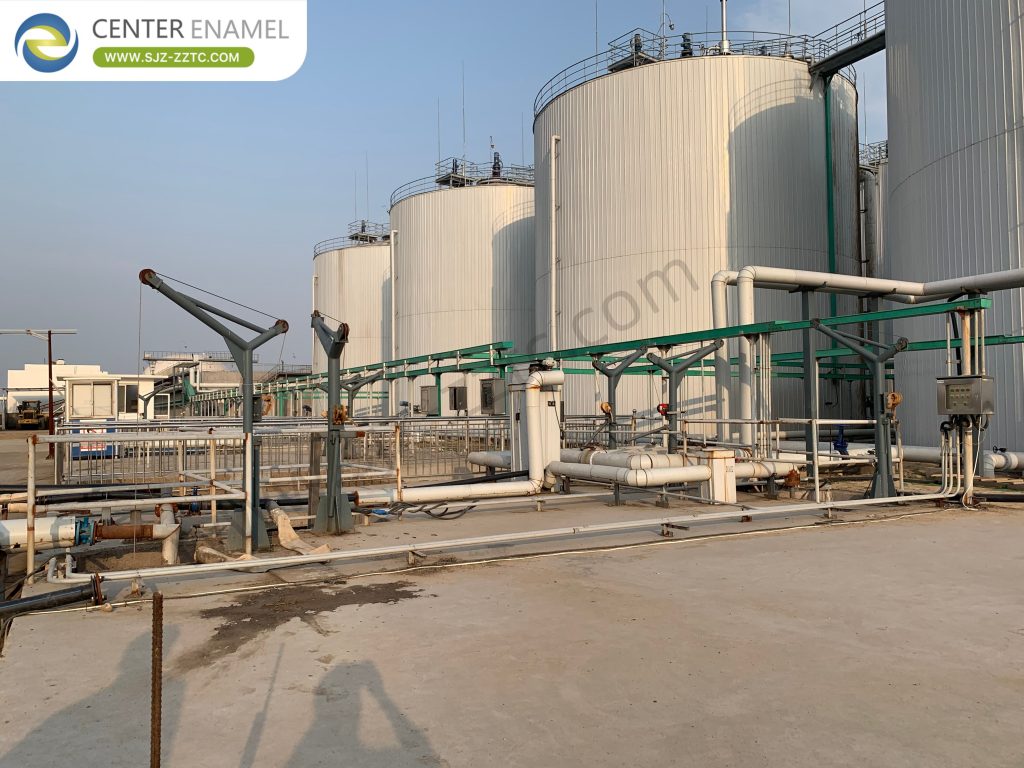
Specifically designed for high-concentration palm oil wastewater treatment with 3 GFS Tanks, each 19.86 m diameter × 8.4 m height. Installation began November 2009 with only 7 construction personnel, completing all tank assembly in 40 days-highly efficient and time-saving. Tanks are fitted with dual-membrane gas storage covers for POME anaerobic digestion-degrading organics and recovering biogas energy while eliminating palm industry pollution. This is an early benchmark POME biogas treatment project in Southeast Asia.
This successful benchmark project demonstrates the value of efficient, modular construction in diverse environmental conditions. As a premier EPC Contractor, we leverage such proven results to optimize every new design and installation. Our goal is to provide scalable energy solutions that perform reliably worldwide.
Center Enamel Development History
Center Enamel has been deeply engaged in the environmental bolted storage equipment field for over 30 years. Starting with proprietary enamel anti-corrosion material technology, the company has gradually completed the full-industry-chain upgrade from a single tank manufacturer to a comprehensive environmental EPC Contractor. Throughout its 30+ year history, the company has been recognized as a National High-Tech Enterprise and successfully delivered over 30,000 environmental projects globally. The company has fully integrated the entire chain from enamel frit R&D to intelligent environmental equipment manufacturing, ensuring every project breakthrough is driven by proprietary core technology.
Three decades of experience have allowed us to master the complexities of both materials science and large-scale project management. We invite you to leverage our extensive track record to simplify your upcoming infrastructure projects. Our commitment to innovation guarantees top-tier performance for your facility.
Center Enamel Innovative Material Technology
Center Enamel has independently developed over 200 anti-corrosion enamel formulations, with proprietary double-sided double-layer enameling technology-GFS Tanks anti-corrosion service life exceeds 30 years-far surpassing concrete and ordinary equipment-suitable for global high-corrosion wastewater and biogas fermentation conditions.
High-performance materials are the backbone of a successful anaerobic facility, ensuring that your investment remains productive for decades. When integrated with advanced engineering, these materials redefine the standards of industrial storage and treatment. Our proprietary technology provides the quality assurance your operations demand.
Glass-Fused-to-Steel Roof Cover Solution
GFS Tanks Roof is a specialized solution designed for high air-tightness, primarily suited for CSTR anaerobic fermentation tanks. Manufactured with the same material system as our assembled tanks, the roof ensures high-level air-tightness, sealing biogas inside to enable recovery and odor control. The product resists long-term corrosion from fermentation slurry and will not delaminate in anaerobic environments. Modular components enable rapid assembly, making it the mainstream reliable choice for large-volume anaerobic fermentation projects.
Providing a total system solution, from foundation to roof, ensures seamless integration and maximum biogas capture efficiency. We prioritize holistic engineering, ensuring every component of your facility works in harmony. Partnering with us means securing a complete, high-efficiency system for your energy goals.
FAQ
1.Why partner with Center Enamel as your EPC Contractor?
We offer end-to-end expertise, from R&D and manufacturing to turnkey project delivery. With 30 years of experience, we provide reliable, high-performance biogas solutions tailored to your unique industrial wastewater needs.
2.How does the CSTR Process enhance biogas recovery?
The CSTR Process ensures thorough mixing of microorganisms and high-solids waste, preventing sedimentation and maximizing biogas output. It is highly efficient for treating complex, viscous industrial or agricultural waste streams effectively.
3.What are the key benefits of GFS Tanks for biogas projects?
GFS Tanks offer superior corrosion resistance and a 30+ year service life. Their modular design allows for fast, cost-effective assembly, ensuring long-term containment stability in harsh, high-corrosion anaerobic fermentation environments.