
How a Professional Biogas Solution Provider Delivers Projects from Feedstock to Gas
The global biogas industry competitive landscape shows divergence. Leading companies dominate major project market shares through the "EPC + Operation" integrated model, while small and medium-sized enterprises focus on county-level distributed projects and specialized equipment segments. China's biogas equipment exports continue to expand, with generator sets primarily flowing to emerging markets. Business model innovation is accelerating, with carbon asset development becoming a standard feature of large projects, converting methane emission reductions into tradable carbon credits. Some countries have piloted digestate fertilizer carbon credit trading, encouraging the integration of digestate application to farmland with carbon accounting. The "biogas operation outsourcing" service model is emerging, improving operational efficiency of county-level projects through professional management.
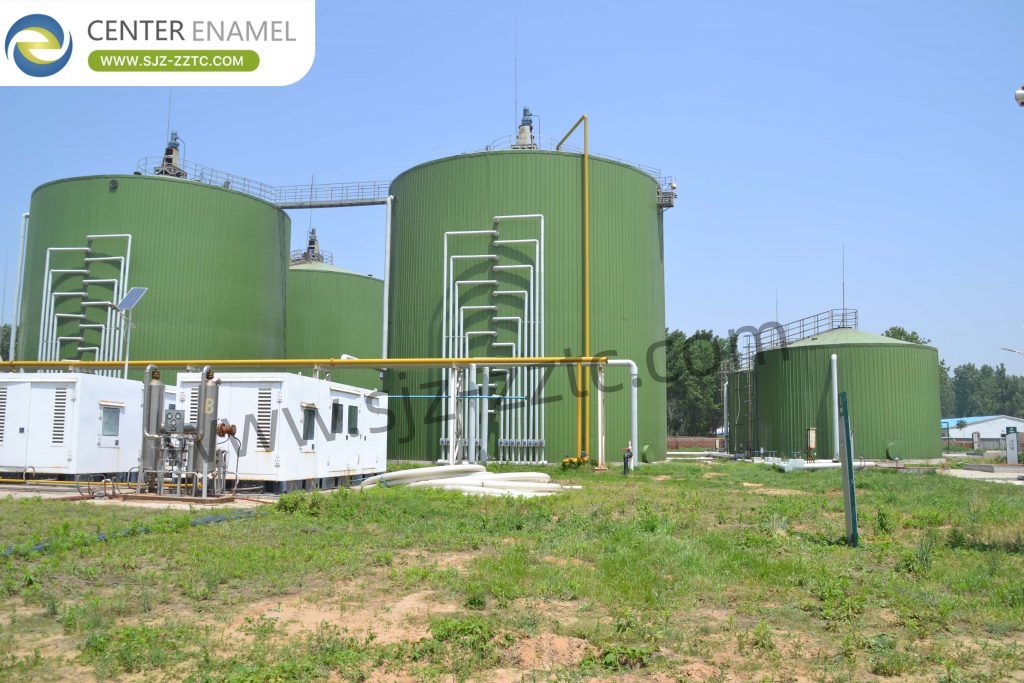
From a technology and equipment perspective, anaerobic digestion is the core process of biogas engineering. GFS Tanks, with their excellent sealing, corrosion resistance, and construction convenience, have become the mainstream choice for large anaerobic digestion tanks. Their modular design can be combined with membrane gas holders to form an integrated "fermentation + gas storage" solution, with penetration rates continuing to rise in new projects in biogas industry clusters.
Why GFS Tanks Are the Mainstream Choice for Modern Biogas Plants
GFS Tanks offer flexible customization of size and appearance, with higher land utilization rates, ideally suited for modern compact plant layouts, with significant advantages over fixed poured concrete tanks. Concrete tanks cannot alter volume or shape after pouring, with heavy bases occupying large areas, making placement difficult on narrow or irregular plots. Their rough, uniform appearance cannot match modern facility aesthetic requirements.
GFS tank volume can be precisely customized as needed, with capacities ranging from dozens of cubic meters to 50,000 cubic meters freely selectable. Tank height and diameter can be flexibly combined to fit narrow or irregularly shaped plots, effectively saving plant land occupation. Enamel color customization is also supported, achieving visual harmony with plant buildings and environmental facilities. During later plant expansion, GFS tanks can be directly adjusted in layout and expanded; concrete tanks, being monolithic structures, must be demolished and rebuilt, offering less flexibility in land resource utilization. This aligns well with the intensive construction and aesthetic operation and maintenance needs of industrial parks.
USR Supporting Equipment: Built for High-Solids Reliability
Core equipment is the GFS Tank with no complex media or precision three-phase separators, featuring a rugged clog-resistant structure. The bottom large-diameter anti-clogging distribution system is suitable for high-solids wastewater, preventing pipe clogging. Supporting equipment includes influent lift pumps, simple pretreatment screens, and equalization tanks for impurity removal and water quality balancing. Simple top gas collection devices and biogas conveying/desulfurization equipment enable biogas resource recovery. Temperature, level, and pH online monitoring equipment ensures process stability. Bottom large-diameter sludge discharge pipes and pumps allow rapid removal of high-concentration residual sludge, suitable for high-solids conditions. The complete system has extremely low failure rates, outstanding wear and clog resistance, and is far easier to maintain than conventional anaerobic processes.
Five Major Biogas Feedstock Sources for Anaerobic Digestion
Biogas plants use organic waste as feedstock to produce biogas through anaerobic digestion-the core technological pathway for biomass energy utilization. As a Biogas Solution Provider, Center Enamel designs systems around five major organic feedstock categories:
(1) Livestock manure (pig, cattle, poultry manure from large-scale farms)-rich in easily degradable organics with high gas production efficiency, the most mainstream biogas feedstock;
(2) Crop straw and agricultural residues (corn stover, wheat straw, rice straw, vegetable waste)-high cellulose/hemicellulose content requiring pretreatment to improve gas yield;
(3) Food waste and kitchen residues-rich in oils, starches, proteins, with high organic loading and large gas production;
(4) Municipal sludge (primary and waste activated sludge from WWTPs)-high solids content, suitable for high-solids anaerobic digestion;
(5) Industrial organic waste residues and liquids (distillers' grains, sugar factory waste, fruit pomace, papermaking black liquor, etc.)-high-concentration organic liquids with excellent gas production efficiency.
Various feedstocks can be digested alone or in co-digestion, with mixed feedstocks providing more balanced nutrition and stable gas production. Core anaerobic processes use CSTR/USR with Center Enamel GFS Tanks as digesters-corrosion-resistant, excellent sealing, ensuring stable anaerobic conditions and efficient biogas production.
Case Study: Ghana Municipal Domestic Wastewater Treatment Project
| Parameter | Specification |
| Location | Ghana |
| Completion Year | 2021 |
| Treatment Capacity | 1,800 m³/day |
| Process | UBF Anaerobic + A²/O Nitrogen/Phosphorus Removal |
| GFS Tanks | 1 UBF Anaerobic Reactor, 1 Secondary Clarifier, 2 Internal/External Double-Layer A²/O Biological Tanks |
| Influent Characteristics | High COD, BOD, Suspended Solids, Nitrogen/Phosphorus |
| Effluent Quality | pH Stable at 6.5–9.0; Meets Local Environmental Discharge Standards |
| Key Advantage | Corrosion-Resistant, Conveniently Assembled GFS Tanks Solve Urban Domestic Wastewater Pollution |
A Marketing Team Built for Global Biogas Projects
The marketing team brings together environmental industry multi-skilled professionals and multilingual foreign trade specialists, with deep expertise in global biogas, wastewater treatment, and biomass new energy markets-accumulating extensive practical project experience in Southeast Asia, Africa, Europe, and the Americas.
The team is proficient in various countries' wastewater discharge regulations, biogas subsidy policies, and carbon trading rules-providing one-stop preliminary site survey, solution planning, and investment return analysis consulting services. With multilingual capabilities (English, French, Spanish, Arabic), the team effectively communicates with clients worldwide-precisely matching regional industrial resources, project budgets, and environmental requirements-customizing high-cost-performance GFS Tanks and anaerobic reactor solutions based on client production capacity, treatment targets, and gas production expectations. Leveraging extensive overseas project experience, the team proactively helps clients avoid risks in overseas approvals, equipment import, and construction implementation-building a globally adaptable integrated environmental equipment business service system.
Certified for Global Project Bidding
Center Enamel holds CE, NSF, WRAS, ISO9001, BSCI, ASME, and other global certifications-fully clearing EU, North American, Southeast Asian, and African project tendering barriers-providing critical hard credential advantages for large overseas project bidding.
Ready to start your biogas project? Contact Center Enamel today for a customized solution-our team will respond within 24 hours.
Frequently Asked Questions
Q1: What makes Center Enamel a reliable biogas solution provider?
A: Center Enamel offers one-stop EPC services covering design, GFS tank manufacturing, installation, and commissioning-backed by 1,000+ biogas projects, international certifications, and multilingual global support teams.
Q2: Why are GFS tanks preferred over concrete tanks in biogas plants?
A: GFS tanks offer customizable volumes up to 50,000 m³, superior sealing and corrosion resistance, faster modular installation, and flexible expansion-while concrete tanks cannot be resized and require demolition for upgrades.
Q3: What feedstocks can Center Enamel biogas systems process?
A: Our systems handle livestock manure, crop straw, food waste, municipal sludge, and industrial organic residues-with CSTR/USR processes and GFS tanks ensuring stable, efficient biogas production.