
Food Waste Treatment: Anaerobic Digestion And Resource Recovery
Food waste treatment is the staged management of separated organic waste - kitchen scraps, supermarket and food-processing discards - so it is diverted from landfill and converted into biogas and a stabilised digestate. A typical route screens and dewaters the feed, digests it in a CSTR or similar anaerobic reactor at 35-38 C, and polishes the side streams; the design is driven by feed dryness, impurity load, and the off-take for gas or compost, not by a single unit.
Why Food Waste Needs Its Own Train
Food waste is not sewage and not raw manure. It arrives as a mixed, often wet stream with 15-30% total solids, high readily-degradable organics, and contaminants such as plastic, bone, and salt. Because the degradable fraction is high, the biogas potential is strong, but the impurities and variable dryness decide the first separator and whether the reactor runs as a wet or dry system. A restaurant stream and a fruit-processing stream therefore need different pre-treatment even though both are 'food waste'.
| Feed property | Typical range | Design impact |
| Total solids | 15-30% | Wet vs dry AD choice |
| Biogas yield | 0.30-0.60 m3/kg VS | Reactor sizing |
| Impurities | Plastic, bone, salt | Sorting + dewatering |
| C:N | Often wide | Co-digestion balancing |
Pre-Treatment Sets The Reactor Up
Separation and dewatering are the first economic step: they remove inerts that would otherwise clog the digester and raise the solids concentration of the fraction sent to the reactor. For very wet, low-solids streams a wet CSTR with mixing suits continuous feeding; for drier discards a plug-flow or dry system reduces heating and water demand. Salt and oil, if present, are capped because both inhibit the methanogens - a real limit, not a marketing caveat.
What Food Waste Becomes
Inside the digester the organics are converted to biogas, roughly 55-65% methane, which can fire a boiler, run a CHP unit, or be upgraded to biomethane. The solid and liquid residues form digestate: the liquid is a fertilizer base after nutrient management, and the fibre can be composted. The energy and the soil product are the two measurable outputs that justify the train.
| Output | Form | Use |
| Biogas | 55-65% CH4 | Heat, CHP, upgrade |
| Liquid digestate | NH3 + P rich | Fertilizer base |
| Fibre | Stabilised solids | Compost / bedding |
Project Case Study: Pakistan Biogas Project
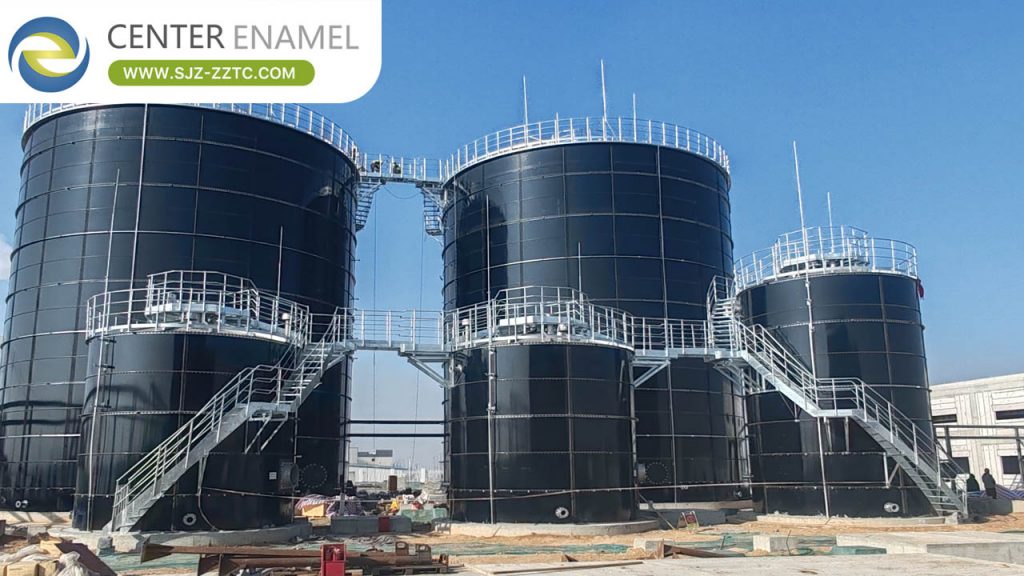
Project / Application: Food waste plus napier grass co-digestion, Pakistan. Industry: Organic waste to energy. Process: CSTR (Continuous Stirred-Tank Reactor). Key Requirements: Convert mixed food waste and Pennisetum purpureum into renewable biogas.
| Field | Value | Source / Evidence |
| Core Technology | CSTR Process | Company project reference |
| Feedstock | Food waste + Pennisetum purpureum | Company project reference |
| Daily Biogas Output | 100 m3/day | Company project reference |
| Application | Waste-to-Energy / Biogas | Company project reference |
| Partner | Center Enamel | Company project reference |
About Company
Shijiazhuang Zhengzhong Technology Co., Ltd (Center Enamel) is a comprehensive high-tech enterprise specializing in wastewater engineering, process section contracting, and equipment manufacturing. The company delivers biogas and wastewater projects through three main lines - EPC (turnkey) contracting, equipment supply, and process packages - covering livestock and municipal wastewater, biomass energy, industrial wastewater, and food waste. Its reactor portfolio spans CSTR, USR, UBF, UASB, IC, and EGSB, backed by in-house Glass-Fused-to-Steel tank manufacturing (enamel firing at 820-930 C) and certifications including ISO 9001, NSF/ANSI 61, and CE-EN 1090. With 35+ years of operation, a 150,000 m2 manufacturing base, and projects in 100+ countries, Center Enamel provides the single-responsibility engineering behind the Pakistan biogas project that applied a CSTR to co-digest food waste with energy crop, producing 100 m3/day of biogas - a scoped organic-waste solution, not a generic package.
Comparison: Wet Versus Dry Food-Waste AD
| Element | Wet CSTR | Dry system |
| Feed TS | Low, pumpable | High, stackable |
| Water demand | Higher | Lower |
| Impurity tolerance | Needs tight sorting | More forgiving |
| Best for | Liquid food discard | Household + market mix |
Food waste treatment is the impurity-aware integration of sorting, dewatering, anaerobic conversion, and digestate use - scoped from feed dryness and contaminants, not from a catalogue reactor.
Frequently Asked Questions
Q1: Can food waste be digested anaerobically? A1: Yes; separated food waste is highly degradable and yields 0.30-0.60 m3 biogas per kg volatile solids in a CSTR at 35-38 C.
Q2: What does food waste become after AD? A2: Biogas (55-65% methane) plus a liquid and fibre digestate used as fertiliser and compost.
Q3: Which reactor suits food waste? A3: A wet CSTR for liquid streams; a plug-flow or dry system for high-solids discards after dewatering.
Q4: How is food waste pre-treated? A4: Mechanical sorting removes plastic and bone, then dewatering concentrates solids before the digester.
Q5: Does food waste AD produce energy? A5: Yes - the biogas can run a boiler or CHP, or be upgraded to biomethane.
Q6: What limits food-waste AD? A6: Salt and oil inhibit methanogens; both are capped during pre-treatment.
Q7: Is co-digestion used? A7: Often, to balance C:N and dilute inhibitors with a complementary feed like energy crop.
Q8: Who scopes the train? A8: An engineer sizes reactors from the feed's solids, impurities, and gas off-take.
Suggested CTA
Send your food-waste volume, dry matter, and gas or compost goal to an engineer, or request a scoped food waste treatment outline.