
Garden Waste to Biogas in Tanzania: GFS Tanks and Double Membrane Roof Solutions for Biogas Project
Tanzania is experiencing rapid urbanization, with cities like Dar es Salaam, Arusha, and Mwanza expanding at an unprecedented pace. This urban growth brings with it a significant increase in organic waste generation, particularly from garden and landscaping activities. In Dar es Salaam alone, it is estimated that the city generates approximately 4,000 tonnes of solid waste per day, with organic matter accounting for the largest fraction. Garden waste—including grass clippings, leaves, branches, prunings, and other vegetative matter—constitutes a substantial portion of this organic stream.
The management of garden waste in Tanzania presents considerable challenges. Current waste collection coverage in major cities remains below 50%, and the majority of collected organic waste is disposed of in unregulated landfills or open dumpsites. These practices release significant quantities of methane, a potent greenhouse gas, into the atmosphere. Furthermore, open burning of garden waste, still common in peri-urban areas, contributes to air pollution and poses serious health risks to local communities. The lack of proper waste segregation and treatment infrastructure means that this valuable organic resource is lost to decay or combustion, representing a missed opportunity for energy recovery and soil enrichment.
Transforming Garden Waste into Renewable Energy
The conversion of garden waste into biogas through anaerobic digestion offers a transformative solution for Tanzania's waste management crisis. This biological process breaks down organic matter—grass, leaves, branches, and other garden trimmings—in an oxygen-free environment. The result is a methane-rich biogas that can be utilized for electricity generation, cooking, heating, or even as a vehicle fuel.
The advantages are compelling and multifaceted. First, anaerobic digestion significantly reduces the volume of waste destined for landfills, conserving valuable space and extending the lifespan of existing disposal sites. Second, the biogas produced represents a clean, renewable energy source that can displace fossil fuels, contributing to Tanzania's energy security and climate goals. Third, the nutrient-rich digestate byproduct serves as an excellent organic fertilizer, improving soil structure and fertility—a particularly valuable asset for Tanzanian smallholder farmers who rely on healthy soils for their livelihoods.
The Core Technology: CSTR Process
The heart of our garden waste-to-energy solution is the Continuous Stirred-Tank Reactor (CSTR). This advanced anaerobic treatment technology ensures that fermentation raw materials and microorganisms remain in a state of thorough and continuous mixing within a sealed tank. The CSTR reactor is equipped with a mechanical stirring device that maintains optimal conditions for microbial activity, including consistent temperature, pH, and nutrient distribution.
By feeding the system continuously or semi-continuously at a controlled temperature, the CSTR Process effectively degrades the high-suspended solids and high-concentration organic matter typical of garden waste. This consistent mixing prevents stratification and acid accumulation, ensuring maximum biogas yield and operational stability. The CSTR's robust design, proven across installations in diverse climates worldwide, makes it particularly well-suited for Tanzanian conditions where feedstock composition can vary significantly with seasonal changes.
Center Enamel: Expert Design for Your Biogas Project
With over 36 years of commitment to water, wastewater, and Biogas Projects, Center Enamel stands as a dedicated Engineering, Procurement, and Construction (EPC) contractor. The company brings world-class expertise to Tanzania, delivering high-performance solutions tailored to the nation's specific environmental and operational conditions.
Our engineering team conducts detailed assessments to calculate specific organic loading rates, hydraulic retention times, and expected biogas yields based on waste characteristics and project goals. We design according to international standards including AWWA D103, EN ISO 28765, and EuroCode, ensuring our systems withstand Tanzania's diverse climate—from the humid coastal conditions of Dar es Salaam to the temperate highland regions. As Asia's largest manufacturer of Glass-Fused-to-Steel (GFS) tanks, Center Enamel provides robust infrastructure essential for long-term Biogas Project success. With a 150,000m² R&D and production base and annual production capacity of 250,000 tank sheets, we deliver precise, reliable, and bankable solutions for projects of any scale.
Premium Products for Superior Biogas Storage: GFS Tanks and Double Membrane Roof
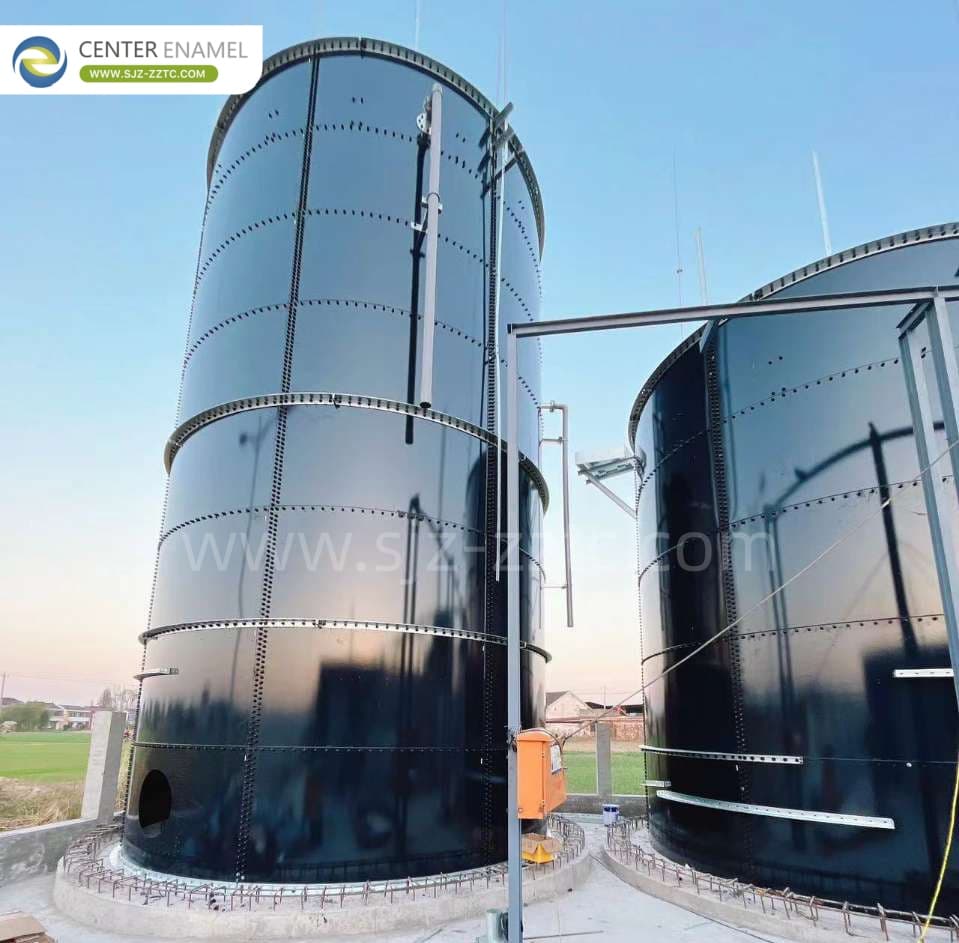
Center Enamel is globally recognized for its premium GFS Tanks. Manufactured using specialized Glass-Fused-to-Steel technology, these tanks are fired at temperatures between 820°C and 930°C. This process creates an inert, inorganic bond that combines the strength and flexibility of steel with outstanding corrosion resistance—making them the ideal choice for containing the chemically aggressive materials found in anaerobic digestion.
Complementing our robust tanks is the Double Membrane Roof—the preferred roof solution for anaerobic digestion applications. This innovative system offers exceptional air-tightness through a double-layered membrane design. The Double Membrane Roof allows variable gas storage within a compact footprint, eliminating the need for separate ground-mounted gas holders. This significantly reduces required land area, saves foundation construction costs, and simplifies site layout. The outer membrane withstands Tanzania's intense sunlight and weather extremes, while the inner membrane maintains constant gas pressure for stable biogas delivery and odor control.
Diverse Tank Cover Solutions for Every Need
In addition to the Double Membrane Roof, Center Enamel offers various tank cover solutions to meet specific application requirements:
Aluminum Geodesic Dome Roof: Provides expansive clear-span capability, advanced corrosion resistance, and cost-effective construction for many storage applications.
Glass-Fused-to-Steel Roof: This cone-shaped roof, supported by internal or external beams, provides excellent air-tightness for pressurized structures and odor control.
Aluminum Alloy Trough Deck Roof: An economical option suitable for potable water, wastewater, and firewater storage, providing protection without requiring air-tightness.
Stainless Steel Roof: Offers superior anti-corrosion performance and long service life, ideal for harsh environments and air-tight applications.
FRP Roof: This dome or flat-shaped roof suits applications not requiring air-tightness, such as drinking water and agricultural storage.
Comprehensive Biogas Plant Auxiliary Equipment
A successful Biogas Project requires more than storage tanks. Center Enamel supplies a complete suite of auxiliary equipment ensuring seamless plant operation:
Gas Holder: For safe and reliable biogas storage.
Black Membrane: Used for covering lagoons in secondary storage or wastewater management.
Solid-liquid Separator: For separating digestate into solid and liquid fractions.
Torch System: An essential safety feature for controlled combustion of excess gas.
Lifting Pump: For reliable movement of wastewater and sludge between process units.
Dehydration and Desulfurization Tank: Purification system removing moisture and corrosive hydrogen sulfide from biogas.
Screw Sludge Dewatering Machine: For reducing residual biosolids volume.
Efficient Installation of GFS Tanks
Center Enamel's GFS Tanks are designed for efficient and rapid installation—a crucial advantage for Tanzanian projects where infrastructure and logistics can present challenges. Our tanks arrive as prefabricated modular panels and assemble on-site using bolted construction methods:
Speed: Significantly reduced construction time compared to field-welded or concrete alternatives, allowing projects to become operational faster.
Quality Control: Factory-controlled manufacturing ensures the highest quality standards, with each panel inspected before shipment.
Logistics: Modular panels are easier to transport and handle, particularly valuable in locations with challenging road conditions or limited access.
Long-term Durability: Factory-applied glass coating guarantees a long service life with minimal maintenance, saving time and resources for project owners over decades of operation.
Center Enamel: Your One-Stop Solution Provider in Tanzania
Center Enamel serves as your single point of contact and responsibility for a complete Biogas Project in Tanzania. As a full-service EPC contractor, we offer:
Comprehensive Services: From initial design and engineering to procurement, construction, commissioning, and after-sales support.
Customized Solutions: Systems designed specifically to meet unique project requirements and waste characteristics, ensuring optimal performance.
Proven Technology: Industry-leading solutions including our premium GFS Tanks, advanced Double Membrane Roof, and efficient CSTR Process.
Global Standards: Design and manufacturing to international standards including AWWA D103, EN ISO 28765, NSF61, and WRAS.
Local Support: We provide expert installation and training for local personnel, ensuring long-term operational success.
Project Case Studies
Center Enamel has successfully delivered biogas projects globally, demonstrating our capability to manage complex installations:
Biogas Project in France
Process: CSTR
Tank dimensions: φ18.33m x 8.4m (H) (1 unit)
Total volume: 2,215 m³ (1 unit)
Completion year: 2021
Biogas Project in Canada
Tank dimensions: φ8.4m x 7.2m (H) (2 units)
Total volume: 798 m³
Completion year: 2024
Conclusion
Converting Tanzania's abundant garden waste into a valuable energy resource represents a critical step toward a sustainable and circular economy. With urban centers generating increasing quantities of organic waste and landfill space rapidly diminishing, the need for modern waste-to-energy solutions has never been more urgent. Center Enamel, as a leading EPC contractor, is uniquely positioned to deliver state-of-the-art Biogas Projects that combine our premium GFS Tanks, advanced Double Membrane Roof technology, and proven CSTR Process. By choosing Center Enamel, you are not just investing in waste treatment infrastructure—you are investing in a cleaner, more sustainable, and energy-secure future for Tanzania.
Frequently Asked Questions
1.What is the optimal retention time for garden waste in a CSTR system?
The hydraulic retention time for garden waste in a CSTR Process typically ranges from 20 to 40 days, depending on the specific feedstock composition and operating temperature. Our engineering team conducts detailed analysis to determine the optimal retention time for each specific project.
2.Can the Double Membrane Roof withstand extreme weather conditions common in Tanzania?
Yes, the Double Membrane Roof is engineered to withstand diverse climate conditions, including the intense UV radiation and heavy rainfall experienced in Tanzania. The outer membrane is specifically designed for weather resistance, while the inner membrane maintains gas pressure integrity.
3. What maintenance does a GFS Tank require in a biogas application?
GFS Tanks require minimal maintenance due to the durable glass coating. Routine inspections of seals, bolted connections, and the glass surface are recommended. The non-corrosive nature of the glass coating means the tank itself requires no repainting or protective coatings over its service life.