
How Does IC Process and GFS Tank Make Chemical Wastewater Treatment More Efficient?
Chemical wastewater ranks among the most difficult industrial effluents to treat. Its composition shifts with every production batch, pollutant loads spike unpredictably, and biodegradability is often poor. Yet the competitive landscape is shifting: leading companies are building integrated service capabilities, industry concentration is rising, and anaerobic technologies like UASB, EGSB, and IC reactors are proving their value in high-concentration organic wastewater pretreatment across chemical, pharmaceutical, and food processing sectors. Among these, the IC Process stands out for its ability to handle shock loads while occupying minimal land-a critical advantage for chemical plants operating within constrained industrial zones.
What Makes Chemical Wastewater So Challenging to Treat?
Chemical wastewater presents a combination of extremes that defeats conventional treatment approaches. COD typically ranges from 5,000 to 80,000 mg/L, with coal chemical high-strength streams exceeding 100,000 mg/L. BOD/COD ratios fall below 0.25, signaling poor biodegradability driven by synthetic refractory macromolecules. The wastewater carries benzene series, phenols, cyanides, sulfides, halogenated hydrocarbons, and other toxic characteristic pollutants. Salinity reaches tens of thousands to over 100,000 mg/L, dominated by sodium chloride and sodium sulfate. pH swings wildly between strong acid and strong alkaline batches. Color is deep, odor is strong, and some streams contain heavy metal ions. Water quality and quantity vary dramatically with production cycles, creating frequent shock loads that make biochemical system acclimation extremely difficult. Any treatment train must be designed for instability, not steady-state operation.
How Does IC Process Rise to the Chemical Wastewater Challenge?
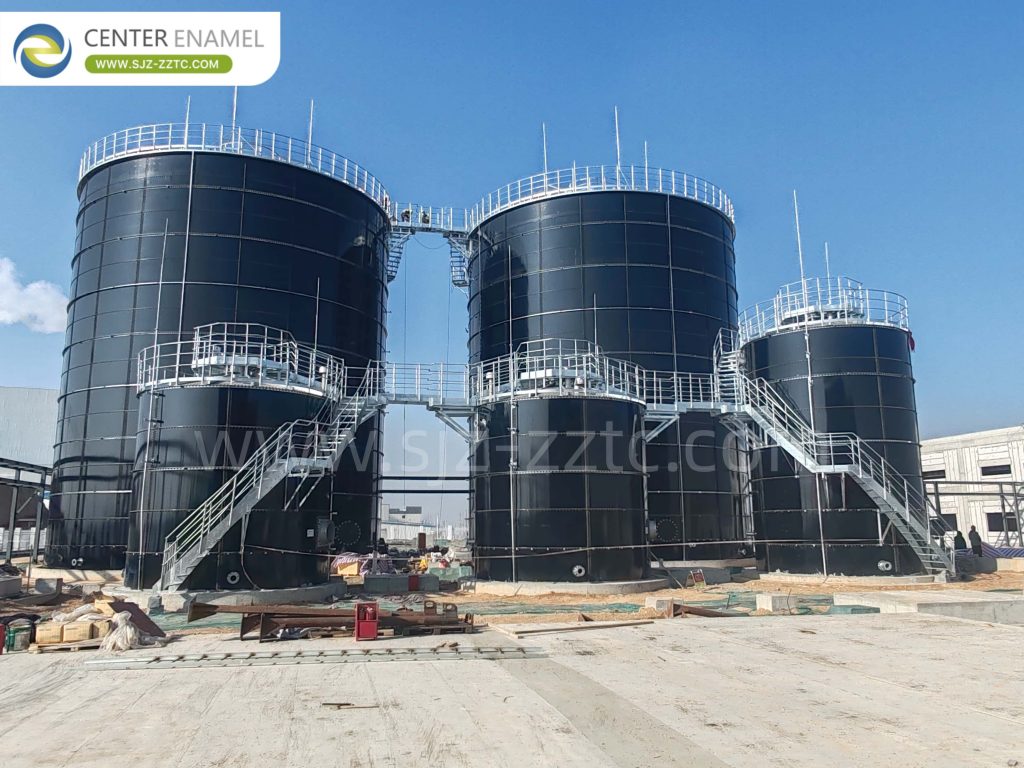
The IC Process-Internal Circulation Anaerobic Bioreactor-was developed as a third-generation anaerobic technology building on UASB principles. Its defining feature is the biogas-driven internal circulation that returns degassed mixed liquor from the upper gas-liquid separator to the reactor bottom, creating autonomous circulation without external pumping energy. For chemical wastewater, this design delivers three practical advantages. First, the internal circulation dilutes incoming toxic or shock loads, protecting the anaerobic biomass from inhibition. Second, the high upflow velocity keeps granular sludge in an expanded state, maximizing contact between microorganisms and pollutants even when the substrate is recalcitrant. Third, the two-stage anaerobic zone configuration provides a polishing effect: most degradation occurs in the first zone, while the second zone captures residual organics with minimal biogas disturbance, ensuring stable effluent quality. The reactor height of 16–25 meters accommodates high volumetric loading rates within a compact footprint-crucial for chemical plants where land is scarce and expansion is constrained.
Why Does GFS Tank Construction Matter for IC Reactor Longevity?
IC reactors for chemical wastewater operate in a hostile internal environment: sulfide-rich biogas, fluctuating pH, and corrosive intermediates. The tank shell’s corrosion resistance and gas-tightness directly determine long-term operational stability. Glass-Fused-to-Steel (GFS) tanks address this requirement through factory-controlled manufacturing that cast-in-place concrete cannot match. GFS panels are mass-produced in automated facilities, with steel stamping, high-temperature enameling, and dimensional cutting controlled by CNC equipment. Each panel’s parameters and enamel thickness follow unified national standards. All components are packaged and transported to site, then assembled according to standardized drawings. Full-process quality inspection from raw material to finished panel eliminates the hidden defects-honeycombing, voids, insufficient wall thickness-that plague on-site concrete construction. The result is a reactor shell with consistent performance and a service life exceeding 30 years, even in chemical service.
What Does Global Project Experience Reveal About IC Process Reliability?
Center Enamel’s manufacturing base spans over 150,000 m² in Hebei Province, with dual-phase facilities, dedicated material laboratories, and finished product testing centers operating under ISO, NSF, and CE standards. The company has deployed GFS tanks and anaerobic process solutions across more than 90 countries, with over 10,000 equipment and project installations. In 2009, the first overseas GFS tank installation was completed in Niger, Africa. In 2015, Center Enamel became the first Chinese GFS tank manufacturer to export and install in the United States, passing strict US acceptance standards. Construction experience covers Southeast Asia, Africa, the Americas, and other regions, with specialized solutions for mountainous terrain, coastal salt spray, tropical high temperatures, and high-standard European/American facility conditions. For chemical wastewater treatment specifically, this global footprint means IC Process configurations have been validated across diverse climates, regulatory regimes, and wastewater characteristics.
Table 1: IC Process Performance Characteristics for Chemical Wastewater
| Parameter | Specification / Range |
| Reactor height | 16–25 m |
| COD range (chemical wastewater) | 5,000–80,000+ mg/L |
| BOD/COD ratio | Typically below 0.25 |
| Salinity tolerance | Up to 100,000+ mg/L (NaCl/Na₂SO₄) |
| Internal circulation drive | Biogas lift (no external pumping) |
| Tank shell material | GFS, service life >30 years |
| Footprint | Compact; suitable for land-constrained plants |
Table 2: Global Manufacturing & Project Snapshot
| Metric | Detail |
| Manufacturing base area | >150,000 m² (Hebei, China) |
| International standards | ISO, NSF, CE |
| Countries served | 90+ |
| Total projects completed | 10,000+ |
| First overseas GFS installation | Niger, Africa (2009) |
| First US GFS export | 2015 |
| Specialized site solutions | Coastal salt spray, tropical heat, mountainous terrain |
What Support Does Center Enamel Provide Beyond the Reactor?
A chemical wastewater treatment project involves more than selecting an anaerobic process. Center Enamel’s integrated service capability covers engineering design, equipment manufacturing, installation and commissioning, and construction-a full-chain delivery model refined over more than three decades in the environmental industry. For chemical clients, this means the IC Process reactor, the GFS tank shell, the gas-liquid separation system, and the biogas handling equipment arrive from a single accountable source. The company operates six marketing service centers across China and maintains a global localized agent network, ensuring that commissioning support and spare parts access remain available long after project handover. Whether the project requires a stand-alone IC reactor or an integrated anaerobic-aerobic treatment train, the engineering and manufacturing are coordinated under one roof.
Frequently Asked Questions
Q: Can IC Process handle chemical wastewater with high salinity?
A: Yes. IC reactors have demonstrated stable operation with inorganic salt concentrations reaching tens of thousands to over 100,000 mg/L, primarily sodium chloride and sodium sulfate.
Q: What COD removal efficiency can IC Process achieve?
A: For high-strength chemical wastewater, IC reactors typically achieve rapid COD reduction in the first anaerobic zone, with the second zone polishing residual organics for stable effluent quality.
Q: How long does a GFS tank IC reactor last in chemical service?
A: The GFS enamel coating provides corrosion resistance for a service life exceeding 30 years, even in sulfide-rich and pH-fluctuating chemical environments.
Send us your chemical wastewater characteristics and we will return a preliminary IC Process configuration with footprint and loading estimates.
Contact Center Enamel to discuss how an IC Process reactor can bring stable, compact anaerobic treatment to your Chemical Wastewater Treatment project.