
GFS Tanks & Anaerobic Technologies for Livestock Wastewater Treatment
Livestock farms need more than a tank and a process-they need an integrated system that can handle high-strength organic wastewater, withstand aggressive manure chemistry, capture biogas safely, and keep running for decades with minimal intervention. Center Enamel provides exactly that by combining advanced Anaerobic Technologies with proprietary GFS Tanks and purpose-built gas storage covers. From policy-driven compliance to energy recovery, every element is engineered to work together. This guide explains the regulatory context, the climate resilience of GFS Tanks, the USR process, the characteristics of livestock wastewater, and the membrane roof systems that complete a modern biogas facility.
The Global Policy Shift Reshaping Livestock Manure Management
The regulatory environment for livestock manure is changing fast, and it shapes every treatment decision farms make today. The global livestock manure treatment policy system, with the US and EU as typical representatives, is shifting from end-of-pipe treatment to full-process nutrient management. The US establishes a manure management framework covering the entire livestock production process through Comprehensive Nutrient Management Plans. The EU, through the Nitrates Directive, strictly limits manure application amounts, with Germany and the Netherlands using tax instruments to mandate nitrogen and phosphorus recovery rates, and Denmark demonstrating distinctive features in livestock regulation and ecological compensation. The Netherlands uses a management mechanism linking manure treatment with phosphate quotas. China has issued a series of environmental regulations, with the current legal system providing comprehensive regulation of pollution from large-scale livestock operations.
These converging policies point in one direction: manure must be treated, nutrients must be recovered, and emissions must be controlled. Meeting that standard reliably depends on durable infrastructure and proven Anaerobic Technologies working as one system.
GFS Tanks Built to Survive Extreme Climates and Seismic Zones
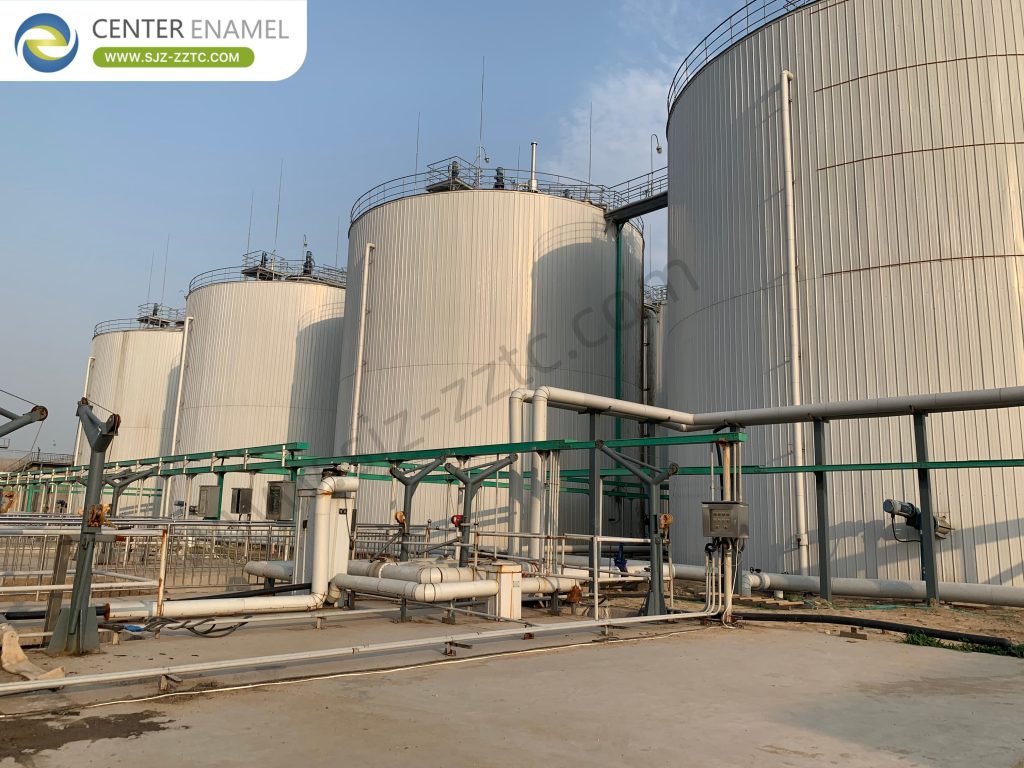
Because livestock facilities are often located in remote or exposed areas, tank durability becomes a foundational requirement. GFS Tanks can undergo customized wind and seismic design based on project site climate and geological conditions, with environmental adaptability far superior to concrete tanks. Concrete tanks are cast-in-place monolithic structures, with seismic and wind resistance entirely dependent on on-site construction quality. In remote areas, typhoon-prone zones, and earthquake belts, construction quality is difficult to control. Under strong earthquakes or typhoons, concrete tanks are prone to cracking and base settlement damage, with subsequent reinforcement costs equivalent to rebuilding.
GFS Tanks take a fundamentally different approach. Before construction, local seismic intensity, maximum wind pressure, and foundation bearing capacity data are collected, with customized thickened steel panels, stiffening ribs, and anchored base components-all factory-prefabricated to standardized specifications. The bolted panel structure has excellent stress distribution capability, making it less prone to overall fracture under seismic and typhoon impacts, and minor foundation settlement will not cause through-cracking. Structural parameters can be flexibly adjusted for mountainous, coastal typhoon-zone, and high-seismic-zone projects, providing long-term protection against extreme natural climate damage. For any deployment of Anaerobic Technologies in the field, this resilience protects both the investment and the treatment performance.
Inside the USR Process-A Definition Built for High-Solids Wastewater
With containment secured, the biological core of the system comes into focus. USR, or Upflow Solids Reactor, is an upflow anaerobic process modified for high-suspended-solids, high-solids organic wastewater, specifically designed to solve problems of clogging, sludge washout, and uneven reaction common in traditional anaerobic processes for high-solids wastewater.
The process eliminates complex three-phase separators, simplifies internal structure, and relies on upflow hydraulics to promote thorough mixing of solid materials and anaerobic sludge. No strict granular sludge formation conditions are required-flocculent sludge can operate stably. The key feature is high solids tolerance and impurity resistance, with very high influent suspended solids tolerance. It is a dedicated high-efficiency anaerobic process for livestock manure, agricultural organic waste, and high-solids livestock wastewater, specifically developed for agricultural and environmental applications. Among available Anaerobic Technologies, the USR process stands out for its simplicity and forgiveness of real-world farm conditions.
Where Livestock Wastewater Comes From and Why It Varies So Much
Understanding the influent is essential to designing the right system. Livestock wastewater is the core agricultural pollution wastewater from large-scale poultry, livestock, and aquaculture operations, generated primarily during farming operations and facility cleaning. Poultry and livestock wastewater is the main component, including wash water from pig, cattle, and poultry housing, manure and urine seepage, and facility washdown-rich in livestock metabolic residues. Aquaculture wastewater comes from periodic pond water exchange and pond cleaning, with feed residues and metabolic waste as pollutants.
Wastewater is primarily generated in peri-urban and rural farming areas. Small-scale farmers lack adequate collection facilities, with wastewater discharged directly to land and water. Large-scale farms have collection systems for centralized treatment, with water production varying with production cycles and cleaning frequency. This variability-combined with high solids and high organic load-is precisely why robust GFS Tanks and adaptable Anaerobic Technologies are necessary rather than optional.
Manpower and Construction Capability Behind Every Installation
Even the best technology depends on skilled execution. Center Enamel has established its own domestic and international certified construction teams, with regular practical training on GFS tank installation and overseas construction standards for various countries. Domestically, regional construction teams cover multiple zones, capable of simultaneously deploying multiple teams for large tank farm projects. Internationally, cross-border professional installation teams are equipped to various country construction standards-sufficient manpower reserves ensure uninterrupted construction delivery for remote African sites, high-standard European and American facilities, and other projects. This construction depth is what allows complex Anaerobic Technologies to be delivered reliably across geographies.
Innovative Material Technology That Extends Tank Service Life
The foundation of that reliability is materials science. Center Enamel has independently developed over 200 anti-corrosion enamel formulations, with proprietary double-sided double-layer enameling technology-GFS tank anti-corrosion service life exceeds 30 years-far surpassing concrete and ordinary equipment, and suitable for global high-corrosion wastewater and biogas fermentation conditions.
Table 1: Center Enamel GFS Tank Material and Construction Capabilities
| Capability | Specification | Benefit |
| Enamel Formulations | 200+ proprietary anti-corrosion formulas | Adapted to diverse wastewater chemistry |
| Enameling Technology | Double-sided, double-layer | Superior barrier against corrosion |
| Service Life | Exceeds 30 years | Lower lifecycle cost than concrete |
| Construction Teams | Domestic and international certified crews | Uninterrupted global delivery |
| Domestic Coverage | Multiple regional teams | Parallel deployment for large projects |
| International Standards | Trained to various country codes | Compliance in Africa, Europe, Americas |
| Climatic Design | Customized wind and seismic parameters | Protection in extreme environments |
Single and Double Membrane Roofs for Biogas Capture and Storage
A digester's performance also depends on how well its gas is contained. Single and Double Membrane Roofs are proprietary airtight tank cover systems for anaerobic digestion and biogas storage projects, specifically developed for biogas collection and odor containment, representing a benchmark lightweight sealing solution for fermentation tanks.
The single-layer membrane roof features a simple structure with economical cost, meeting basic biogas containment needs. The double-layer membrane roof consists of inner and outer corrosion-resistant membrane materials, with pressurized air in the interlayer forming rigid support, providing outstanding thermal insulation that reduces biogas condensate formation inside the tank, with enhanced wind and snow load resistance suitable for high-altitude and windy outdoor sites.
The membrane material is specialized aging-resistant and biogas-slurry-corrosion-resistant PVDF membrane, which will not leak or degrade from long-term contact with biogas or hydrogen sulfide. The flexible structure accommodates tank settlement and slight deformation without cracking or gas leakage. The lightweight design eliminates heavy steel support trusses, significantly reducing the load on the tank and foundation, saving construction costs.
The roof integrates biogas outlets, safety pressure relief valves, and access channels, fully enabling closed gas collection for anaerobic fermentation tanks, recovering biogas for power generation and heating while blocking odor diffusion to meet environmental odor control requirements. It is widely used in large-scale livestock biogas projects, municipal sludge anaerobic digestion, and food waste fermentation projects, compatible with large-volume glass-fused-to-steel anaerobic tanks, with fast construction and simple maintenance requiring only periodic membrane seal integrity checks, offering significant overall engineering advantages.
Table 2: Membrane Roof Options for Biogas Storage Projects
| Feature | Single-Layer Membrane Roof | Double-Layer Membrane Roof |
| Structure | Simple, single membrane | Inner and outer membranes with pressurized interlayer |
| Cost | Economical | Higher initial investment |
| Thermal Insulation | Basic | Outstanding; reduces condensate |
| Wind and Snow Load | Standard | Enhanced resistance |
| Best Suited For | Basic biogas containment | High-altitude, windy, cold sites |
| Membrane Material | PVDF, aging and corrosion resistant | PVDF, aging and corrosion resistant |
| Gas Collection | Closed biogas capture | Closed biogas capture |
| Maintenance | Periodic seal checks | Periodic seal checks |
From GFS Tanks and USR process design to membrane biogas storage and global construction, Center Enamel delivers the complete infrastructure your farm or project requires. Reach out to our engineering team today for a customized treatment and biogas recovery plan. Let us show you how our Anaerobic Technologies and proven tank systems have supported livestock projects across 100+ countries.
Frequently Asked Questions
What Anaerobic Technologies does Center Enamel provide for livestock wastewater?
We deliver USR and CSTR anaerobic processes tailored to high-solids manure wastewater, integrated with GFS Tanks, biogas collection, desulfurization, and monitoring equipment as a complete system.
Why are GFS Tanks preferred over concrete for biogas digesters?
GFS Tanks use double-layer enamel fired at high temperature, resisting ammonia and hydrogen sulfide corrosion while withstanding seismic and typhoon loads-delivering 30+ years of service with minimal maintenance.
How is biogas captured and stored in these systems?
Single or double membrane roofs provide airtight biogas collection. The double-layer version adds thermal insulation and wind resistance, and both use PVDF membrane resistant to hydrogen sulfide degradation.