
GFS Tanks and Double Membrane Roof: Anaerobic Solutions for Philippines Livestock Waste-to-Energy
The Philippines is an archipelago of more than 7,000 islands, and this geography presents unique energy challenges. While major cities like Manila and Cebu enjoy relatively stable power, many rural areas across Luzon, Visayas, and Mindanao face frequent brownouts, voltage fluctuations, and high electricity costs. For livestock farmers in provinces such as Nueva Ecija, Bulacan, Batangas, Iloilo, and Davao, unreliable power disrupts water pumping, feed milling, egg incubation, and milk cooling. Diesel generators offer a backup but come with rising fuel expenses that strain farm budgets.
At the same time, the country’s agricultural sector generates millions of tons of animal manure each year-waste that often ends up in rivers or open fields, releasing methane and contributing to water pollution. This combination of energy instability and waste accumulation calls for practical, on-farm solutions. Modern Anaerobic Solutions provide a proven pathway, transforming livestock waste into a dependable, renewable energy source while protecting the environment.
Advantages of Converting Livestock Manure and Wastewater to Biogas
The Philippines has a substantial livestock sector, including cattle, carabao (water buffalo), pigs, goats, and poultry. These animals produce large volumes of manure and organic wash water every day. Without proper treatment, this waste emits greenhouse gases, contaminates groundwater, and creates odors that affect nearby communities. A well-designed anaerobic digestion system completely changes this picture, converting an environmental problem into a productive farm asset. Key advantages for Filipino farmers and cooperatives include:
Energy security - Biogas, typically containing 55-70% methane, can power generator sets, boiler systems, or direct cooking appliances, providing electricity and heat even in remote off-grid locations.
Reduced operating expenses - Generating energy on-site lowers diesel purchases and electricity bills, directly improving farm profitability over time.
Climate benefits - Methane capture prevents harmful emissions from reaching the atmosphere, and projects may qualify for carbon credit programs that generate additional revenue.
Fertilizer value - The byproduct of anaerobic digestion (digestate) retains essential nutrients including nitrogen, phosphorus, and potassium, improving soil health and reducing dependence on expensive synthetic fertilizers.
Good neighbor relations - Treating organic waste reduces odors and water pollution, helping farms maintain positive relationships with surrounding villages.
For Filipino dairy farmers, pig producers, and poultry growers, Anaerobic Solutions represent a practical, financially sound investment that turns waste from a liability into a valuable resource.
Center Enamel: Professional Anaerobic Project Design and Engineering
With over 36 years of industry experience, Center Enamel has established itself as Asia’s largest manufacturer of Glass-Fused-to-Steel (GFS) tanks and a comprehensive provider of turnkey anaerobic systems. Starting from enamel frit production, the company has grown into an integrated EPC (Engineering, Procurement, and Construction) contractor specializing in Anaerobic Solutions.
Center Enamel holds internationally recognized certifications, including CE/EN1090, ISO9001, NSF61, WARS, and EN28765, and follows established design standards such as AWWA D103, OSHA, and EuroCode. The company’s service portfolio includes feasibility studies, process engineering, equipment fabrication, site construction, and practical operator training. For Filipino farms, agricultural cooperatives, and food processing operations, Center Enamel delivers rugged systems that are carefully tailored to local climate conditions, available feedstocks, and specific project scales-ensuring long-term reliability and strong returns on investment.
Pre-treatment Stage and CSTR Process: The Core of Anaerobic Solutions
Every successful anaerobic installation begins with proper preparation of the incoming feedstock. Center Enamel’s pre-treatment stage includes several integrated steps that protect downstream equipment and enhance biological performance:
Screening - Removes large solids such as plastic bags, stones, ropes, and other debris that could clog pipes or damage internal components.
Crushing - Reduces particle size to increase the surface area of organic matter, making it more accessible to anaerobic bacteria.
Sand settling - Eliminates heavy grit and inorganic particles that would otherwise accumulate and cause mechanical wear over time.
Homogenization tank - Balances variations in flow rate and organic concentration, ensuring steady, predictable conditions for the biological reactor.
Following pre-treatment, the core of the system is the CSTR Process. CSTR stands for Continuous Stirred-Tank Reactor, an advanced anaerobic digestion technology in which fermentation materials and microorganisms remain in a completely mixed state inside a sealed vessel. A mechanical agitator operates continuously or semi-continuously while the temperature is maintained within the mesophilic range (typically 35-37°C). This constant mixing delivers three critical benefits: it prevents solid particles from settling at the bottom, stops scum layers from forming on the surface, and maximizes contact between bacterial populations and incoming organic matter.
As a result, the CSTR Process achieves high organic removal efficiency and stable biogas production, even with challenging Filipino feedstocks such as poultry litter, carabao manure, or pig slurry that contain high levels of suspended solids. Biogas is continuously collected from the tank roof, while the remaining digestate is discharged for further separation and eventual use as liquid or solid fertilizer.
GFS Tanks and Double Membrane Roof: Two Essential Products for Anaerobic Solutions
Center Enamel supplies two key infrastructure products for Anaerobic Solutions: Glass-Fused-to-Steel (GFS) tanks and two distinct roof options-the GFS roof and the double membrane roof.
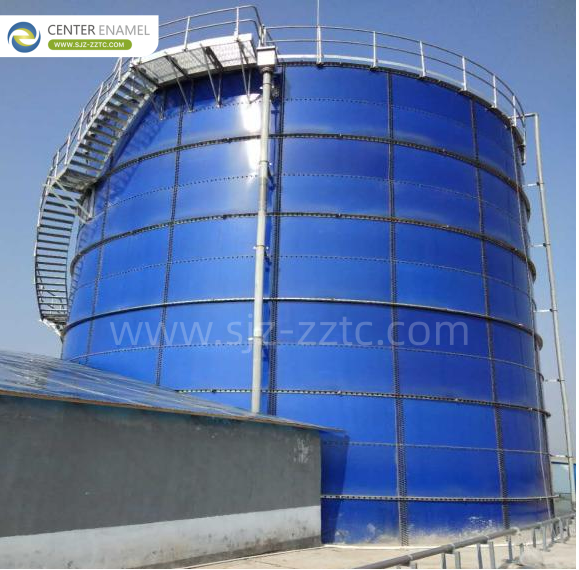
GFS Tanks are widely used as anaerobic digesters and for biogas storage. The glass coating is fused to the steel substrate at extremely high temperatures, creating a smooth, inert, and corrosion-resistant surface that withstands the acidic, high-sulfide environment typical inside digesters. With an annual production capacity exceeding 250,000 panels, Center Enamel manufactures bolted GFS tanks that are easy to transport and assemble on-site, making them particularly suitable for the Philippines’ scattered rural farms across different islands. The bolted design eliminates the need for welding, significantly speeding up installation and reducing the requirement for skilled labor.
Roof selection depends on local weather conditions and specific project needs:
GFS roof - Recommended for locations that experience harsh weather, including typhoons, high wind speeds, heavy rainfall, or other extreme conditions. This option is also appropriate when a separate ground-mounted gas holder is preferred for operational reasons. The GFS roof performs well for tank diameters under 23 meters.
Double membrane roof - Under normal Filipino climatic conditions, this is the preferred choice. Its advantages include lower material costs compared to a full steel roof, and meaningful space savings because it integrates gas storage directly above the digester. This eliminates the need for a separate gas holder, reducing the project’s land footprint and foundation expenses.
Both roof types maintain an airtight seal, allowing efficient biogas capture while working seamlessly with the CSTR Process. By selecting the appropriate tank and roof combination, Filipino project owners can optimize both upfront investment and long-term operational reliability.
Supporting Equipment for a Complete Anaerobic System
A fully functioning anaerobic digestion plant requires more than just a digester and roof. Center Enamel supplies a full range of auxiliary equipment to ensure smooth, continuous operation:
Gas holder - Stores biogas to balance production rates with consumption, providing a buffer for fluctuating energy demand.
Black membrane - Used for lined storage ponds or secondary containment, preventing leaks and protecting surrounding soil and groundwater.
Solid-liquid separator - Divides digestate into solid fiber (which can be used as animal bedding, compost, or low-grade fuel) and liquid fertilizer for direct land application.
Flare system - Safely combusts excess biogas when production exceeds storage or utilization capacity, preventing overpressure and eliminating explosion risks.
Lifting pump - Transfers feedstock, digestate, and recirculated liquids between different process stages.
Dehydration and desulfurization tank - Removes moisture and corrosive hydrogen sulfide from raw biogas, protecting downstream generators, boilers, and piping.
Screw sludge dewatering machine - Reduces the volume of sludge generated during pre-treatment or digestate handling, minimizing disposal costs and simplifying byproduct management.
This complete equipment suite ensures that Anaerobic Solutions operate reliably with minimal daily intervention, even in remote Filipino locations where technical support may be limited.
Efficient Installation Capabilities of Center Enamel
Construction speed and simplicity are especially important for Philippine projects, many of which are located on different islands with logistical challenges. Center Enamel’s bolted GFS Tanks are prefabricated in a 150,000-square-meter production facility and then shipped in compact, containerized loads to project sites across the archipelago. On-site assembly requires no welding and only minimal heavy equipment, allowing a typical digestion system to be erected in weeks rather than months.
All components are designed for straightforward assembly by local crews working under the guidance of Center Enamel’s experienced technical supervisors. The company also provides startup support and comprehensive training, enabling farm staff to operate and maintain the system long after commissioning. For projects in the Philippines’ rural areas-whether in Luzon, Visayas, or Mindanao-this efficient installation method reduces weather-related delays, lowers labor costs, and keeps project timelines firmly on track.
Center Enamel: A One-Stop Anaerobic Solution Provider for the Philippines
Center Enamel is not merely a tank manufacturer; it is a one-stop solution provider for complete Anaerobic Solutions. From initial concept and process engineering through equipment manufacturing, site installation, and final commissioning, Center Enamel delivers turnkey systems adapted to the Philippines’ diverse agricultural landscape and waste characteristics. The company’s business scope includes full EPC services, process packages, and individual equipment supply-all backed by internationally recognized certifications.
For example, a Filipino dairy cooperative with 1,500 cattle can rely on Center Enamel to engineer a CSTR Process system using GFS Tanks fitted with a double membrane roof, plus all auxiliary components including pumps, desulfurization equipment, a flare system, and a solid-liquid separator. The biogas produced can power a generator that runs water pumps, lighting, and milk chilling equipment-directly replacing diesel or extending power availability in off-grid areas. The digestate can be sold to neighboring farms or applied to forage crops, reducing synthetic fertilizer expenses. Center Enamel manages every step: permit guidance, civil coordination, tank erection, piping, and commissioning. This integrated, single-source approach minimizes project risk, shortens timelines, and guarantees a system that meets Philippine safety, environmental, and performance standards.
With exports to more than 100 countries and over 500 employees dedicated to water, wastewater, and renewable energy treatment, Center Enamel has the scale, experience, and technical depth to support the Philippines’ growing need for decentralized energy solutions. Whether for a small family farm or a larger agricultural cooperative, Center Enamel delivers reliable, durable, and cost-effective Anaerobic Solutions that create lasting value.
Conclusion
The Philippines’ livestock sector produces large volumes of manure that, without proper treatment, contribute to pollution and methane emissions. By adopting modern Anaerobic Solutions based on the CSTR Process inside durable GFS Tanks with efficient double membrane roofs, Filipino farmers can achieve energy access, lower operating costs, and manage waste responsibly. Center Enamel offers a complete, proven approach-from pre-treatment through gas utilization-as a single accountable partner. For Filipino farmers, cooperatives, and investors, choosing Center Enamel means choosing a certified, experienced, and long-term partner in renewable energy.
FAQ
Q1: How does the CSTR Process perform during the Philippines’ typhoon season and frequent power interruptions?
A1: Center Enamel’s CSTR systems are designed with robust construction and can be equipped with backup mixing options. In the event of power loss, the digester can retain heat and maintain biological activity for a reasonable period. For areas with frequent outages, Center Enamel recommends installing a small backup generator or battery system to keep the agitator running during critical periods.
Q2: What maintenance is required for the double membrane roof in hot and humid tropical conditions?
A2: The double membrane roof requires minimal routine maintenance. Periodic visual inspections (every 6-12 months) for surface wear, UV degradation, or debris accumulation are recommended. The pressurization fan and control system should be checked annually. Center Enamel provides maintenance guidelines and can supply replacement membranes when needed, typically after 10-15 years of service.
Q3: Can the same GFS tank system handle different types of livestock manure mixed together?
A3: Yes. The CSTR Process is specifically designed for mixed feedstocks. Filipino farms often have multiple animal types-cattle, carabao, pigs, and poultry. The continuous mixing ensures uniform blending of different manures, and the system automatically adjusts to variations in solids content and nutrient balance. Center Enamel can provide feedstock analysis services to optimize the mixing ratio for maximum gas yield.