
GFS Tanks and Full EPC Delivery for Beverage Wastewater Treatment Projects
Industrial wastewater treatment is defined by three persistent pressures: high difficulty, high cost, and high energy consumption. Effluent from chemical, pharmaceutical, and new energy sectors carries complex pollutant profiles that conventional processes struggle to remove, while tightening discharge standards demand continuous technological upgrades. Beverage manufacturing adds its own twist-high-sugar, highly biodegradable streams that fluctuate with product cycles and CIP schedules. Meeting these demands requires both a proven process and containment that survives decades of corrosive exposure. As a specialist Beverage Wastewater Treatment Project EPC Contractor, Center Enamel integrates IC anaerobic process design with factory-built GFS Tanks to deliver single-point responsibility from engineering through commissioning.
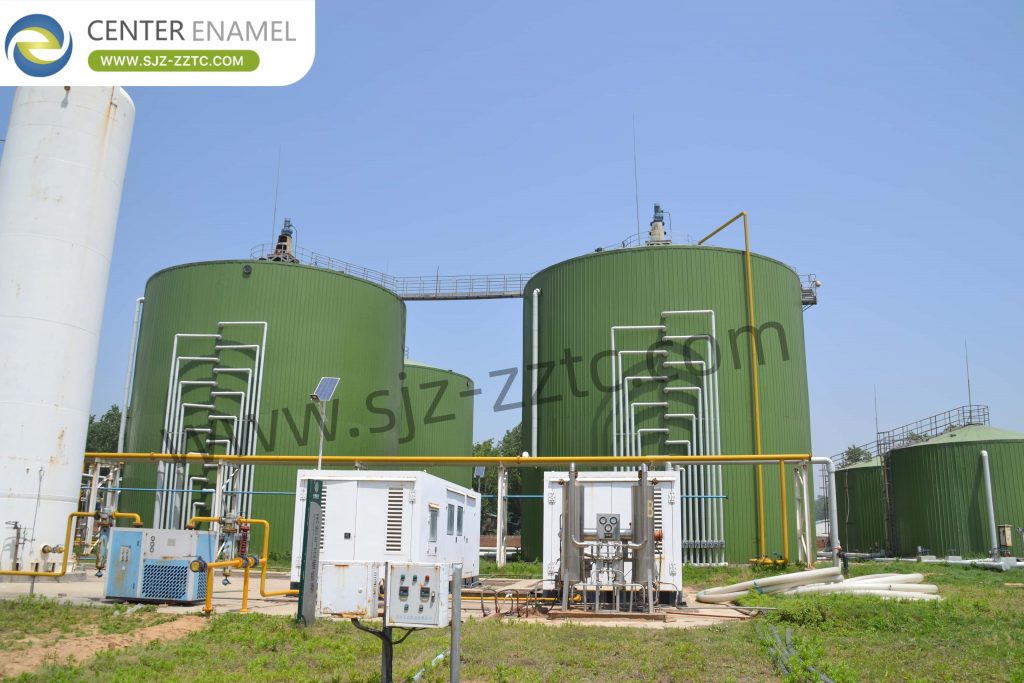
Factory-Built GFS Tanks vs. Cast-in-Place Concrete
The containment decision shapes project risk more than most owners anticipate. Cast-in-place concrete tanks are built in the open air, where rebar tying, pouring, and curing depend on worker skill, ambient temperature, and rainfall. Wall thickness, density, and strength vary between batches, and hidden defects-honeycombing, voids, insufficient cover-are difficult to detect and expensive to remediate. Quality cannot be uniformly controlled across a large tank farm.
Center Enamel's GFS Tanks invert this risk profile. Steel panels, seals, and reinforcement components are mass-produced in automated factories, with stamping, high-temperature enameling, and dimensional cutting controlled by CNC equipment. Each panel's parameters and enamel thickness follow unified standards. Components are uniformly packaged, shipped to site, and assembled per standardized drawings. Full-process inspection from raw material to finished panel ensures consistent performance, eliminating the batch-to-batch variability inherent in on-site concrete work. For a Beverage Wastewater Treatment Project EPC Contractor managing schedule and quality simultaneously, this factory-controlled consistency is a decisive advantage.
The IC Reactor: Third-Generation Anaerobic Efficiency
Process selection determines both footprint and operating cost. The Internal Circulation (IC) reactor represents the third generation of high-rate anaerobic technology, building on the UASB platform with a critical innovation: a built-in gas-lift internal circulation system that recirculates wastewater without external return pumps. Biogas generated in the lower reaction zone lifts liquid through the riser, creating hydraulic circulation that dramatically increases upflow velocity and improves contact between granular sludge and substrate.
The reactor's dual-zone configuration-a lower main reaction zone and an upper polishing zone-allows it to handle high organic loading within a compact footprint. This makes the IC reactor particularly suited to land-constrained industrial sites and to high-concentration, high-flow soluble organic wastewater such as brewery, beverage, starch, pharmaceutical, chemical, and papermaking streams. It is less appropriate for high-solids or high-viscosity feeds where mass transfer becomes limiting. For beverage producers, the IC configuration delivers rapid COD removal, biogas recovery, and a footprint that fits within existing plant boundaries.
Where Beverage Wastewater Comes From-and Why It Matters
Understanding the source stream is the foundation of effective process design. Beverage wastewater originates across the entire production chain: raw material pretreatment (fruit washing, crushing, juicing, syrup preparation), blending and mixing (high-sugar compounding streams), filtration and clarification (juice and tea residues), filling and packaging (low-concentration, high-volume wash water), and CIP cleaning (the core high-concentration stream from pipeline, tank, and mixer cleaning).
Each stream carries a distinct signature. Juice processing wastewater contains pectin, pulp, and juice residues at extremely high organic concentration. Carbonated beverage wastewater carries syrup, phosphoric acid, and CO₂ residues. Tea beverage wastewater contains tea polyphenols and residues. Large and medium plants discharge hundreds to thousands of tons daily, with quality varying by product type and CIP cycle. An experienced Beverage Wastewater Treatment Project EPC Contractor designs equalization and pretreatment around this variability rather than assuming a steady feed-the difference between a system that performs and one that struggles during changeover weeks.
Table 1: Sweden Organic Waste Biogas Project (2024)
| Parameter | Specification |
| Location | Northern Europe (Sweden) |
| Application | Organic waste biogas production |
| Process | UASB anaerobic digestion |
| Tank Type | Center Enamel GFS Tanks |
| Single Tank Size | 19.11 m diameter × 19.2 m height |
| Key Challenge | Acid/alkali and low-temperature corrosion |
| Design Life | 30-year corrosion protection |
| Outcome | Harmless treatment + biogas recovery |
Material Technology: The 30-Year Corrosion Barrier
Anaerobic digestion generates volatile fatty acids and hydrogen sulfide that attack conventional coatings and concrete. Center Enamel has independently developed over 200 anti-corrosion enamel formulations, with proprietary double-sided, double-layer enameling technology that extends GFS tank service life beyond 30 years-far surpassing concrete and ordinary coated equipment. The glass enamel is fused to steel at high temperature, creating an inorganic, non-porous barrier resistant to strong acids, high salinity, and microbial corrosion.
This material capability is backed by a full-chain R&D team led by national-level materials technology experts, specializing in enamel frit and tank anti-corrosion core technologies. Proprietary laboratories operate alongside university research collaboration, conducting year-round durability pilot testing and long-term corrosion simulation. Specialized formulations are iteratively developed for extreme conditions-high-salinity wastewater, strong acid/alkali POME, and high-organic livestock manure-building a proprietary material technology barrier that supports the company's annual invention and utility patents.
Global EPC Delivery and Localized Service
Equipment performance means little without disciplined delivery. Center Enamel's global footprint covers more than 100 countries and regions, with installation service spanning Southeast Asia, Africa, Europe, the Americas, the Middle East, and Latin America. The company adapts to tropical high-salt spray, high-altitude mountainous terrain, Nordic severe cold, and high-standard European and American facility conditions.
The delivery model pairs company cross-border construction teams with overseas local agent coordination, providing one-stop services including site survey, installation, process commissioning, and operator training. This structure allows projects in remote regions to proceed without sacrificing technical oversight-a critical factor for beverage producers who cannot afford extended commissioning delays. Certifications including CE, NSF, WRAS, ISO9001, BSCI, and ASME clear tendering barriers across major markets, reinforcing the credibility of Center Enamel as a Beverage Wastewater Treatment Project EPC Contractor for international tenders.
R&D Depth and Long-Term After-Sales Support
The R&D organization extends beyond materials into anaerobic supporting integrated equipment, strengthening the interface between reactor design and containment. External senior environmental engineering and mechanical structure engineers are retained to reinforce capabilities, focusing on anti-corrosion coating formulations and specialty corrosion-resistant tanks. This integration matters because reactor performance depends on how well the tank, the gas-lift system, and the three-phase separators work as one assembly rather than separate procured items.
After-sales support completes the lifecycle. A 24/7 team provides remote fault diagnosis, process parameter adjustment, and tank anti-corrosion maintenance guidance. Overseas technical personnel can be dispatched for on-site inspection, annual servicing, and equipment refurbishment. Long-term feedback tracking collects operational data from tanks and anaerobic equipment to continuously refine product structure and support processes. External expert teams backstop anaerobic process commissioning, biogas upgrading O&M, and wastewater retrofit projects-ensuring long-term stable operation and improved repurchase rates across the global client base.
FAQ
Q: What makes GFS Tanks more reliable than concrete for anaerobic reactors?
A: Factory-controlled enameling and CNC fabrication eliminate batch variability, honeycombing, and curing risks, delivering consistent 30-year corrosion protection against organic acids and sulfide.
Q: Can Center Enamel act as a single EPC contractor for beverage wastewater projects?
A: Yes. Center Enamel provides process design, GFS tank manufacturing, equipment integration, installation, commissioning, and operator training under one contract across 100+ countries.
Q: Which beverage streams are best suited to IC anaerobic treatment?
A: High-sugar streams such as syrup, juice, and CIP cleaning water with COD above 2,000 mg/L are ideal; low-strength rinse water is typically balanced in equalization tanks before treatment.
Evaluating containment and process options for your next beverage plant upgrade? Share your effluent data and site conditions with our engineering team for a tailored feasibility review.
Reach out to Center Enamel today and let our EPC specialists map a GFS tank and anaerobic solution to your compliance, footprint, and budget requirements.