
How Do GFS Tanks and the IC Process Handle Beverage Factory Wastewater?
Beverage factories produce some of the most treatment-friendly-yet most volatile-wastewater in the food processing sector. It is high in dissolved sugars, highly biodegradable, and prone to sharp swings between concentrated CIP discharge and dilute rinse water. Regulations are simultaneously pushing plants away from simple compliance discharge toward resource recovery and near-zero liquid discharge. The combination of GFS Tanks and the IC Process addresses both sides of this equation: a reactor that converts organic load into biogas, housed in containment that survives decades of organic acid attack. This article explains how the pairing works in practice.
The Regulatory Push Behind Resource Recovery
Global policy is escalating from "compliance discharge" to mandatory "resource recovery" and "zero liquid discharge." The EU's Circular Economy Action Plan requires member states to raise industrial wastewater reuse rates and extends carbon footprint accounting across the full treatment life cycle. China continuously tightens discharge standards, with increasingly stringent limits on total nitrogen, total phosphorus, and characteristic pollutants for chemicals, pharmaceuticals, and printing and dyeing. Some water-scarce regions and highly polluting industries are mandated to adopt zero or near-zero liquid discharge technologies. Germany has built a differentiated pretreatment standard system by industry, enforcing strict source control before discharge into municipal plants.
For beverage producers, these trends point in one direction: wastewater must be treated as a resource stream, not a disposal problem. That reframing is exactly what the IC Process enables-converting sugar-rich effluent into recoverable biogas while meeting tightening effluent limits.
Why Beverage Wastewater Suits Anaerobic Treatment
Beverage wastewater-from carbonated drinks, juices, tea drinks, bottled water, and energy drinks-is a typical high-sugar, high-concentration organic stream. Its pollution load concentrates in specific stages: raw material pretreatment (fruit washing, crushing, juicing, syrup preparation), blending and mixing (high-sugar compounding), filtration and clarification (fruit and tea residues), filling and packaging (low-concentration, high-volume wash water), and CIP cleaning (the core high-concentration stream from pipeline, tank, and mixer cleaning).
Sugars are the ideal anaerobic substrate. They degrade readily, produce high biogas yields, and require no specialty chemicals-only small amounts of pH adjusters and flocculants. When COD exceeds roughly 2,000 mg/L, anaerobic digestion flips from an energy cost to an energy source. The standardized treatment train-"pretreatment + anaerobic digestion + aerobic treatment + advanced treatment"-is built around this principle: screens and sieves remove pulp and residues to prevent clogging, equalization tanks balance high-concentration CIP against low-concentration rinse water, alkali addition neutralizes acidic streams, and the anaerobic stage does the bulk COD removal with rates exceeding 80%.
Inside the IC Process: Circulation Without External Pumps
The IC (Internal Circulation) Process is the third-generation high-efficiency anaerobic technology built on the UASB platform. Its core innovation is a built-in gas-lift internal circulation system that recirculates wastewater autonomously-no external return pumps required. Biogas generated in the lower reaction zone lifts liquid upward, creating hydraulic circulation that significantly increases upflow velocity and enhances contact between granular sludge and substrate. The reactor uses a dual-zone configuration: a lower main reaction zone for bulk degradation and an upper polishing zone for final treatment.
Supporting equipment is tightly integrated. A bottom precision distribution system and pressure-regulating feed device ensure uniform, stable influent. Influent lift pumps, equalization tanks, and flow meters provide precise front-end control. Top-mounted high-efficiency biogas collection, desulfurization, dehydration, and storage equipment form a complete gas train. High-precision online monitoring tracks temperature, pH, COD, and level in real time, while dedicated sludge discharge pipes at the bottom and mid-section complete the system. The result is a compact, highly automated reactor train with no excess external equipment-well suited to land-constrained beverage plants with high treatment efficiency requirements.
GFS Tanks: Containment Built for Corrosive Fermentation
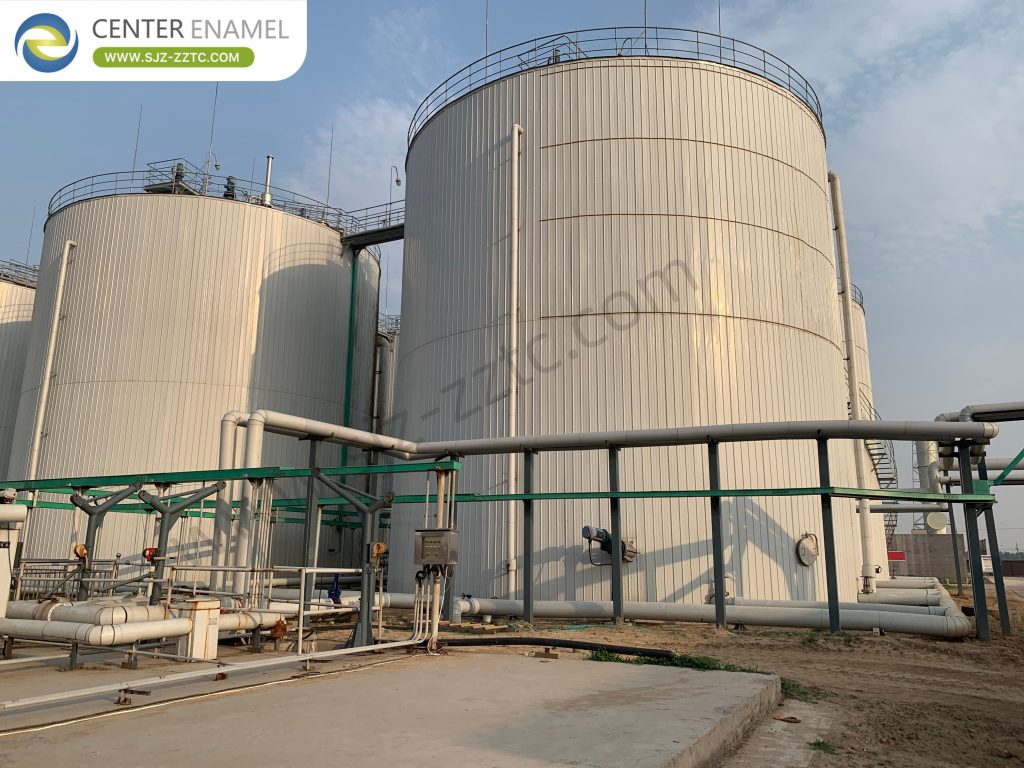
Reactor performance depends on what surrounds it. GFS Tanks are fully factory-prefabricated to standardized specifications, and their quality stability far exceeds cast-in-place concrete. Concrete tanks are built in the open air, where rebar tying, pouring, and curing depend on worker skill, temperature, and rainfall. Wall thickness, density, and strength vary between batches, and hidden defects-honeycombing, voids, insufficient wall thickness-are common and hard to detect.
Center Enamel's GFS tank panels, seals, and reinforcement components are mass-produced in automated factories. Steel stamping, high-temperature enameling, and dimensional cutting are CNC-controlled, with each panel's parameters and enamel thickness following unified standards. Components are uniformly packaged, shipped, and assembled per standardized drawings, with full-process inspection from raw material to finished panel. For anaerobic service, this matters because digestion generates organic acids and hydrogen sulfide that attack conventional materials-GFS tanks resist organic acid and sugar fermentation corrosion, delivering stable, consistent performance across every tank in a farm.
Table 1: Standardized Beverage Wastewater Treatment Train
| Stage | Function | Key Equipment |
| Pretreatment | Remove pulp, tea residue, suspended solids | Screens and sieves |
| Equalization | Balance high-concentration CIP and low-concentration rinse water | Equalization tanks |
| Neutralization | Adjust acidic wastewater pH | Alkali dosing |
| Anaerobic Digestion | High-concentration sugar degradation, biogas production, COD removal >80% | UASB / IC reactors in GFS Tanks |
| Aerobic Treatment | Deep degradation of residual organics, nitrogen/phosphorus removal | A/O or SBR |
| Advanced Treatment | Final compliance assurance | Sedimentation, filtration, disinfection |
Covers, Certifications, and Complete Delivery
Beyond the reactor, Center Enamel supplies the balance of containment and credentials that international projects require. The Aluminum Alloy Trough Deck Roof is a cost-effective cover for clean water and wastewater storage-drinking water, production wastewater, and firewater reserve tanks. Its anti-corrosion aluminum alloy plates and support trusses form a lightweight structure that reduces foundation load and civil investment. A naturally formed dense oxide layer resists rain and mild wastewater corrosion, blocks wind, rain, insects, leaves, and odor volatilization, and prevents dust and debris from causing secondary contamination. The flat roof accommodates walkways, guardrails, vents, and level monitoring ports, and the simple sealing structure shortens installation while virtually eliminating anti-corrosion painting maintenance. It suits atmospheric-pressure storage where biogas collection or high-pressure sealing is not required.
For tendering, the company holds CE, NSF, WRAS, ISO9001, BSCI, ASME, and other global certifications, clearing EU, North American, Southeast Asian, and African project barriers.
Global Service System and After-Sales Loop
Delivery capability determines whether a well-designed system actually performs. Leveraging regional sales centers in China and overseas local agent networks, Center Enamel has established a complete after-sales service loop covering all markets. The system rests on four pillars: a 24/7 rapid response mechanism, on-site domestic and overseas installation services, full-project-cycle after-sales support, and long-term warranty protection. This forms a complete chain from preliminary site survey through mid-term construction management to long-term inspection and maintenance.
The system is uniformly adapted to both domestic and international standards, coordinating personnel scheduling, material support, and on-site coordination for simultaneous projects across multiple regions. For beverage producers running seasonal campaigns, this coordination reduces multi-party management costs and protects commissioning schedules-ensuring the IC Process and GFS Tanks perform as specified from day one.
Table 2: Sweden Organic Waste Biogas Project (2024)
| Parameter | Specification |
| Location | Northern Europe (Sweden) |
| Application | Organic waste biogas production |
| Process | UASB anaerobic digestion |
| Tank Type | Center Enamel GFS Tanks |
| Single Tank Size | 19.11 m diameter × 19.2 m height |
| Key Challenge | Acid/alkali and low-temperature corrosion |
| Design Life | 30-year corrosion protection |
| Outcome | Harmless treatment + biogas recovery |
FAQ
Q: Why use GFS Tanks instead of concrete for IC Process reactors?
A: Factory enameling and CNC fabrication eliminate batch variability and hidden defects, while glass enamel resists organic acids and sulfide for a service life exceeding 30 years.
Q: What COD removal can the IC Process achieve on beverage wastewater?
A: Well-designed IC and UASB systems typically exceed 80% COD removal on high-sugar streams, with biogas recovery offsetting a substantial share of O&M energy costs.
Q: Does the IC Process remove nitrogen and phosphorus?
A: No. Anaerobic treatment passes nutrients through, so a downstream A/O or SBR aerobic stage is required wherever nitrogen and phosphorus limits apply.
Want to know whether the IC Process and GFS Tanks fit your beverage plant's effluent profile? Send your COD range, discharge limits, and site constraints to our engineers for a preliminary assessment.
Talk to Center Enamel today and let our specialists design a containment and anaerobic solution matched to your production cycle, climate, and compliance targets.