
Leading GFS Tanks and UASB Process Solutions for Industrial Wastewater Treatment Projects
Industrial wastewater treatment projects worldwide face unprecedented challenges from tightening regulations, rising energy costs, and the need for resource recovery. Center Enamel addresses these demands through its integrated approach, combining superior GFS tank corrosion resistance with the proven UASB process to deliver durable, high-performance solutions that transform industrial effluent into a renewable energy asset while ensuring compliance across diverse regional markets.
Regional Development Trends Shape Industrial Wastewater Treatment Demands
The Asia-Pacific region, particularly China, has become the world's largest industrial wastewater treatment market, with the operation and maintenance service segment's contribution continuing to rise, marking a shift from project construction to long-term operational management. This evolution reflects the growing maturity of industrial wastewater treatment projects, where lifecycle performance and reliability are increasingly valued over initial capital expenditure. The North American market focuses on upgrading existing facilities, while Europe emphasizes high-value-added resource recovery technologies, driving demand for advanced anaerobic digestion systems that can extract maximum value from waste streams.
Wastewater from the new energy industry chain (lithium batteries, photovoltaics, hydrogen) has become the most notable emerging growth area due to its complex composition and high treatment difficulty, generating significant demand for customized solutions. The maturity of third-party treatment models in industrial parks continues to improve, driving consolidation in the professional operation market. The Middle East has strong demand for advanced treatment and reuse of industrial wastewater due to water scarcity; manufacturing transfer in Southeast Asia drives local industrial wastewater treatment facility construction demand. These diverse regional requirements underscore the need for flexible, robust technologies like GFS tanks and the UASB process, which can be adapted to varying regulatory frameworks, climate conditions, and industrial applications.
GFS Tanks Deliver Unmatched Corrosion Resistance for Aggressive Industrial Effluents
Center Enamel's independently developed double-sided double-layer enameling technology is the industry's leading coating anti-corrosion technology, with corrosion resistance completely surpassing concrete tanks. Concrete tank interiors are riddled with pores, allowing wastewater and acid/alkaline media to easily penetrate and corrode the structural layer. Long-term use leads to irreversible problems such as internal wall spalling, water seepage, and rebar corrosion, which are difficult to repair and cannot be fundamentally resolved. These failures are particularly costly in industrial wastewater treatment projects, where unplanned downtime can disrupt entire production processes.
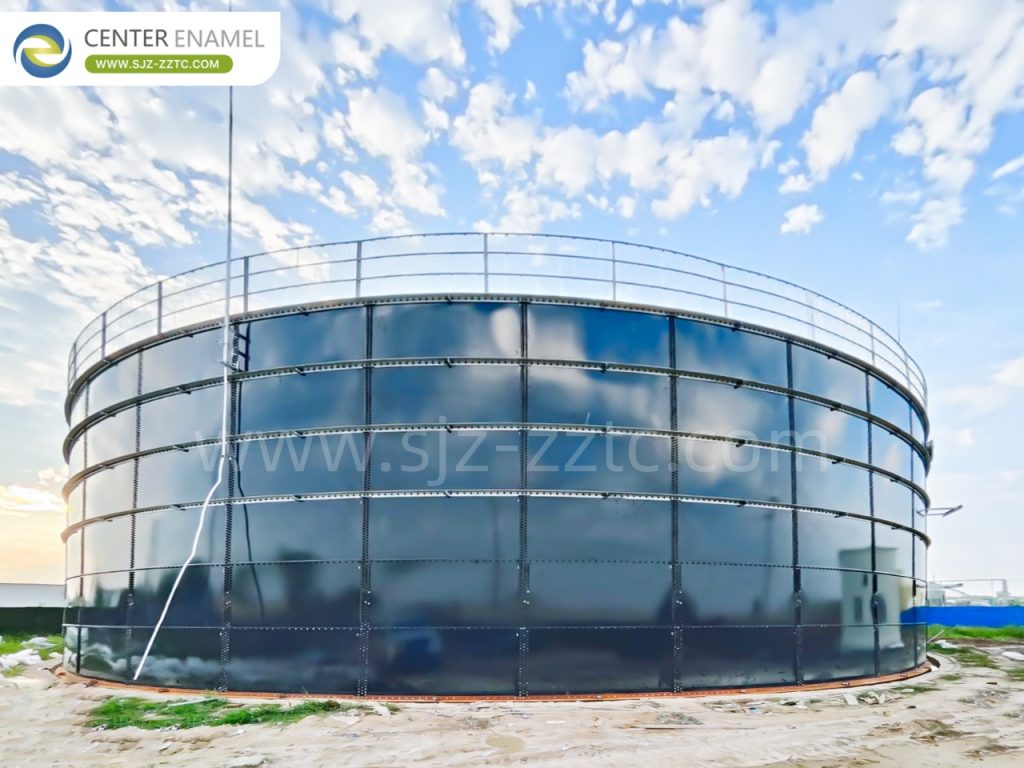
GFS tanks feature high-temperature enameling on both the interior and exterior surfaces of steel panels, with a dense, non-porous enamel finish that completely blocks corrosive liquids and biogas permeation. The enamel layer has extremely strong chemical stability, resisting acids, alkalis, salts, and microbial corrosion. Concrete tanks will develop extensive corrosion and leakage after 5-8 years of use, while GFS tank anti-corrosion service life can exceed 30 years, with no need for frequent internal lining repairs throughout the service life, significantly reducing long-term anti-corrosion maintenance investment and fundamentally eliminating environmental risks of medium leakage contaminating sites and groundwater. Compared to traditional concrete and FRP tanks, GFS tank coatings have no risk of peeling or blistering, and are adaptable to highly corrosive conditions such as palm oil mill effluent, livestock manure, and chemical high-salinity wastewater, with outstanding long-term comprehensive cost advantages.
This durability is essential for industrial wastewater treatment projects handling aggressive streams from chemical, pharmaceutical, and textile processes. The non-porous enamel surface also prevents biofilm accumulation and simplifies cleaning, further reducing operational costs over the project lifecycle. Center Enamel's proprietary material technology, with over 200 differentiated anti-corrosion enamel formulations, ensures that GFS tanks can be tailored to specific industrial wastewater characteristics, providing an irreplaceable competitive advantage.
The UASB Process Offers Proven Advantages for High-Strength Industrial Wastewater
No mechanical mixing equipment is required, with sludge suspension achieved through hydraulic action, resulting in very low overall energy consumption. High-concentration anaerobic granular sludge can be cultivated, with high sludge concentration, strong activity, excellent settleability, low sludge washout, and low sludge yield, significantly reducing sludge disposal costs. The integrated design combines reaction, sedimentation, and separation simultaneously, with small footprint and moderate capital investment. Simple structure with low failure rates and convenient maintenance. High volumetric loading rate with excellent organic pollutant degradation efficiency and good shock load resistance. Stable biogas production with high resource recovery value. The process is mature and widely adopted, with well-established construction, commissioning, and O&M systems, suitable for large-scale industrial wastewater treatment.
These advantages make the UASB process particularly attractive for industrial wastewater treatment projects where space is limited, energy costs are high, or stringent discharge standards require reliable organic removal. The process's ability to handle significant fluctuations in flow and organic loading-common in batch industrial operations-ensures stable performance even under challenging conditions. When housed in corrosion-resistant GFS tanks, UASB reactors provide a durable, long-term solution that minimizes lifecycle costs while maximizing resource recovery.
Environmental Toxicity of Textile Pollutants Highlights Treatment Imperative
Textile wastewater primarily has color and organic pollution with some chemical toxicity. High-color wastewater discharged to natural waters blocks sunlight penetration, inhibiting aquatic plant photosynthesis and disrupting self-purification capacity and aquatic food chains. Some dyes and intermediates have biological toxicity-azo dye reductive cleavage can produce carcinogenic aromatic amines with chronic toxicity risks. High-alkalinity desizing/scouring wastewater causes elevated pH in receiving waters, directly harming fish and disrupting aquatic acid-base balance. Surfactants and PVA sizing agents are water-soluble polymers difficult to naturally degrade, increasing water viscosity and affecting aquatic organism respiration. Moderate salinity with long-term discharge causing soil salinization. Some dyes contain heavy metal complexes (copper, chromium), with chronic toxicity risks from environmental accumulation. Overall pollution is primarily ecological damage-sustained discharge causes colored water pollution and ecological degradation.
This environmental toxicity profile underscores the critical importance of effective industrial wastewater treatment projects. The UASB process, with its ability to break down complex organic molecules and reduce COD, provides a first line of defense against these pollutants. Combined with GFS tanks that prevent leakage and groundwater contamination, this integrated approach offers a comprehensive solution to the environmental challenges posed by industrial wastewater.
Center Enamel's Core R&D and Global Certifications Ensure Quality
Technology R&D is Center Enamel's core competitive advantage. The company independently masters over 200 differentiated anti-corrosion enamel formulations, with full self-control over the enamel raw material chain, holding nearly 100 invention and utility patents. Products have passed NSF, WRAS, ASME, BSCI, CE, ISO9001, and other global certifications. This extensive R&D capability ensures that GFS tanks can be customized for the specific chemical challenges of diverse industrial wastewater treatment projects, from high-salinity chemical effluents to high-temperature textile streams.
Company certifications and honors include: National High-Tech Enterprise, National Specialized and Sophisticated "Little Giant," Hebei Manufacturing Single Champion, Provincial Smart Factory, Provincial Green Factory; complete environmental engineering and special equipment manufacturing compliance qualifications. The company maintains long-term collaborative research with multiple universities through joint materials laboratories-continuously iterating anti-corrosion coatings and large bolted tank structural design technologies. The proprietary material technology barrier creates an irreplaceable competitive advantage, with product performance comparable to high-end imported European/American storage equipment. These credentials provide critical assurance for industrial wastewater treatment projects, where equipment quality directly impacts regulatory compliance and operational continuity.
Global Installation Expertise Ensures Project Success
The installation team has practical experience from over 10,000 GFS tank projects globally, strictly following standardized construction procedures-full control over project mobilization, civil coordination, tank assembly, piping, and commissioning schedules and quality. This extensive experience is invaluable for industrial wastewater treatment projects, where site conditions can vary dramatically and tight schedules must be met.
The team is proficient in complete standardized installation processes for GFS tanks, dual-membrane gas storage covers, USR/CSTR/IC anaerobic reactors, and biogas desulfurization/piping systems-adaptable to large-scale farms, industrial parks, remote mountainous sites, coastal high-corrosion sites, and other complex locations-strictly implementing unified global safety construction standards. For large overseas cross-border projects, the team can be deployed as complete units for on-site construction, technical training, and local worker practical instruction-full control over construction details, air-tightness testing, and corrosion protection-ensuring timely and stable commissioning of global environmental projects through standardized delivery capability. This global installation network ensures that industrial wastewater treatment projects, regardless of location, benefit from consistent quality and proven execution.
Aluminum Geodesic Dome Roof Enhances System Integrity
Aluminum Geodesic Dome Roof independently developed by Center Enamel is manufactured using high-strength aluminum alloy plates through integral stamping. It features a triangular grid spherical self-supporting structure, enabling large-span full coverage without internal support columns. Made of aluminum alloy, the roof offers excellent weather resistance and corrosion resistance, capable of long-term protection against acid rain, salt spray, and UV radiation, suitable for various extreme outdoor climate conditions. The structural design complies with international AWWA D108 standards, with aluminum plate thickness, rib cross-sections, and joint connections all verified by finite element stress analysis, ensuring wind and snow load resistance that meets building code requirements across different global regions.
The weight of the Aluminum Geodesic Dome Roof is only one-third to one-half of a steel roof with the same span, significantly reducing the load on the tank top and allowing direct installation without tank wall reinforcement. The roof provides superior overall sealing performance, with double sealing between panels using specialized sealant strips and mechanical interlocking, enabling both airtight gas storage and enclosed odor control, suitable for biogas collection and storage, wastewater tank odor control, and drinking water contamination prevention. The support-column-free design does not interfere with the installation and operation of internal equipment such as mixers and water distributors. The aluminum material does not support microbial growth, requiring no anti-corrosion maintenance over long-term use, resulting in low total life-cycle costs.
This innovative roof system complements the GFS tank and UASB process by providing a complete, integrated solution for industrial wastewater treatment projects. The superior sealing performance is particularly valuable for biogas capture, maximizing energy recovery while minimizing odor and greenhouse gas emissions. The corrosion-resistant aluminum construction ensures long-term durability even in aggressive industrial environments, aligning with the overall lifecycle value proposition of Center Enamel's offerings.
Frequently Asked Questions
1. Why are GFS tanks preferred for industrial wastewater treatment projects?
GFS tanks provide superior corrosion resistance through a non-porous glass enamel coating fused at 860°C, preventing chemical attack from aggressive industrial effluents. Unlike concrete tanks that corrode and leak within 5-8 years, GFS tanks maintain integrity for over 30 years with no internal lining repairs. With over 200 proprietary enamel formulations, Center Enamel can tailor tanks to specific wastewater characteristics, significantly reducing long-term costs and environmental risks.
2. What makes the UASB process suitable for high-strength industrial wastewater?
The UASB process requires no mechanical mixing, using hydraulic action for sludge suspension, resulting in very low energy consumption. It cultivates high-concentration granular sludge with excellent settleability, achieving high volumetric loading rates and stable biogas production. The simple, integrated design combines reaction, sedimentation, and separation with a small footprint, making it ideal for space-constrained industrial sites.
3. How does the Aluminum Geodesic Dome Roof benefit industrial wastewater systems?
The aluminum dome roof provides large-span coverage without internal support columns, eliminating interference with tank equipment. Its lightweight construction (one-third to one-half of steel) reduces tank loads. Superior sealing enables biogas collection and odor control, while corrosion resistance and non-microbial-supporting properties ensure no maintenance is required, reducing total lifecycle costs.