
Durable GFS Tanks and Efficient UASB Process for Sustainable Beverage Wastewater Treatment
Global industrial wastewater treatment policies are escalating from "compliance discharge" to mandatory "resource recovery" and "zero liquid discharge." The EU, through its Circular Economy Action Plan, requires member states to increase industrial wastewater reuse rates and extends carbon footprint accounting to the full life cycle of wastewater treatment. China continuously updates and tightens industrial water pollutant discharge standards, with increasingly stringent limits on total nitrogen, total phosphorus, and characteristic pollutants for industries such as chemicals, pharmaceuticals, and printing and dyeing. Some water-scarce regions and highly polluting industries are mandated to adopt zero or near-zero liquid discharge technologies. Germany has established a differentiated pretreatment technical standard system by industry, requiring industrial wastewater to meet specific quality requirements before discharge into municipal wastewater treatment plants, implementing strict source control.
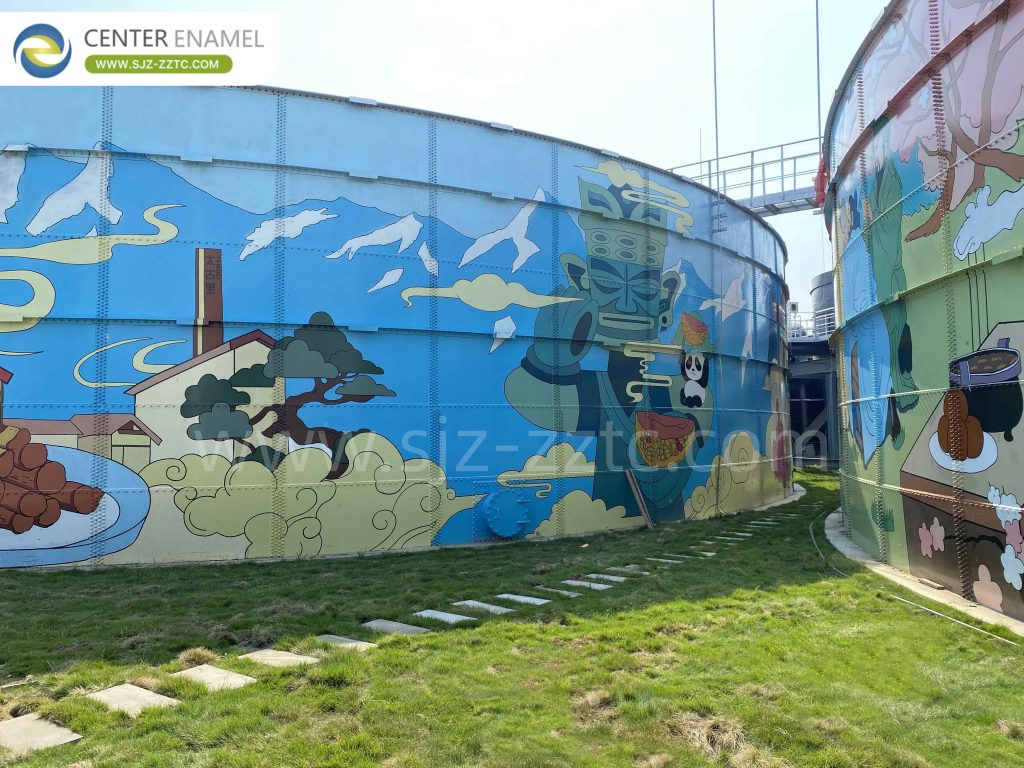
Meeting these increasingly rigorous regulatory demands requires robust and durable infrastructure that can deliver consistent treatment performance over decades. This is where advanced containment solutions like Glass-Fused-to-Steel (GFS) tanks become essential, providing the corrosion-resistant foundation for reliable biological processes such as the UASB process, which forms the core of many modern Beverage Wastewater Treatment systems.
GFS Tanks Corrosion Resistance Far Superior to Traditional Concrete Tanks
Center Enamel's independently developed double-sided double-layer enameling technology is the industry's leading coating anti-corrosion technology, with corrosion resistance completely surpassing concrete tanks. Concrete tank interiors are riddled with pores, allowing wastewater and acid/alkaline media to easily penetrate and corrode the structural layer. Long-term use leads to irreversible problems such as internal wall spalling, water seepage, and rebar corrosion, which are difficult to repair and cannot be fundamentally resolved.
GFS tanks feature high-temperature enameling on both the interior and exterior surfaces of steel panels, with a dense, non-porous enamel finish that completely blocks corrosive liquids and biogas permeation. The enamel layer has extremely strong chemical stability, resisting acids, alkalis, salts, and microbial corrosion. Concrete tanks will develop extensive corrosion and leakage after 5-8 years of use, while GFS tank anti-corrosion service life can exceed 30 years, with no need for frequent internal lining repairs throughout the service life, significantly reducing long-term anti-corrosion maintenance investment and fundamentally eliminating environmental risks of medium leakage contaminating sites and groundwater. Compared to traditional concrete and FRP tanks, GFS tank coatings have no risk of peeling or blistering, and are adaptable to highly corrosive conditions such as palm oil mill effluent, livestock manure, and chemical high-salinity wastewater, with outstanding long-term comprehensive cost advantages.
This exceptional durability makes GFS Tanks the ideal reactor vessels for housing sensitive biological processes like the UASB process, ensuring that the high organic loads characteristic of Beverage Wastewater Treatment are contained safely and efficiently over the project's entire lifecycle.
UASB Process Definition and Core Advantages
UASB, or Upflow Anaerobic Sludge Blanket Reactor, is the benchmark mainstream technology for medium-to-high concentration soluble organic wastewater treatment. It requires no mechanical mixing or media carriers, relying on the upward flow of wastewater to suspend and expand granular sludge within the reactor, forming a stable sludge bed layer. Highly active anaerobic granular sludge efficiently degrades pollutants, with excellent settleability and high microbial concentration. UASB innovatively integrates reaction, sedimentation, and gas-liquid-solid separation functions, simplifying the anaerobic treatment process with advantages of high efficiency, energy savings, and compactness. It is widely used in various medium-to-high concentration soluble organic wastewater treatment applications.
When the UASB process is deployed within Center Enamel's GFS Tanks, the combination delivers a powerful treatment solution that excels in high-sugar, easily biodegradable effluents. This synergy is particularly valuable for Beverage Wastewater Treatment, where the robust anaerobic degradation of sugars and organic acids is essential for meeting discharge standards while recovering energy in the form of biogas.
Beverage Wastewater Sources and Characteristics
Beverage wastewater originates from the entire processing chain of carbonated beverages, fruit juices, tea drinks, bottled water, energy drinks, and other beverage products—a typical high-sugar, high-concentration organic wastewater in the food processing sector. Key pollution stages include raw material pretreatment (fruit washing, crushing, juicing, syrup preparation), blending/mixing (beverage compounding, syrup mixing—high-sugar wastewater), filtration/clarification (juice and tea filtration—fruit/tea residue), filling/packaging (filler and bottle wash—low-concentration high-volume wastewater), CIP cleaning (pipeline, tank, mixer cleaning—core high-concentration wastewater), and floor cleaning.
Juice processing wastewater contains pectin, fruit pulp, and juice residues—extremely high organic concentration; carbonated beverage wastewater contains syrup, phosphoric acid, and CO₂ residues; tea beverage wastewater contains tea polyphenols and tea residues. Large and medium-sized beverage plants discharge hundreds to thousands of tons daily, with water quality varying with product type and CIP cleaning cycles. This variability and high organic strength make these waste streams ideal candidates for the UASB process, which can efficiently handle fluctuating loads while producing valuable biogas, all within the protective environment of GFS Tanks.
Center Enamel Professional Construction Team Manpower Reserve
Center Enamel has established its own domestic and international certified construction teams, with regular practical training on GFS tank installation and overseas construction standards for various countries. Domestically, regional construction teams cover multiple zones, capable of simultaneously deploying multiple teams for large tank farm projects. Internationally, cross-border professional installation teams are equipped to various country construction standards—sufficient manpower reserves ensure uninterrupted construction delivery for remote African sites, high-standard European/American facilities, and other projects.
This robust construction capability ensures that every GFS Tank and UASB process installation, whether for a new Beverage Wastewater Treatment facility or an upgrade, is executed to the highest standards, guaranteeing long-term performance and regulatory compliance.
Center Enamel Innovative Material Technology
Center Enamel has independently developed over 200 anti-corrosion enamel formulations, with proprietary double-sided double-layer enameling technology—GFS tank anti-corrosion service life exceeds 30 years—far surpassing concrete and ordinary equipment—suitable for global high-corrosion wastewater and biogas fermentation conditions. This continuous material innovation underpins the reliability of the UASB process within GFS tanks, ensuring that aggressive organic acids generated during Beverage Wastewater Treatment do not compromise reactor integrity.
FRP Roof Cover Solution for General Storage Applications
FRP Roof is a general-purpose economical roof for atmospheric pressure storage tanks without air-tightness requirements, suitable for drinking water storage, agricultural irrigation water, firewater reserve, and general production wastewater temporary storage. It is available in two styles: flat and dome, allowing flexible selection based on tank specifications and site aesthetic requirements. The roof is integrally molded from resin and fiberglass, lightweight, with natural water resistance and mild acid/alkali corrosion resistance. It will not rust or rot in long-term humid environments, eliminating the frequent anti-corrosion maintenance required for metal roofs.
The dome style features excellent drainage performance due to its curved structure, resisting water accumulation, dust buildup, snow load, and strong winds. The flat style facilitates the installation of maintenance walkways, level gauges, and vents on top, making inspection and operation convenient. The product is fully insulated with no risk of galvanic corrosion, will not contaminate drinking water quality, and meets environmental standards for domestic water storage. The modular design with low individual component weight allows for simple on-site hoisting and assembly, offering high construction efficiency and affordable procurement and installation costs.
It is only suitable for atmospheric pressure water storage tanks without biogas collection or pressurization requirements, and is not recommended for anaerobic fermentation gas-producing conditions. It is widely used in rural agricultural water storage tanks, industrial park firewater tanks, waterworks buffer tanks, and small to medium-sized domestic wastewater temporary storage facilities, making it a cost-effective general-purpose roof choice for conventional water storage applications. For biogas-producing UASB reactors used in Beverage Wastewater Treatment, Center Enamel offers specialized sealed cover solutions to safely capture the generated biogas.
Frequently Asked Questions
Q1: Why are GFS Tanks preferred for the UASB process in Beverage Wastewater Treatment?
GFS Tanks provide exceptional corrosion resistance and gas-tightness essential for anaerobic digestion. Their non-porous enamel coating withstands organic acids and biogas for 30+ years, outperforming concrete tanks which corrode and leak within 5-8 years, ensuring reliable long-term operation.
Q2: What makes the UASB process ideal for Beverage Wastewater Treatment?
The UASB process efficiently degrades high-sugar, soluble organic loads in beverage wastewater without mechanical mixing. It produces biogas for energy recovery, generates minimal sludge, and handles variable flow rates typical of beverage production, making it a cost-effective and sustainable solution.
Q3: How does Center Enamel support global Beverage Wastewater Treatment projects?
Center Enamel offers complete EPC services, proprietary GFS Tanks, and certified installation teams across 100+ countries. They provide over 200 corrosion-resistant formulations, 30-year tank warranties, and comprehensive after-sales support, ensuring regulatory compliance and operational excellence worldwide.