
Why GFS Tanks and USR Process Are the Ideal Combination for Food Waste Treatment
Food waste treatment demands containment systems and process technology that can withstand some of the most aggressive conditions in industrial wastewater-high oil content, elevated salinity, heavy organic loads, and abrasive solids. The USR Process (Upflow Anaerobic Sludge Reactor) has proven particularly effective for these challenging streams, and when paired with GFS Tanks, it delivers a treatment solution that is both durable and operationally efficient.
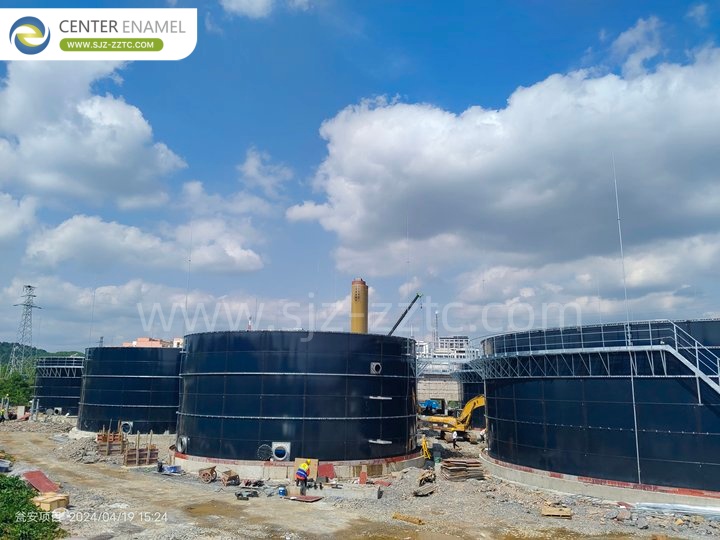
Center Enamel's proprietary GFS Tanks provide the corrosion-resistant, gas-tight containment that USR Process systems require, while the reactor design itself eliminates complex internal structures that would otherwise clog when treating high-solids food waste. Together, they form a complete solution for converting food waste from an environmental liability into biogas and compliant effluent.
Regional Market Dynamics Shaping Industrial Wastewater Treatment Demand
The global industrial wastewater treatment market is evolving rapidly, with distinct regional priorities shaping demand for different technologies and service models. The Asia-Pacific region, particularly China, has become the world's largest industrial wastewater treatment market, with the operation and maintenance service segment's contribution continuing to rise-marking a shift from project construction toward long-term operational management. The North American market focuses on upgrading existing facilities, while Europe emphasizes high-value-added resource recovery technologies.
Wastewater from the new energy industry chain, including lithium batteries, photovoltaics, and hydrogen, has become the most notable emerging growth area due to its complex composition and high treatment difficulty, generating significant demand for customized solutions. The maturity of third-party treatment models in industrial parks continues to improve, driving consolidation in the professional operation market. The Middle East has strong demand for advanced treatment and reuse of industrial wastewater due to water scarcity, while manufacturing transfer in Southeast Asia drives local industrial wastewater treatment facility construction demand. These regional trends collectively point to a growing need for treatment solutions that combine robust containment-such as GFS Tanks-with efficient biological processes like the USR Process.
GFS Tanks Deliver Corrosion Resistance That Concrete Cannot Match
Within any anaerobic treatment system, the containment vessel determines operational lifespan and maintenance economics. Center Enamel's independently developed double-sided double-layer enameling technology represents the industry's leading coating anti-corrosion solution, with corrosion resistance completely surpassing traditional concrete tanks.
Concrete tank interiors are inherently riddled with pores, allowing wastewater and acid/alkaline media to easily penetrate and corrode the structural layer. Long-term exposure leads to irreversible problems including internal wall spalling, water seepage, and rebar corrosion-issues that are difficult to repair and cannot be fundamentally resolved. GFS Tanks address this challenge directly through high-temperature enameling on both interior and exterior surfaces of steel panels, creating a dense, non-porous enamel finish that completely blocks corrosive liquids and biogas permeation. The enamel layer possesses extremely strong chemical stability, resisting acids, alkalis, salts, and microbial corrosion.
The operational contrast is substantial. Concrete tanks typically develop extensive corrosion and leakage after 5–8 years of use, while GFS Tanks anti-corrosion service life can exceed 30 years, with no need for frequent internal lining repairs throughout the service life. This significantly reduces long-term anti-corrosion maintenance investment and fundamentally eliminates environmental risks of medium leakage contaminating sites and groundwater. Compared to traditional concrete and FRP tanks, GFS Tanks coatings have no risk of peeling or blistering and are adaptable to highly corrosive conditions such as palm oil mill effluent, livestock manure, and chemical high-salinity wastewater-all conditions commonly encountered in food waste treatment. The long-term comprehensive cost advantages are outstanding.
How the USR Process Handles High-Solids, High-Oil Food Waste
The USR Process is specifically engineered for the most demanding organic waste streams. At its core, the system uses GFS Tanks with no complex media or precision three-phase separators, featuring a rugged clog-resistant structure. A bottom large-diameter anti-clogging distribution system is suitable for high-solids wastewater, preventing pipe clogging-a common failure point in conventional anaerobic systems. Supporting equipment includes influent lift pumps, simple pretreatment screens, and equalization tanks for impurity removal and water quality balancing. Simple top gas collection devices and biogas conveying/desulfurization equipment enable biogas resource recovery. Temperature, level, and pH online monitoring equipment ensures stable operation. Bottom large-diameter sludge discharge pipes and pumps allow rapid removal of high-concentration residual sludge, suitable for high-solids conditions. The complete system has extremely low failure rates, outstanding wear and clog resistance, and is far easier to maintain than conventional anaerobic processes. This makes the USR Process particularly well-suited for food waste streams where oil, solids, and salinity would quickly incapacitate more delicate reactor designs.
Complete Food Waste Treatment Solution: From Pretreatment to Final Polishing
The standardized treatment solution for food waste centers on a combination process of "pretreatment oil/grease/solids removal + anaerobic digestion + aerobic treatment + advanced treatment," specifically addressing high oil, high salt, and high organic load characteristics. Pretreatment uses mechanical sorting and crushing/screening to remove inorganic impurities like plastics and bone fragments. Three-phase separators recover oil for sale, significantly reducing wastewater oil content. DAF further removes emulsified oil to prevent oil entry into biological systems. The main stage uses CSTR anaerobic process, suitable for high-solids, high-oil organic fermentation with strong shock resistance, simultaneously producing biogas for energy recovery. Anaerobic effluent is followed by A/O or A²O aerobic processes for nitrogen and phosphorus removal. High-salinity wastewater requires salinity load control, with dilution or halophilic bacteria acclimation as needed. Final membrane treatment or constructed wetlands provide polishing for compliance. Digester tanks use Center Enamel GFS Tanks, resistant to oil and high-salt corrosion with excellent sealing to prevent odor escape. This integrated approach ensures that every stage of treatment is matched to the specific challenges of food waste, from the initial separation of oils and solids through to final discharge or reuse.
Product Matrix Supporting USR Process and Food Waste Treatment
Center Enamel has built a complete product matrix of "core storage tanks + supporting covers + specialty pressure vessels + complete environmental engineering services"-the only company globally to achieve integrated enamel frit research and development, self-manufacturing, and GFS Tanks application.
Core Product Categories and Applications
| Product Category | Key Features | Primary Applications |
| GFS Tanks | Double-sided hot-rolled double-layer enamel anti-corrosion technology; resistant to strong acids/alkalis, high salinity, microbial corrosion; modular quick assembly | All strong-corrosion conditions in wastewater, biogas, and chemical applications |
| Fusion Bonded Epoxy Tanks | Produced on China's first intelligent standardized production line | Drinking water, fire water, neutral medium storage |
| Aluminum Dome Covers | Proprietary high-strength aluminum alloy self-supporting structure; meets international waterproof and load-bearing standards | Tank sealing and biogas collection |
| Other Tanks | Carbon steel tanks, stainless steel tanks, composting tanks, various non-standard pressure vessels | Diverse industrial and environmental applications |
| Engineering Services | Environmental EPC general contracting, anaerobic process section subcontracting | Food waste, leachate, municipal wastewater, livestock biogas, petrochemical/metallurgical, seawater desalination |
This comprehensive matrix allows Center Enamel to serve as a single-source provider for USR Process projects, delivering tanks, covers, pressure vessels, and engineering services under one contract-reducing coordination complexity and ensuring that all components are designed to work together optimally.
Aluminum Geodesic Dome Roof: Superior Sealing for Biogas Collection
The Aluminum Geodesic Dome Roof, independently developed by Center Enamel, is manufactured using high-strength aluminum alloy plates through integral stamping. It features a triangular grid spherical self-supporting structure, enabling large-span full coverage without internal support columns. Made of aluminum alloy, the roof offers excellent weather resistance and corrosion resistance, capable of long-term protection against acid rain, salt spray, and UV radiation, suitable for various extreme outdoor climate conditions. The structural design complies with international AWWA D108 standards, with aluminum plate thickness, rib cross-sections, and joint connections all verified by finite element stress analysis, ensuring wind and snow load resistance that meets building code requirements across different global regions.
The weight of the Aluminum Geodesic Dome Roof is only one-third to one-half of a steel roof with the same span, significantly reducing the load on the tank top and allowing direct installation without tank wall reinforcement. The roof provides superior overall sealing performance, with double sealing between panels using specialized sealant strips and mechanical interlocking, enabling both airtight gas storage and enclosed odor control-suitable for biogas collection and storage, wastewater tank odor control, and drinking water contamination prevention. The support-column-free design does not interfere with the installation and operation of internal equipment such as mixers and water distributors. The aluminum material does not support microbial growth, requiring no anti-corrosion maintenance over long-term use, resulting in low total life-cycle costs.
Marketing and Technical Support for Global USR Process Projects
Successfully delivering USR Process projects worldwide requires more than technical capability-it demands deep understanding of local regulations, policies, and market conditions. Center Enamel's marketing team brings together environmental industry multi-skilled professionals and multilingual foreign trade specialists, with deep expertise in global biogas, wastewater treatment, and biomass new energy markets, accumulating extensive practical project experience in Southeast Asia, Africa, Europe, and the Americas.
The team is proficient in various countries' wastewater discharge regulations, biogas subsidy policies, and carbon trading rules, providing one-stop preliminary site survey, solution planning, and investment return analysis consulting services. With multilingual capabilities in English, French, Spanish, and Arabic, the team effectively communicates with clients worldwide, precisely matching regional industrial resources, project budgets, and environmental requirements. They customize high-cost-performance GFS Tanks and anaerobic reactor solutions based on client production capacity, treatment targets, and gas production expectations. Leveraging extensive overseas project experience, the team proactively helps clients avoid risks in overseas approvals, equipment import, and construction implementation-building a globally adaptable integrated environmental equipment business service system.
Ready to upgrade your food waste treatment with GFS Tanks and USR Process? Contact Center Enamel for a tailored solution that matches your specific waste characteristics and treatment goals. Request a free technical consultation and project feasibility assessment today.
Frequently Asked Questions
Q: What makes USR Process suitable for food waste treatment?
The USR Process features a rugged, clog-resistant structure with large-diameter distribution and sludge discharge systems. It handles high solids, oils, and salinity without complex separators that would otherwise clog-ideal for food waste conditions.
Q: How do GFS Tanks improve USR Process performance?
GFS Tanks provide gas-tight, corrosion-resistant containment with a 30+ year service life. Their enamel coating resists oils, salts, and acids in food waste, while superior sealing prevents biogas leakage and odor escape.
Q: Can Center Enamel supply both tanks and process equipment?
Yes. Center Enamel integrates enamel frit R&D, tank manufacturing, and environmental EPC contracting. We deliver GFS Tanks, aluminum dome covers, pressure vessels, and complete USR Process systems under one contract.