
Advanced GFS Tanks and Wastewater Treatment Solutions for a Changing World
Global industrial wastewater treatment policies are escalating from "compliance discharge" to mandatory "resource recovery" and "zero liquid discharge." The EU, through its Circular Economy Action Plan, requires member states to increase industrial wastewater reuse rates and extends carbon footprint accounting to the full life cycle of wastewater treatment.
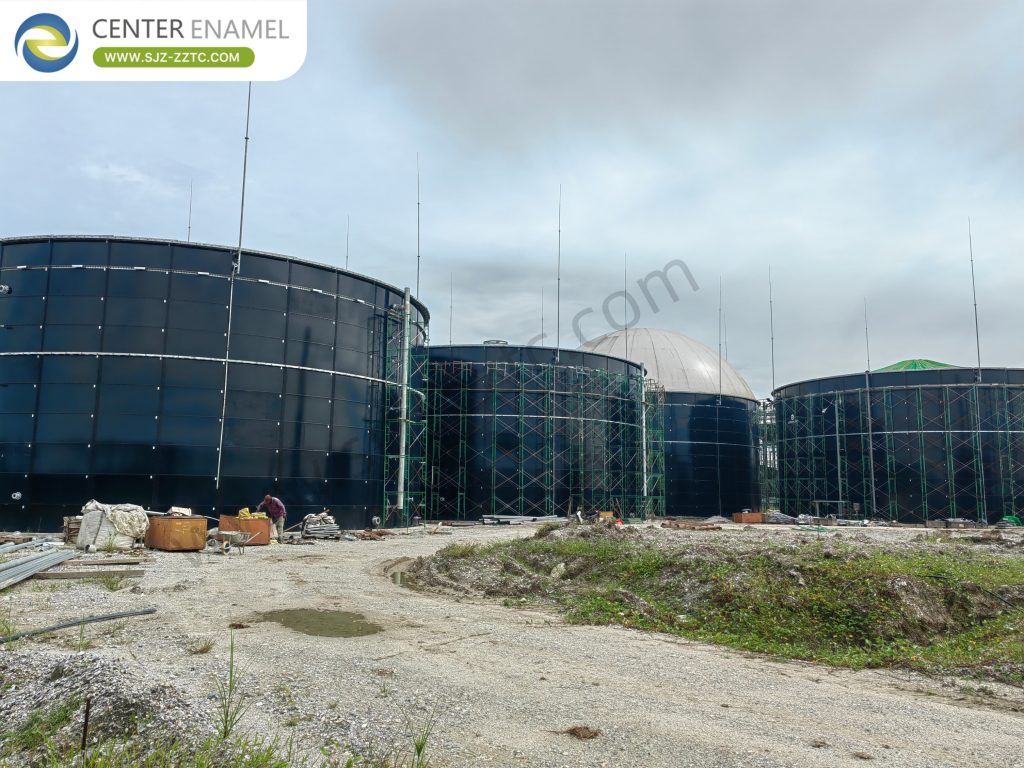
China continuously updates and tightens industrial water pollutant discharge standards, with increasingly stringent limits on total nitrogen, total phosphorus, and characteristic pollutants for industries such as chemicals, pharmaceuticals, and printing and dyeing. Some water-scarce regions and highly polluting industries are mandated to adopt zero or near-zero liquid discharge technologies. Germany has established a differentiated pretreatment technical standard system by industry, requiring industrial wastewater to meet specific quality requirements before discharge into municipal wastewater treatment plants, implementing strict source control.
To meet these rigorous standards, facilities require infrastructure that is both biologically efficient and structurally resilient. This is where integrating advanced GFS Tanks with tailored Wastewater Treatment Solutions becomes essential. Center Enamel combines proprietary manufacturing with deep process engineering to deliver systems that thrive under extreme conditions and strict environmental regulations.
Built to Endure: GFS Tanks in Extreme Climates
Environmental adaptability is a defining factor in project success, and GFS tanks are engineered to far surpass the limitations of concrete tanks. Concrete tanks are cast-in-place monolithic structures, with seismic and wind resistance entirely dependent on on-site construction quality. In remote areas, typhoon-prone zones, and earthquake belts, construction quality is difficult to control. Under strong earthquakes or typhoons, concrete tanks are prone to cracking and base settlement damage, with subsequent reinforcement costs equivalent to rebuilding.
GFS tanks undergo collection of local seismic intensity, maximum wind pressure, and foundation bearing capacity data before construction. They are customized with thickened steel panels, stiffening ribs, and anchored base components-all factory-prefabricated to standardized specifications. The bolted panel structure has excellent stress distribution capability, making it less prone to overall fracture under seismic and typhoon impacts. Minor foundation settlement will not cause through-cracking. Structural parameters can be flexibly adjusted for mountainous, coastal typhoon-zone, and high-seismic-zone projects, providing long-term protection against extreme natural climate damage.
The IC Process: Peak Efficiency in Wastewater Treatment Solutions
At the heart of modern high-strength wastewater treatment is the IC (Internal Circulation) process, which delivers top-tier treatment efficiency. Its footprint is only one-third that of traditional anaerobic processes for the same treatment capacity-a significant compactness advantage. The built-in gas-lift internal circulation requires no external recirculation equipment, providing autonomous forced mixing of sludge and water. Strong hydraulic mixing ensures thorough microbe-pollutant contact, greatly improving degradation efficiency and withstanding high water quality and hydraulic shock loads.
The dual-zone configuration combines high-efficiency degradation with deep polishing for stable effluent quality. It achieves a high degree of sludge granulation, strong activity, and very low washout. The system offers high automation, stable operation, low failure rates, large biogas production, and outstanding resource recovery benefits. Long-term energy and O&M costs are far lower than traditional anaerobic processes, making it highly suitable for large-flow, high-concentration industrial wastewater treatment.
The Environmental Profile of Beverage Effluent
Beverage wastewater pollutants are entirely natural food components (sugars, fruit juice, tea)-with no synthetic toxic chemicals, meaning extremely low chemical toxicity and good environmental safety. Core pollutants are high-concentration soluble sugars. While non-toxic to aquatic organisms, direct discharge leads to rapid aerobic decomposition, severely depleting dissolved oxygen and causing fish suffocation-a classic oxygen-demanding pollution problem.
Fruit juice organic acids lower receiving water pH, affecting aquatic life. Tea polyphenols affect water color and taste at trace levels. High sugar content promotes rapid microbial growth, mold, and decomposition/odor. Long-term discharge causes organic pollution, algal blooms, and eutrophication. Overall pollution is primarily oxygen-demanding organic pollution-there are no heavy metals or persistent organic accumulation risks, and pollutants are rapidly naturally degradable with short environmental recovery periods.
Proven Results: Sweden Organic Waste Biogas Project
The practical application of these GFS Tanks and treatment solutions is demonstrated by a 2024 installation in Northern Europe. The Sweden project uses UASB anaerobic process with Center Enamel GFS tanks as the main reaction equipment. The tank's ability to resist acid, alkali, and low-temperature corrosion makes it suited to Nordic organic waste fermentation conditions. The UASB process efficiently retains granular sludge and degrades organic pollutants, producing stable biogas. GFS tank assembly is convenient, with 30-year corrosion protection suited to Nordic cold climates, achieving both organic waste harmless treatment and biogas clean energy recovery-a European biomass environmental demonstration project.
| Sweden Project Parameter | Specification |
| Location and Year | Sweden, 2024 |
| Core Process | UASB Anaerobic Digestion |
| Containment | Center Enamel GFS Tanks |
| Single Tank Dimensions | Ø 19.11 m × 19.2 m height |
| Conditions Addressed | Acid/alkali corrosion; low-temperature Nordic climate |
| Project Outcome | Organic waste treatment + biogas energy recovery |
Flawless Execution: Installation and Global Experience
Delivering these advanced Wastewater Treatment Solutions requires flawless on-site execution. Center Enamel's installation team has practical experience from over 10,000 GFS tank projects globally, strictly following standardized construction procedures. They maintain full control over project mobilization, civil coordination, tank assembly, piping, and commissioning schedules and quality.
The team is proficient in complete standardized installation processes for GFS tanks, dual-membrane gas storage covers, USR/CSTR/IC anaerobic reactors, and biogas desulfurization/piping systems. They are adaptable to large-scale farms, industrial parks, remote mountainous sites, coastal high-corrosion sites, and other complex locations-strictly implementing unified global safety construction standards. For large overseas cross-border projects, the team can be deployed as complete units for on-site construction, technical training, and local worker practical instruction. This ensures full control over construction details, air-tightness testing, and corrosion protection, guaranteeing timely and stable commissioning of global environmental projects.
This delivery capability is backed by an extensive global benchmark portfolio. Center Enamel's project portfolio covers over 100 countries across Southeast Asia, Africa, Europe, and the Americas-with 30,000+ mature projects. We have accumulated complete industry solutions across palm oil, livestock, municipal, brewing, and food waste biogas, rapidly matching customized solutions for different regional climates, water quality, and regulations.
| Global Track Record | Metrics |
| Project Experience | 10,000+ GFS tank installations |
| Global Reach | 100+ countries (SE Asia, Africa, Europe, Americas) |
| Total Projects | 30,000+ mature projects delivered |
| Industry Sectors | Palm oil, livestock, municipal, brewing, food waste biogas |
Frequently Asked Questions
Q: Why are GFS Tanks preferred over concrete in extreme climates?
GFS tanks are factory-prefabricated with customized steel panels and anchored bases designed for local seismic and wind loads. Their bolted structure distributes stress evenly, resisting cracking from typhoons and earthquakes better than cast-in-place concrete.
Q: What are the main advantages of the IC Process?
The IC Process offers a footprint one-third the size of traditional anaerobic systems, requires no external recirculation pumps, and handles high hydraulic shock loads. It delivers stable effluent quality, high biogas production, and significantly lower O&M costs.
Q: How does Center Enamel support global projects?
We leverage regional sales centers and local agent networks to provide 24/7 after-sales support, on-site installation, and long-term warranty protection. Our team can deploy complete units for cross-border construction and technical training.
Ready to upgrade your facility's infrastructure? Contact our engineering team to discuss how GFS Tanks can lower your total cost of ownership.
Let Center Enamel design a resilient Wastewater Treatment Solution for your next project-reach out today to start the conversation.