
Why GFS Tanks Are the Backbone of Reliable Anaerobic Digestion for Livestock Manure
Livestock manure treatment projects succeed or fail on the durability of their core equipment. A digester must withstand corrosive digestate, aggressive biogas, seismic activity, typhoons, and decades of continuous operation. This is why Center Enamel builds its livestock manure treatment solutions around GFS Tanks-Glass-Fused-to-Steel vessels engineered for extreme conditions and optimized for Anaerobic Digestion. This guide explores the regional drivers of manure treatment, the climate adaptability of GFS Tanks, the supporting equipment that completes the system, and the full product and service matrix that makes Center Enamel a trusted global partner.
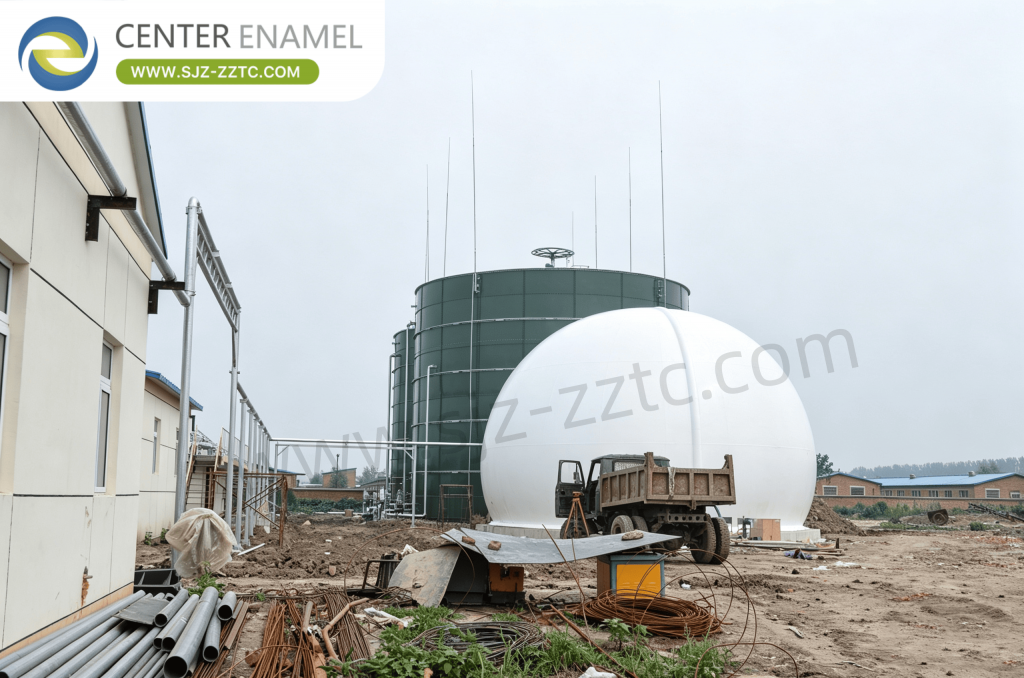
Regional Momentum in Livestock Manure Management
Global livestock inventories such as swine remain stable, but the way regions manage manure varies sharply. The United States has developed technical models represented by integrated crop-livestock systems with on-field application and Comprehensive Nutrient Management Plans. Denmark, the Netherlands, and others have developed centralized biogas projects with digestate application systems. China's large-scale farms still have considerable room for improvement in supporting biogas project coverage, and digestate resource utilization rates lag behind advanced European levels.
Greenhouse gas emissions from livestock account for a significant proportion of total global anthropogenic emissions, making manure management a critical battleground for agricultural carbon reduction. Latin American countries started later in manure management but are accelerating relevant infrastructure development. Across every region, the common requirement is the same: durable containment and efficient Anaerobic Digestion. That is where GFS Tanks prove their value.
GFS Tanks Engineered for Extreme Climates and Seismic Zones
GFS Tanks can undergo customized wind and seismic design based on project site climate and geological conditions, with environmental adaptability far superior to concrete tanks. Concrete tanks are cast-in-place monolithic structures, with seismic and wind resistance entirely dependent on on-site construction quality. In remote areas, typhoon-prone zones, and earthquake belts, construction quality is difficult to control. Under strong earthquakes or typhoons, concrete tanks are prone to cracking and base settlement damage, with subsequent reinforcement costs equivalent to rebuilding.
GFS Tanks take a different approach. Before construction, local seismic intensity, maximum wind pressure, and foundation bearing capacity data are collected, with customized thickened steel panels, stiffening ribs, and anchored base components-all factory-prefabricated to standardized specifications. The bolted panel structure has excellent stress distribution capability, making it less prone to overall fracture under seismic and typhoon impacts, and minor foundation settlement will not cause through-cracking. Structural parameters can be flexibly adjusted for mountainous, coastal typhoon-zone, and high-seismic-zone projects, providing long-term protection against extreme natural climate damage. This adaptability is essential for Anaerobic Digestion projects deployed across the world's most challenging geographies.
Supporting Equipment That Completes the Anaerobic Digestion System
A GFS tank alone does not make a treatment plant. The supporting equipment determines whether Anaerobic Digestion runs smoothly under high-solids conditions. Center Enamel's core equipment is the GFS tank, with no complex media or precision three-phase separators, featuring a rugged clog-resistant structure.
The bottom large-diameter anti-clogging distribution system is suitable for high-solids wastewater, preventing pipe clogging. Supporting equipment includes influent lift pumps, simple pretreatment screens, and equalization tanks for impurity removal and water quality balancing. Simple top gas collection devices and biogas conveying and desulfurization equipment enable biogas resource recovery. Temperature, level, and pH online monitoring equipment provides operational visibility. Bottom large-diameter sludge discharge pipes and pumps allow rapid removal of high-concentration residual sludge, suitable for high-solids conditions.
The complete system has extremely low failure rates, outstanding wear and clog resistance, and is far easier to maintain than conventional anaerobic processes. Paired with GFS Tanks, this equipment set forms a dependable foundation for long-term Anaerobic Digestion.
Standardized Treatment Solutions for Rural Livestock Wastewater
With tanks and equipment in place, the treatment train itself must fit agricultural and rural realities. Center Enamel's standardized approach uses a low-cost treatment train of "solid-liquid separation + Anaerobic Digestion + ecological polishing," specifically addressing high-suspended-solids, high-concentration organic wastewater.
Pretreatment uses solid-liquid separation equipment and sedimentation tanks to rapidly remove solid impurities like manure and feed residues, significantly reducing biochemical load. The main stage uses USR/CSTR anaerobic processes for efficient organic degradation with simultaneous biogas energy recovery. Subsequent A/O biological treatment precisely removes nitrogen and phosphorus, with final constructed wetlands or stabilization ponds for polishing.
Digester tanks use Center Enamel GFS Tanks, resistant to manure corrosion and with convenient assembly for rural projects. The entire process has strong shock load resistance, adapts to significant water quality and quantity fluctuations, is simple to operate, and achieves both pollution control and resource recycling.
Proven Results-The Bangladesh Poultry Farm Reference Project
The effectiveness of this integrated approach is demonstrated by a benchmark project in Southeast Asia. The Bangladesh Large-Scale Poultry Farm Manure Resource Recovery Project targets local poultry farm manure resource recovery with daily treatment of 47 tons.
Influent COD, BOD, and SS measure as high as 50,000 mg/L, 25,000 mg/L, and 50,000 mg/L. After CSTR + UASB anaerobic treatment, all three parameters are reduced to below 200 mg/L, 100 mg/L, and 100 mg/L-effluent compliant with local environmental discharge standards. The project produces approximately 4,900 m³ of biogas daily. Each cubic meter of biogas can generate 2 kWh of electricity, with daily power generation of 9,800 kWh-simultaneously achieving pollutant reduction and clean energy recovery.
Table 1: Bangladesh Poultry Farm Manure Recovery Project-Performance Results
| Parameter | Influent Concentration | After Anaerobic Treatment | Removal Rate |
| COD | 50,000 mg/L | Below 200 mg/L | >99.6% |
| BOD | 25,000 mg/L | Below 100 mg/L | >99.6% |
| SS | 50,000 mg/L | Below 100 mg/L | >99.8% |
| Daily Treatment Capacity | 47 tons poultry manure | - | - |
| Biogas Production | 4,900 m³/day | - | - |
| Power Generation | 9,800 kWh/day | - | 2 kWh per m³ biogas |
A Full-Category Product Matrix Built Around GFS Tanks
Center Enamel has built a complete product matrix of "core storage tanks + supporting covers + specialty pressure vessels + complete environmental engineering services"-the only company globally to achieve integrated enamel frit R&D, self-manufacturing, and GFS tank application.
At the core are Proprietary GFS Tanks, using proprietary double-sided hot-rolled double-layer enamel anti-corrosion technology-resistant to strong acids, alkalis, high salinity, and microbial corrosion-with modular quick assembly suitable for all strongly corrosive conditions in wastewater, biogas, and chemical applications. Supporting Fusion Bonded Epoxy Tanks are produced on China's first intelligent standardized production line, primarily for drinking water, fire water, and neutral medium storage. For sealing, Aluminum Dome Covers use a proprietary high-strength aluminum alloy self-supporting structure meeting international waterproof and load-bearing standards, suitable for tank sealing and biogas collection. Other tanks include Carbon Steel Tanks, Stainless Steel Tanks, Composting Tanks, and various non-standard pressure vessels.
Engineering services complete the offering: Environmental EPC General Contracting and Anaerobic Process Section Subcontracting provide one-stop coverage across food waste, leachate, municipal wastewater, livestock biogas, petrochemical and metallurgical, and seawater desalination industries-customizable tank volume, corrosion protection grade, and complete process solutions with integrated equipment manufacturing and engineering construction.
Table 2: Center Enamel Product Matrix and Application Scope
| Category | Product | Key Technology | Primary Application |
| Core | GFS Tanks | Double-sided double-layer enamel | Wastewater, biogas, chemical |
| Supporting | Fusion Bonded Epoxy Tanks | Intelligent standardized line | Drinking water, fire water |
| Sealing | Aluminum Dome Covers | Self-supporting alloy structure | Tank sealing, biogas collection |
| Other | Carbon/Stainless Steel Tanks | Non-standard fabrication | Industrial storage |
| Other | Composting Tanks | Organic waste processing | Agricultural recycling |
| Services | Environmental EPC | General contracting | Multi-sector delivery |
| Services | Anaerobic Process Subcontracting | Specialized process section | Biogas integration |
Global Service System Ensuring Long-Term Project Success
Equipment and process design are only the beginning. Leveraging regional sales centers in China and overseas local agent networks, Center Enamel has established a complete after-sales service loop covering all markets.
The system provides four core service pillars: a 24/7 rapid response mechanism, on-site domestic and overseas installation services, full-project-cycle after-sales support, and long-term warranty protection-forming a complete service chain from preliminary site survey, mid-term construction management, to long-term inspection and maintenance. The entire system is uniformly adapted to both domestic and international project service standards, coordinating personnel scheduling, material support, and on-site coordination for simultaneous projects across multiple regions-significantly reducing customer multi-party coordination costs and ensuring efficient domestic and overseas project delivery. For GFS Tanks-based Anaerobic Digestion projects, this service backbone protects the investment over its full operational life.
From extreme-climate engineering to full EPC delivery, Center Enamel provides the GFS Tanks and Anaerobic Digestion expertise your livestock manure project needs. Reach out to our team today for a tailored design consultation and project assessment. Let us demonstrate how our proven product matrix and global service system can turn your manure treatment challenge into a reliable, long-term resource recovery asset.
Frequently Asked Questions
Why are GFS Tanks better than concrete for Anaerobic Digestion?
GFS Tanks resist corrosion from hydrogen sulfide and organic acids, are factory-prefabricated for consistent quality, withstand seismic and typhoon loads, and last over 30 years-outperforming cast-in-place concrete in remote or extreme sites.
How do GFS Tanks handle high-solids livestock wastewater?
They integrate with anti-clogging distribution systems, large-diameter sludge discharge pipes, and rugged USR/CSTR processes, tolerating high suspended solids without clogging or sludge washout.
What services does Center Enamel provide beyond tank supply?
We deliver full EPC contracting, anaerobic process integration, biogas collection and desulfurization, global installation, and long-term after-sales support across multiple industries.