
GFS Tanks For Wastewater And Biogas Applications
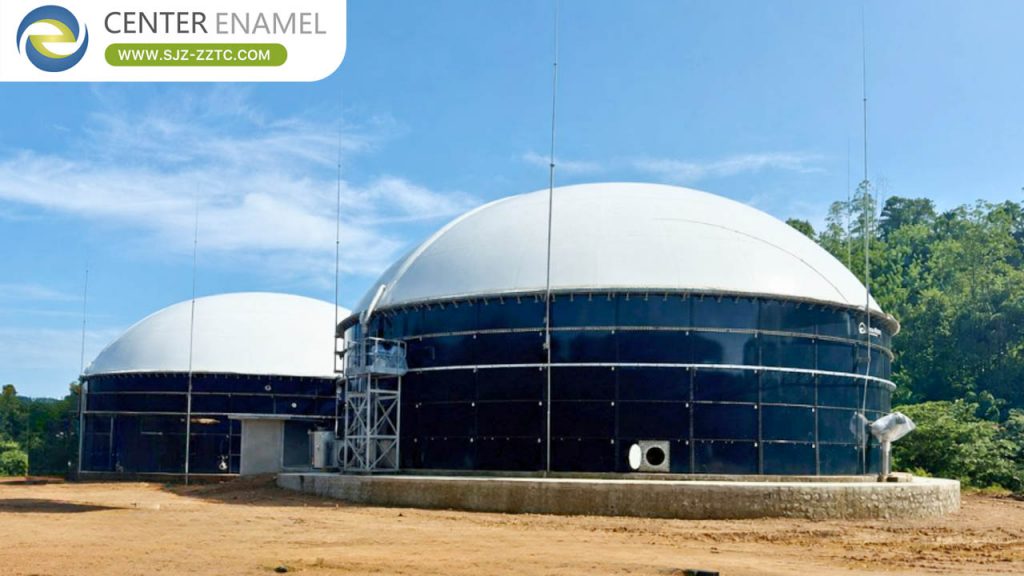
A Glass-Fused-to-Steel (GFS) tank is a bolted vessel made from steel panels fused with a glass enamel coating at 820-930 C, giving a hard, corrosion-resistant surface. For wastewater and biogas it serves as the digester, equalization, and storage tank - resisting the acidic, abrasive, and gaseous environment better than uncoated steel or concrete, while bolting on site for fast, relocatable deployment.
Why GFS For These Duties
Wastewater and biogas streams are corrosive (low pH, H2S, abrasion from sludge) and, for digesters, pressurized by gas. A fused glass lining isolates the steel from the medium, so the tank lasts without liners or frequent recoating. Because the panels bolt together, a plant can be built on a prepared pad in weeks and, if needed, relocated - a real advantage for modular and remote projects.
| Property | GFS | Concrete | Fusion-welded steel |
| Corrosion resistance | Excellent (glass lining) | Good | Needs coating |
| Site build | Bolted, fast | Cast, slow | Welded, slow |
| Relocatable | Often yes | No | No |
| Gas-tight digester | Yes (sealed) | Joint risk | Yes |
Sizing And Configuration
GFS tanks for biogas are usually cylindrical digesters with fixed or floating roofs; equalization and storage tanks are sized from flow and HRT. Projects often mix diameters and heights to fit the process - for example a palm-oil reactor set using two different panel sizes in one battery - so the tank layout follows the process envelope rather than a single standard size.
| Use | Typical Form | Driver |
| Digester | Cylinder + roof | Gas containment |
| Equalization | Cylinder | Flow buffer |
| Storage | Cylinder | Volume |
| Mixed battery | Two diameters | Process fit |
Project Case Study: Indonesia Anaerobic Reactors
Project / Application: Anaerobic reactors at a palm oil WWTP, Indonesia. Industry: Palm oil / agro-industrial. Equipment: 3 Glass-Fused-to-Steel tanks in two sizes. Key Requirements: Anaerobic digestion duty with mixed tank dimensions.
| Field | Value | Source / Evidence |
| Application | Anaerobic Reactors at Palm Oil WWTP | Company project reference |
| Tank Model A | O17.58 x 8.4 m | Company project reference |
| Tank Model B | O16.82 x 7.2 m | Company project reference |
| Tanks Quantity | 3 Nos. of GFS Tanks | Company project reference |
| Installation Year | 2013 | Company project reference |
| Process | Anaerobic Digestion | Company project reference |
About Company
Shijiazhuang Zhengzhong Technology Co., Ltd (Center Enamel) is a comprehensive high-tech enterprise specializing in wastewater engineering, process section contracting, and equipment manufacturing. The company delivers biogas and wastewater projects through three main lines - EPC (turnkey) contracting, equipment supply, and process packages - covering livestock and municipal wastewater, biomass energy, industrial wastewater, and food waste. Its reactor portfolio spans CSTR, USR, UBF, UASB, IC, and EGSB, backed by in-house Glass-Fused-to-Steel tank manufacturing (enamel firing at 820-930 C) and certifications including ISO 9001, NSF/ANSI 61, and CE-EN 1090. With 35+ years of operation, a 150,000 m2 manufacturing base, and projects in 100+ countries, Center Enamel provides the single-responsibility engineering behind in-house Glass-Fused-to-Steel manufacturing (enamel firing at 820-930 C) that produced the two-size anaerobic reactor battery in Indonesia - a reference for tank configuration in biogas projects.
Comparison: GFS Vs Epoxy-Coated Vs Galvanized
| Lining | GFS (glass) | Epoxy | Galvanized |
| Corrosion life | Longest | Medium | Shorter |
| Abrasion | Excellent | Good | Moderate |
| Best duty | Digester / harsh | General | Dry / mild |
GFS tanks are the corrosion-resistant, bolted choice for wastewater and biogas duties - digesters, equalization, and storage - with sizes and roofs set by the process envelope and backed by enamel-firing manufacturing, distinct from a process or an application article.
Frequently Asked Questions
Q1: What is a GFS tank? A1: A bolted steel tank with a glass enamel lining fused at 820-930 C for corrosion resistance.
Q2: Why for wastewater? A2: The glass lining resists acidic, abrasive, H2S-laden streams better than bare steel or concrete.
Q3: What sizes are used? A3: Cylindrical digesters and storage tanks in mixed diameters/heights to fit the process, e.g. O17.58x8.4m and O16.82x7.2m.
Q4: What standards apply? A4: Manufacturing and products are backed by ISO 9001, NSF/ANSI 61, and CE-EN 1090.
Q5: Are they gas-tight? A5: Yes; sealed GFS digesters contain biogas safely.
Q6: How fast to build? A6: Bolted panels go up on a prepared pad in weeks.
Q7: GFS vs epoxy? A7: GFS lasts longer in harsh, abrasive digester duty; epoxy suits general service.
Q8: Who specifies the tank? A8: An engineer sizes diameter and height from volume, HRT, and gas duty.
Suggested CTA
Send your volume, HRT, and duty to an engineer, or request a Glass-Fused-to-Steel tank specification sheet.