
How IC Process and GFS Tanks Handle High-Strength Effluent in Dairy Wastewater Treatment Projects
Dairy effluent is deceptively forgiving. It is rich in lactose, milk proteins, and milk fats-natural organics that degrade readily and carry no heavy metals or persistent toxins. Yet that same biodegradability is what makes it aggressive: high COD/BOD loads strip oxygen from receiving water within hours, milk fats form surface films that block reoxygenation, and protein decomposition releases ammonia that feeds eutrophication. A dairy wastewater treatment project succeeds or fails on how quickly and reliably it intercepts this load-which is why the pairing of the IC process for biological treatment and GFS tanks for containment has become the standard configuration for serious dairy processors.
Policy Pressure Is Redefining What "Compliant" Means
Global industrial wastewater treatment policies are escalating from "compliance discharge" to mandatory "resource recovery" and "zero liquid discharge." The EU, through its Circular Economy Action Plan, requires member states to increase industrial wastewater reuse rates and extends carbon footprint accounting to the full life cycle of wastewater treatment. China continuously updates and tightens industrial water pollutant discharge standards, with increasingly stringent limits on total nitrogen, total phosphorus, and characteristic pollutants for industries such as chemicals, pharmaceuticals, and printing and dyeing. Some water-scarce regions and highly polluting industries are mandated to adopt zero or near-zero liquid discharge technologies. Germany has established a differentiated pretreatment technical standard system by industry, requiring industrial wastewater to meet specific quality requirements before discharge into municipal wastewater treatment plants, implementing strict source control. For dairy plants, the message is that biogas recovery from anaerobic digestion is no longer a bonus-it is increasingly part of what regulators expect to see documented.
Where the IC Process Fits Best
The IC reactor is primarily for high-concentration, high-flow soluble industrial organic wastewater, covering brewery, beverage, starch, pharmaceutical, chemical, and papermaking high-strength wastewater. It suits land-constrained projects with high treatment efficiency requirements in large industrial wastewater treatment facilities, and can serve as the primary process for high-strength wastewater with rapid COD/BOD removal. It is suitable for centralized industrial park WWTPs and large enterprise proprietary treatment systems, particularly for wastewater with significant quality fluctuations and extremely high pollutant concentrations. It is not suitable for high-solids, high-viscosity wastewater-so dairy pretreatment must remove fats and solids before the reactor. Within those boundaries, it is the preferred anaerobic process for modern high-efficiency industrial wastewater treatment, and dairy effluent's moderate temperature range and excellent biodegradability make it a strong match.
The Economics of Dairy O&M
O&M costs are moderate to low with outstanding resource recovery benefits and good overall economics. Excellent wastewater biodegradability requires no expensive oxidants or detoxification agents-only small amounts of flocculants and pH adjusters-so chemical costs stay low. Anaerobic digestion has high efficiency and large biogas production, delivering stable biogas for plant heating and power generation that significantly offsets energy costs. Equipment is simple and durable-conventional pumps, mixers, and aerators-with low failure rates and low maintenance costs. CIP intermittent discharge can be balanced through equalization tanks, avoiding frequent parameter adjustments and reducing labor requirements. Recovered oil from oil separation can be sold, further reducing treatment costs. Because dairy products carry high value-added, treatment costs represent a very small proportion of production costs. Overall resource recovery revenues-biogas plus oil recovery-generally cover O&M costs, making dairy economics superior to most industrial wastewaters.
Dairy Wastewater Treatment Economics and Process Fit
| Cost / Process Factor | Dairy Wastewater Performance | Implication |
| Chemical consumption | Low-flocculants and pH adjusters only | No oxidants or detoxification agents needed |
| Energy balance | Large, stable biogas output | Offsets plant heating and power costs |
| Equipment profile | Conventional pumps, mixers, aerators | Low failure rates and maintenance costs |
| CIP discharge handling | Balanced via equalization tanks | Minimal parameter adjustment and labor |
| By-product recovery | Recovered oil can be sold | Further reduces treatment costs |
| Overall economics | Resource recovery covers O&M costs | Superior to most industrial wastewaters |
GFS Tanks Engineered for Extreme Climates
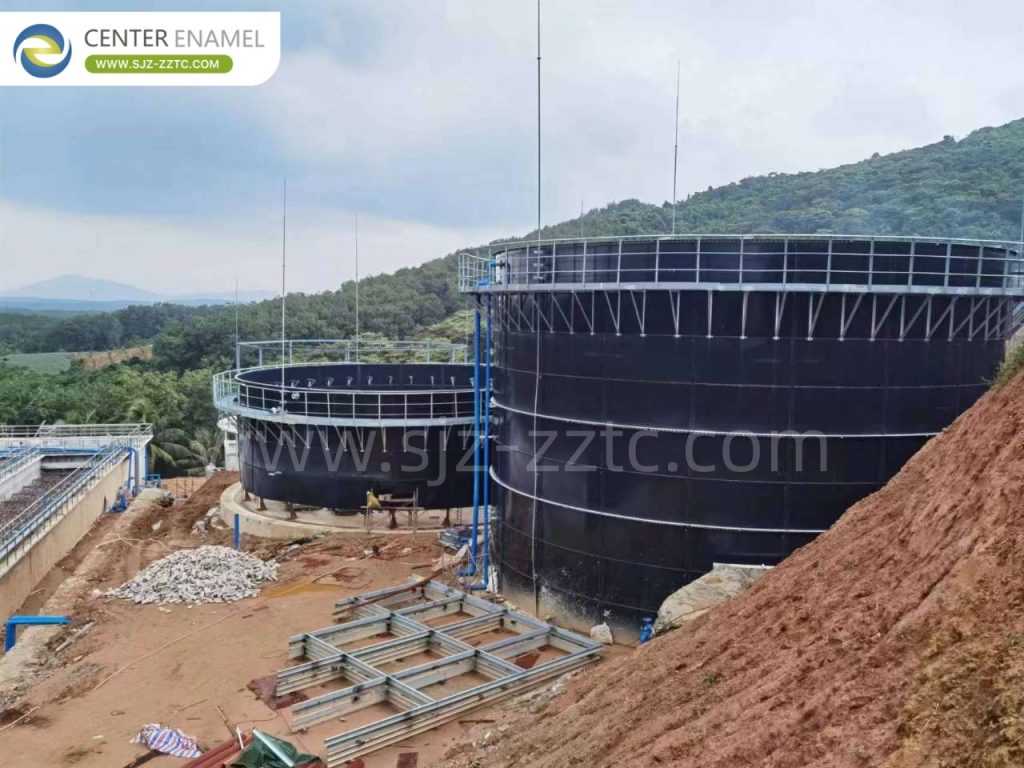
Containment quality determines whether that favorable economics survive contact with the site. GFS tanks can undergo customized wind and seismic design based on project site climate and geological conditions, with environmental adaptability far superior to concrete tanks. Concrete tanks are cast-in-place monolithic structures, with seismic and wind resistance entirely dependent on on-site construction quality. In remote areas, typhoon-prone zones, and earthquake belts, construction quality is difficult to control. Under strong earthquakes or typhoons, concrete tanks are prone to cracking and base settlement damage, with subsequent reinforcement costs equivalent to rebuilding.
GFS tanks take a different route: local seismic intensity, maximum wind pressure, and foundation bearing capacity data are collected before construction, with customized thickened steel panels, stiffening ribs, and anchored base components-all factory-prefabricated to standardized specifications. The bolted panel structure has excellent stress distribution capability, making it less prone to overall fracture under seismic and typhoon impacts, and minor foundation settlement will not cause through-cracking. Structural parameters can be flexibly adjusted for mountainous, coastal typhoon-zone, and high-seismic-zone projects, providing long-term protection against extreme natural climate damage.
Global Delivery Coverage and Modular Service
Design adaptability only matters if it can be delivered where the plant sits. Center Enamel is the pioneer of Chinese GFS equipment exports, with installation service coverage across over 100 countries and regions-possessing full delivery capability across climates, regulations, and geographies. Overseas coverage includes Southeast Asia (Vietnam, Thailand, Malaysia, Indonesia, Cambodia, Bangladesh, Nepal), Africa (Ghana, South Africa, Mali, Guinea, Zambia, Kenya, Pakistan), Europe and the Americas (Sweden, USA, Russia), the Middle East, and Latin America-adaptable to tropical rainy high-salt-spray, high-altitude mountainous, Nordic severe cold, and high-standard European and American facility conditions.
The company uses a dual-service model of own cross-border construction teams plus overseas local agent coordination, providing one-stop services including on-site survey, on-site installation, process commissioning, and operator training regardless of whether clients are in developed countries or remote developing regions. Coverage spans biogas engineering, municipal wastewater, industrial wastewater, livestock manure, and drinking water storage, with the full capability to undertake large-scale tank farm projects in any country worldwide. Modular GFS tank assembly brings short construction periods and dismantlable, reusable capability-suitable for overseas short-term projects, phased expansions, and relocation needs-backed by full-lifecycle after-sales O&M support.
Global Delivery Coverage and Service Model
| Dimension | Coverage / Capability | Client Benefit |
| Geographic reach | 100+ countries and regions | Single contractor across multiple markets |
| Southeast Asia | Vietnam, Thailand, Malaysia, Indonesia, Cambodia, Bangladesh, Nepal | Tropical high-salt-spray adaptation |
| Africa | Ghana, South Africa, Mali, Guinea, Zambia, Kenya, Pakistan | Remote-site delivery capability |
| Europe / Americas | Sweden, USA, Russia | High-standard facility compliance |
| Service model | Own cross-border teams + local agent coordination | Survey, installation, commissioning, training |
| Tank assembly | Modular GFS, dismantlable and reusable | Phased expansion and relocation flexibility |
Roofing Choices for Biogas Capture and Odor Control
The final layer of a dairy wastewater treatment project is the tank cover, which determines whether biogas can be captured and odors contained. The Aluminum Geodesic Dome Roof independently developed by Center Enamel is manufactured using high-strength aluminum alloy plates through integral stamping, featuring a triangular grid spherical self-supporting structure that enables large-span full coverage without internal support columns. Made of aluminum alloy, the roof offers excellent weather resistance and corrosion resistance, capable of long-term protection against acid rain, salt spray, and UV radiation, suitable for various extreme outdoor climate conditions. The structural design complies with international AWWA D108 standards, with aluminum plate thickness, rib cross-sections, and joint connections all verified by finite element stress analysis, ensuring wind and snow load resistance that meets building code requirements across different global regions.
Its weight is only one-third to one-half of a steel roof with the same span, significantly reducing the load on the tank top and allowing direct installation without tank wall reinforcement. The roof provides superior overall sealing performance, with double sealing between panels using specialized sealant strips and mechanical interlocking, enabling both airtight gas storage and enclosed odor control-suitable for biogas collection and storage, wastewater tank odor control, and drinking water contamination prevention. The support-column-free design does not interfere with the installation and operation of internal equipment such as mixers and water distributors, and the aluminum material does not support microbial growth, requiring no anti-corrosion maintenance over long-term use and resulting in low total life-cycle costs.
Frequently Asked Questions
Why does dairy wastewater need pretreatment before the IC process?
The IC reactor is not suitable for high-solids, high-viscosity wastewater, so oil separation and DAF must remove fats and solids first to prevent fouling and reactor upset.
Can GFS tanks be specified for typhoon and earthquake zones?
Yes. Site seismic intensity, wind pressure, and bearing capacity data drive customized panels, ribs, and anchored bases, all factory-fabricated for consistent quality.
Do biogas revenues really offset dairy O&M costs?
In most cases, yes. Biogas plus recovered oil generally cover O&M costs, and dairy treatment costs remain a small share of high-value production costs.
Share your plant's flow rate, fat load, and site conditions with our engineers for a preliminary IC process and GFS tank configuration review.
Talk to Center Enamel about your dairy wastewater treatment project and let our team map the process train, tank specification, and delivery schedule to your site.