
How GFS Tanks Make Industrial Wastewater Treatment Flexible and Compact
Industrial wastewater treatment is no longer a single global story. Regional priorities differ sharply, layouts grow tighter, and operating economics decide which projects survive. Across all of these pressures, two constants stand out: containment must be adaptable, and processes must be efficient. That is why GFS Tanks have become the backbone of modern Industrial Wastewater Treatment, and why Center Enamel pairs them with proven anaerobic processes and full-lifecycle service.
Regional Shifts Reshaping the Market
The Asia-Pacific region, particularly China, has become the world's largest industrial wastewater treatment market, with the operation and maintenance service segment's contribution continuing to rise-marking a shift from project construction to long-term operational management. North America focuses on upgrading existing facilities, while Europe emphasizes high-value-added resource recovery technologies. Wastewater from the new energy chain-lithium batteries, photovoltaics, hydrogen-has emerged as the fastest-growing area due to complex composition and high treatment difficulty, generating strong demand for customized solutions. Third-party treatment models in industrial parks continue to mature, driving consolidation in the professional operation market. The Middle East shows strong demand for advanced treatment and reuse due to water scarcity, while manufacturing transfer in Southeast Asia fuels local facility construction. Every one of these trends points toward compact, flexible, high-efficiency systems-precisely the profile of GFS tank-based plants.
Built for Intensive Plant Layouts
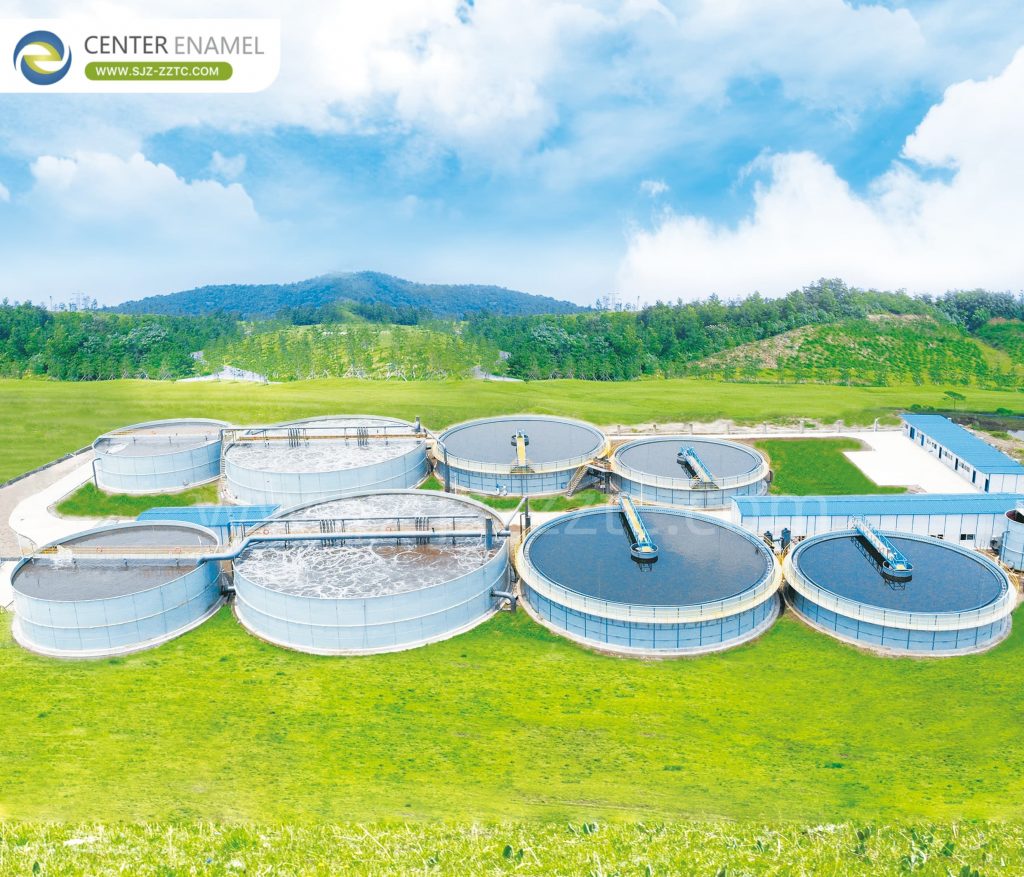
GFS tanks offer flexible customization of size and appearance with higher land utilization rates, making them ideally suited to modern compact plant layouts. Concrete tanks cannot alter volume or shape after pouring; their heavy bases occupy large areas, complicating placement on narrow or irregular plots, and their rough, uniform appearance rarely matches modern facility aesthetics. GFS tanks take a different approach: volume can be precisely customized as needed, with capacities from dozens of cubic meters to 50,000 cubic meters freely selectable. Tank height and diameter can be flexibly combined to fit narrow or irregularly shaped plots, effectively saving plant land occupation. Enamel color customization is also supported, achieving visual harmony with plant buildings and environmental facilities. During later expansion, GFS tanks can be directly adjusted in layout and enlarged; concrete tanks, being monolithic, must be demolished and rebuilt. This aligns well with the intensive construction and aesthetic operation needs of industrial parks.
IC Reactors: The Engine for High-Strength Streams
Within anaerobic processing, the IC reactor serves high-concentration, high-flow soluble industrial organic wastewater-covering brewery, beverage, starch, pharmaceutical, chemical, and papermaking high-strength streams. It suits land-constrained projects with high treatment efficiency requirements in large facilities, and can serve as the primary process for rapid COD/BOD removal. It is equally suited to centralized industrial park WWTPs and large enterprise proprietary treatment systems, particularly where wastewater quality fluctuates significantly and pollutant concentrations run extremely high. It is not suitable for high-solids, high-viscosity wastewater. For modern high-efficiency Industrial Wastewater Treatment, it remains the preferred anaerobic process.
Beverage Wastewater: Where Economics Turn Favorable
Beverage wastewater stands out for outstanding resource recovery economics. Its excellent biodegradability means sugars act as the best possible anaerobic digestion substrate-no specialty chemicals are needed, only small amounts of pH adjusters and flocculants, keeping chemical costs very low. Anaerobic digestion produces large, stable biogas volumes for plant heating and power generation, significantly offsetting or fully covering O&M energy costs. Equipment is simple and durable-conventional pumps, distributors, and three-phase separators, with no high-end precision wear parts-yielding extremely low failure rates and low maintenance costs. Stable, controllable water quality with high automation keeps labor requirements and costs low, while low suspended solids mean low sludge production and low disposal costs. Overall, biogas revenue generally covers O&M costs, making beverage wastewater the most economically favorable high-concentration organic category.
Proven Case: Sweden Organic Waste Biogas Project
Field performance confirms the design logic. A 2024 installation in Northern Europe applied the UASB anaerobic process with Center Enamel GFS tanks as the main reaction equipment.
| Parameter | Specification |
| Location and Year | Sweden, 2024 |
| Core Process | UASB Anaerobic Digestion |
| Containment | Center Enamel GFS Tanks |
| Single Tank Dimensions | Ø 19.11 m × 19.2 m height |
| Conditions Addressed | Acid/alkali and low-temperature corrosion |
| Corrosion Protection | 30-year design life |
| Project Outcome | Organic waste treatment + biogas energy recovery |
The tanks resist acid, alkali, and low-temperature corrosion, suiting Nordic organic waste fermentation conditions. The UASB process efficiently retains granular sludge and degrades organic pollutants, producing stable biogas, while convenient GFS assembly and 30-year corrosion protection meet the demands of cold climates-achieving both harmless organic waste treatment and clean biogas recovery as a European biomass environmental demonstration project.
Service That Protects the Whole Lifecycle
Technology only performs when support keeps pace. Center Enamel's after-sales team adheres to rapid response, professional efficiency, and full-cycle support-providing 24/7 full-lifecycle O&M support to global clients. Standard remote services include fault diagnosis, process parameter adjustment, and tank anti-corrosion maintenance guidance. For domestic and long-distance overseas clients, technical service personnel can be dispatched for on-site inspection, annual inspection, and equipment refurbishment as needed. The team also maintains long-term feedback tracking, regularly collecting tank and anaerobic equipment operational data to continuously optimize product structure and support processes. External technical expert teams add specialized support for anaerobic process commissioning, biogas upgrading O&M, and wastewater upgrade or retrofit projects-ensuring long-term stable operation and steadily improving global client satisfaction and repurchase rates.
Flexible Delivery, Wherever the Project Lands
Delivery flexibility matters as much as equipment quality. Center Enamel combines its own cross-border construction teams with a global localized agent network. Modular GFS tank assembly means short construction periods and dismantlable, reusable capability-suitable for overseas short-term projects, phased expansions, and relocation needs-while full-lifecycle after-sales O&M support ensures long-term stable client operations.
Frequently Asked Questions
Can GFS tanks fit irregular or space-limited sites?
Yes. Volume is customizable from dozens to 50,000 cubic meters, and height-diameter combinations adapt to narrow or irregular plots, with color options for visual harmony.
Which wastewater suits IC reactors?
High-concentration, high-flow soluble organic streams such as brewery, beverage, starch, pharmaceutical, and papermaking wastewater-not high-solids or high-viscosity flows.
How are overseas projects supported?
Through 24/7 remote diagnostics, dispatched on-site service, local agent networks, and full-lifecycle O&M backed by cross-border construction teams.
Send us your site layout and wastewater profile, and our engineers will propose a tank configuration matched to your footprint. Talk to Center Enamel today and let a tailored GFS tank solution move your industrial wastewater project forward.