
How Anaerobic Digestion Technology and GFS Tanks Solve Food Waste Challenges
The Asia-Pacific region, particularly China, has become the world's largest industrial wastewater treatment market, with the operation and maintenance service segment's contribution continuing to rise, marking a shift from project construction to long-term operational management. The North American market focuses on upgrading existing facilities, while Europe emphasizes high-value-added resource recovery technologies.
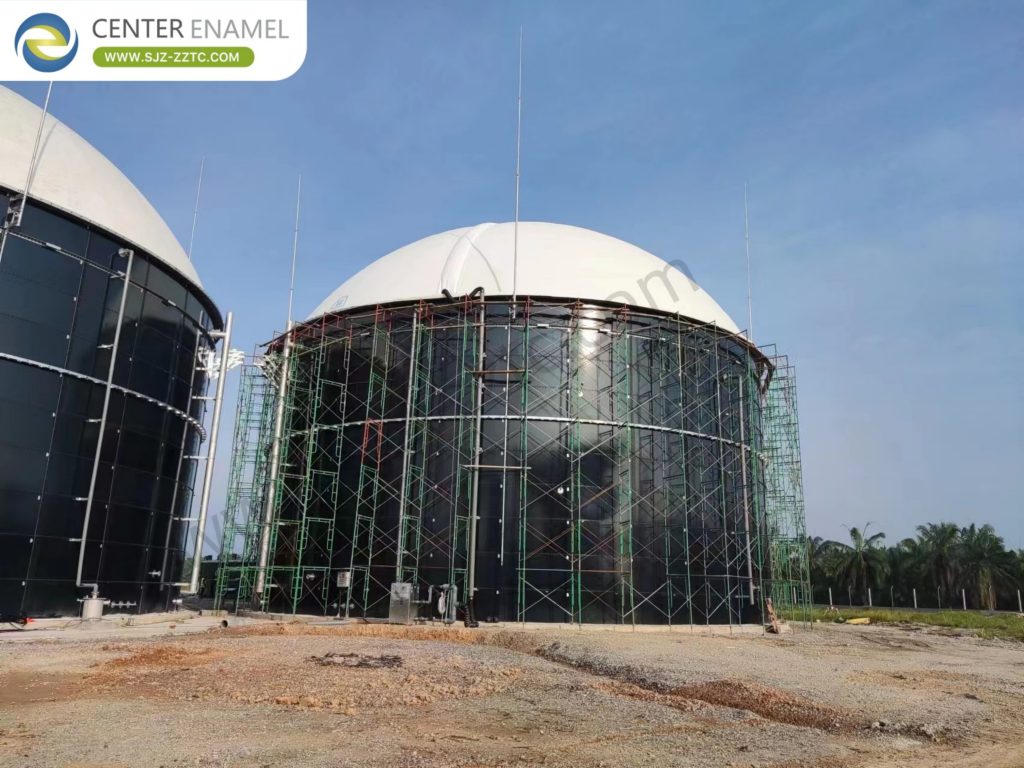
Wastewater from the new energy industry chain (lithium batteries, photovoltaics, hydrogen) has become the most notable emerging growth area due to its complex composition and high treatment difficulty, generating significant demand for customized solutions. The maturity of third-party treatment models in industrial parks continues to improve, driving consolidation in the professional operation market. The Middle East has strong demand for advanced treatment and reuse of industrial wastewater due to water scarcity; manufacturing transfer in Southeast Asia drives local industrial wastewater treatment facility construction demand.
These regional shifts explain why demand for advanced Anaerobic Digestion Technology and durable GFS Tanks continues to growparticularly in food waste, where high oil and salt content defeats conventional processes and concrete structures.
Full-Process Factory Standardization for GFS Tanks
GFS tanks are fully factory-prefabricated to standardized specifications, with finished product quality stability far exceeding cast-in-place concrete tanks. All concrete tank processes are completed in the open air, with rebar tying, concrete pouring, and curing heavily influenced by worker skill, temperature, and rainfall. Wall thickness, density, and strength vary significantly between batches, with hidden defects like honeycombing, voids, and insufficient wall thickness commonquality cannot be uniformly controlled.
Center Enamel's GFS tank steel panels, seals, and reinforcement components are all mass-produced in automated factories. Steel stamping, high-temperature enameling, and dimensional cutting are all controlled by CNC equipment, with each panel's parameters and enamel thickness strictly following unified national standards. All components are uniformly packaged and transported to site, with assembly strictly following standardized construction drawings. Full-process quality inspection from raw materials to finished components ensures highly consistent product performance parameters, completely eliminating the uncontrollable quality risks of on-site concrete construction, with every tank delivering stable, consistent performance.
GFS Tanks vs Concrete Tanks Quality Comparison
| Quality Factor | GFS Tanks | Concrete Tanks |
| Production Environment | Automated factory, CNC-controlled | Open air, weather-dependent |
| Quality Consistency | Highly consistent, standardized | Varies between batches |
| Wall Thickness Control | Strictly per national standards | Prone to honeycombing and voids |
| Enamel or Coating | High-temperature enameling | Manual application, variable |
| Hidden Defects | Eliminated by factory inspection | Commonvoids, insufficient thickness |
| On-Site Assembly | Follows standardized drawings | Dependent on worker skill |
This factory-first approach is what makes GFS Tanks reliable partners for Anaerobic Digestion Technologysince gas-tightness and corrosion resistance must be consistent across every panel.
USR Process Advantages for High-Solids Wastewater
High solids tolerance, clog resistance, and strong adaptability make the USR Process perfectly suited for high-suspended-solids, high-impurity, high-solids organic wastewater. Extremely simple equipment structure, no precision wear parts, low capital investment, long service life, virtually no clogging failures, and extremely low subsequent maintenance costs.
No strict requirements on sludge morphologyno need to cultivate mature granular sludge, flocculent sludge can operate stably, with fast start-up and short sludge acclimation period for rapid commissioning. Gentle hydraulic disturbance results in low sludge washout and high sludge utilization, with stable organic pollutant degradation. Simple operation with low automation requirements and high error tolerance, suitable for remote sites, farms, and other settings with limited O&M capabilitiesoutstanding stability and practicality advantages.
As a specialized branch of Anaerobic Digestion Technology, the USR Process extends treatment capability to waste streams that conventional reactors cannot handle reliably.
Food Waste Environmental Toxicity of Pollutants
Pollutants are primarily natural organics with no synthetic toxic chemicalslow acute chemical toxicity, but biological pollution and eutrophication risks are significant. High-concentration oil discharged to natural waters forms a surface film blocking oxygen exchange, causing aquatic organism suffocation; oil adheres to gills and body surfaces, directly harming fish. High salinity causes osmotic imbalance in freshwater organisms, inhibiting growth and reproduction. High-concentration organics decompose consuming dissolved oxygen, causing oxygen depletion and black-odor conditions.
Food waste decomposition breeds pathogens, flies, and parasite eggsposing public health risks. Long-term discharge causes oil scaling and pipe blockages, corrosion of sewer systems. Digestate with high nitrogen and phosphorus causes rapid eutrophication and algal blooms. Overall pollution is primarily organic pollution and ecological damage, with no heavy metal or persistent organic accumulation risksenvironmental recovery periods are relatively short.
These risks explain why Anaerobic Digestion Technology is preferred for food wasteit contains and treats pollutants while recovering energy, rather than transferring the problem downstream.
Bangladesh Poultry Farm Manure Resource Recovery Project
This benchmark project targets local poultry farm manure resource recovery with daily treatment of 47 tons. Influent COD, BOD, and SS were as high as 50,000 mg/L, 25,000 mg/L, and 50,000 mg/L. After CSTR + UASB anaerobic treatment, all three parameters were reduced to below 200 mg/L, 100 mg/L, and 100 mg/Leffluent compliant with local environmental discharge standards. The project produces approximately 4,900 m³ biogas dailyeach m³ biogas can generate 2 kWh of electricity, with daily power generation of 9,800 kWhsimultaneously achieving pollutant reduction and clean energy recovery. This is a benchmark project for livestock waste recycling in Southeast Asia.
Bangladesh Poultry Farm Manure Project Performance Data
| Parameter | Influent | Effluent | Removal Rate |
| COD | 50,000 mg/L | <200 mg/L | >99.6% |
| BOD | 25,000 mg/L | <100 mg/L | >99.6% |
| SS | 50,000 mg/L | <100 mg/L | >99.8% |
| Daily Treatment | 47 tons | ||
| Daily Biogas | 4,900 m³ | ||
| Daily Power Generation | 9,800 kWh |
Center Enamel Core R&D Capabilities and Global Certifications
Technology R&D is Center Enamel's core competitive advantage. The company independently masters over 200 differentiated anti-corrosion enamel formulations, with full self-control over the enamel raw material chain, holding nearly 100 invention and utility patents. Products have passed NSF, WRAS, ASME, BSCI, CE, ISO9001, and other global certifications.
Company certifications and honors include National High-Tech Enterprise, National Specialized and Sophisticated "Little Giant," Hebei Manufacturing Single Champion, Provincial Smart Factory, and Provincial Green Factory, along with complete environmental engineering and special equipment manufacturing compliance qualifications. The company maintains long-term collaborative research with multiple universities through joint materials laboratoriescontinuously iterating anti-corrosion coatings and large bolted tank structural design technologies. The proprietary material technology barrier creates an irreplaceable competitive advantage, with product performance comparable to high-end imported European and American storage equipment.
This R&D depth is what sustains GFS Tanks performance in aggressive food waste environmentswhere standard coatings would fail within years.
Full-Process Standardized Installation Quality Control
Demonstrating high-standard installation quality through long-term stable global project performance, Center Enamel has established full-chain quality control standards across four dimensions: factory protection, on-site assembly construction, completion inspection, and long-term warrantyensuring quality control for every GFS tank.
At the factory stage, all enameled panels, seals, and structural components receive rust-proof and moisture-proof independent packaging with dedicated protective supportspreventing damage during sea and land transport and avoiding enamel coating damage. On-site construction strictly follows unified assembly process specificationspanel by panel tightening and leak testing in layers, with air-tightness and verticality testing after each tank section completiondual-membrane covers and anaerobic piping undergo simultaneous pressure testing and acceptance.
Differentiated quality acceptance standards are customized for different regions: EU and US projects follow stringent CE and NSF inspection criteria; Southeast Asian hot humid regions receive enhanced corrosion protection and sealing acceptance; remote African sites have additional foundation settlement re-inspection procedures. Upon project completion, complete construction inspection reports, pressure test records, and anti-corrosion appearance acceptance documents are issued, with full photo and video archives retained. Over 10,000 tanks delivered globally have operated long-term without large-scale leakage or structural deformationpreventing future O&M issues at source.
Ready to implement advanced Anaerobic Digestion Technology with factory-standardized GFS Tanks for your food waste project? Contact Center Enamel today for a customized plan covering design, manufacturing, installation, and long-term O&M support.
With 30,000+ projects across 100+ countries and 10,000+ GFS tanks delivered without large-scale leakage, we turn complex food waste challenges into compliant, resource-recovery success. Reach out now and let's build your next project together.
FAQ
1. Why are GFS Tanks preferred over concrete for food waste projects?
GFS Tanks are fully factory-prefabricated with CNC-controlled stamping and high-temperature enameling, ensuring consistent wall thickness and coating quality. Concrete tanks are cast in the open air, prone to honeycombing, voids, and batch variationcompromising gas-tightness and corrosion resistance.
2. What makes the USR Process effective for high-solids food waste?
The USR Process tolerates high suspended solids and impurities without complex separators or granular sludge cultivation. It prevents clogging, operates stably with flocculent sludge, and requires minimal automationideal for high-oil, high-salt food waste with limited O&M resources.
3. How does Center Enamel ensure global installation quality?
Center Enamel applies four-stage quality controlfactory protection, on-site assembly, completion inspection, and long-term warrantywith region-specific standards for EU/US, Southeast Asia, and Africa. Over 10,000 tanks have operated without large-scale leakage or deformation.