
Cost-Effective GFS Tanks with Anaerobic Solutions for Industrial Wastewater Treatment Projects
Global industrial wastewater treatment policies are escalating from "compliance discharge" to mandatory "resource recovery" and "zero liquid discharge." The EU, through its Circular Economy Action Plan, requires member states to increase industrial wastewater reuse rates and extends carbon footprint accounting to the full life cycle of wastewater treatment. China continuously updates and tightens industrial water pollutant discharge standards, with increasingly stringent limits on total nitrogen, total phosphorus, and characteristic pollutants for industries such as chemicals, pharmaceuticals, and printing and dyeing. Some water-scarce regions and highly polluting industries are mandated to adopt zero or near-zero liquid discharge technologies. Germany has established a differentiated pretreatment technical standard system by industry, requiring industrial wastewater to meet specific quality requirements before discharge into municipal wastewater treatment plants, implementing strict source control.
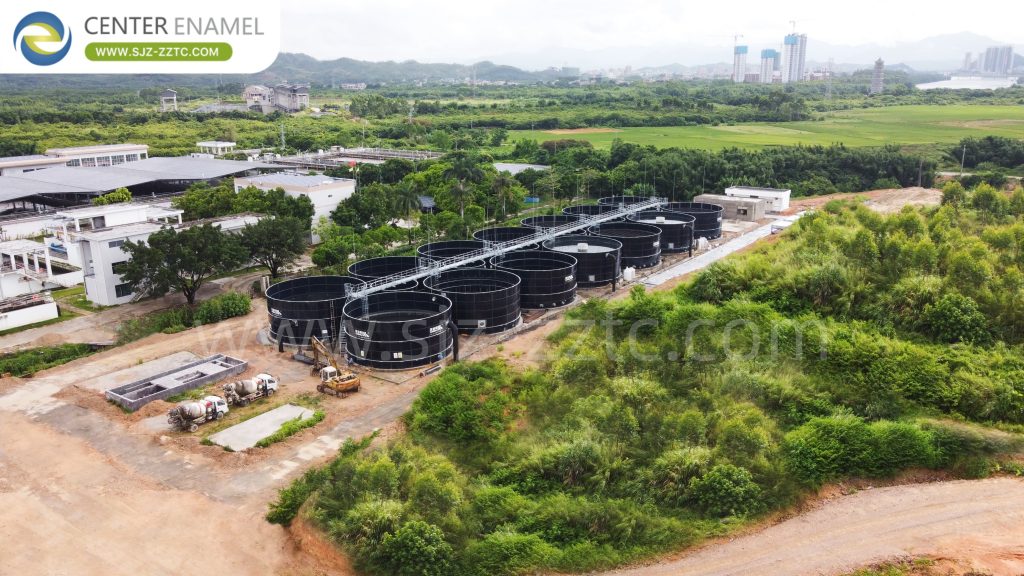
These tightening regulations mean that every Industrial Wastewater Treatment Project must now balance compliance, cost, and resource recovery. Equipment selection therefore becomes a decisive factor-particularly the corrosion resistance of tank systems and the efficiency of anaerobic treatment processes.
GFS Tanks Corrosion Resistance Far Superior to Traditional Concrete Tanks
Center Enamel's independently developed double-sided double-layer enameling technology is the industry's leading coating anti-corrosion technology, with corrosion resistance completely surpassing concrete tanks. Concrete tank interiors are riddled with pores, allowing wastewater and acid/alkaline media to easily penetrate and corrode the structural layer. Long-term use leads to irreversible problems such as internal wall spalling, water seepage, and rebar corrosion, which are difficult to repair and cannot be fundamentally resolved.
GFS Tanks feature high-temperature enameling on both the interior and exterior surfaces of steel panels, with a dense, non-porous enamel finish that completely blocks corrosive liquids and biogas permeation. The enamel layer has extremely strong chemical stability, resisting acids, alkalis, salts, and microbial corrosion. Concrete tanks will develop extensive corrosion and leakage after 5-8 years of use, while GFS Tanks anti-corrosion service life can exceed 30 years, with no need for frequent internal lining repairs throughout the service life, significantly reducing long-term anti-corrosion maintenance investment and fundamentally eliminating environmental risks of medium leakage contaminating sites and groundwater.
Compared to traditional concrete and FRP tanks, GFS Tanks coatings have no risk of peeling or blistering, and are adaptable to highly corrosive conditions such as palm oil mill effluent, livestock manure, and chemical high-salinity wastewater, with outstanding long-term comprehensive cost advantages. These durability advantages directly support the demanding requirements of Anaerobic Solutions deployed in aggressive industrial environments.
USR Applicable Scenarios
Among Anaerobic Solutions, the USR process stands out for its ability to handle the most difficult waste streams. Dedicated process for agricultural high-solids wastewater, primarily suitable for large-scale livestock manure, livestock soaking water, agricultural straw leachate, and livestock slaughterhouse high-solids wastewater. For high-suspended-solids, high-organics, high-impurity wastewater conditions, it is the core process for rural livestock pollution treatment and agricultural organic waste resource utilization.
Suitable for township decentralized wastewater treatment and small to medium-sized agricultural enterprise wastewater treatment. Can serve as the primary process for large livestock base manure resource recovery, combining wastewater treatment with biogas recovery. Also suitable for various high-solids, easily clogged, difficult-to-treat organic wastewater pretreatment, with superior suitability in agricultural environmental applications compared to other anaerobic processes. Because these scenarios often involve corrosive and high-solid media, pairing USR with GFS Tanks ensures both process reliability and long-term structural integrity.
Palm Oil Mill Effluent Operation and Maintenance Cost Analysis
O&M costs are moderate to low-biogas recovery benefits are exceptionally high-outstanding overall economics-one of the best input-output ratios in industrial wastewater treatment. POME has excellent biodegradability (BOD/COD 0.5-0.6) with very high anaerobic digestion efficiency-no expensive advanced oxidants or detoxification agents needed-only small amounts of lime/NaOH for pH adjustment and flocculants-low chemical costs. CSTR/USR anaerobic equipment is simple and durable-GFS Tanks with 30+ year corrosion resistance, no precision wear parts-extremely low failure rates and minimal repair/replacement-controllable long-term O&M costs.
Biogas recovery is the core economic benefit-high-concentration organic wastewater produces exceptional biogas yields of 8-15 m³ per m³ POME-CHP can meet 30-50% of mill electricity demand, with waste heat for digester heating and FFB sterilization preheating-very high energy self-sufficiency, greatly reducing or eliminating external electricity purchases. Recovered palm oil from pretreatment oil separation can be sold as biodiesel feedstock or oleochemical raw material-substantial economic benefits. Anaerobic effluent rich in nitrogen, phosphorus, and potassium can be used for palm plantation irrigation and fertilization after advanced treatment-dual resource recovery of water and fertilizer, further reducing treatment costs.
Palm oil mills in Southeast Asia commonly benefit from renewable energy subsidies and carbon reduction credits (CDM/carbon trading)-biogas power projects can apply for carbon asset development for additional carbon revenue, further improving project economics. Overall, POME treatment system capital payback period is typically 5-8 years-biogas power generation revenues can fully cover O&M costs and generate net profit-one of the highest resource recovery value wastewater categories in industrial wastewater treatment, delivering both environmental management and clean energy recovery. These compelling economics make POME one of the most attractive applications for Anaerobic Solutions within any Industrial Wastewater Treatment Project.
After-Sales and Technical Support Team
Strong economics and durable equipment must be backed by reliable service to protect long-term project value. The after-sales team adheres to the service principles of rapid response, professional efficiency, and full-cycle support-providing 24/7 full-lifecycle O&M support to global clients.
Standard remote services include fault diagnosis, process parameter adjustment, and tank anti-corrosion maintenance guidance. For domestic and long-distance overseas clients, overseas technical service personnel can be dispatched for on-site inspection, annual inspection, and equipment refurbishment as needed. The team also maintains long-term client feedback tracking mechanisms-regularly collecting tank and anaerobic equipment operational data to continuously optimize product structure and support processes.
Supporting external technical expert teams provide specialized support for anaerobic process commissioning, biogas upgrading O&M, and wastewater upgrade/retrofit projects-ensuring long-term stable operation of domestic and overseas projects, continuously improving global client satisfaction and repurchase rates.
Flexible and Efficient Service Delivery System
Service flexibility further enhances project execution speed and adaptability. Center Enamel's own cross-border construction teams + global localized agent network-modular GFS Tanks assembly with short construction periods and dismantlable/reusable capability-suitable for overseas short-term projects, phased expansions, and relocation needs-full-lifecycle after-sales O&M support ensuring long-term stable client operations.
Whether you are dealing with palm oil wastewater or any other industrial wastewater challenge, contact us today — our team will provide you with professional, efficient, and cost-effective treatment solutions.
Frequently Asked Questions
Q1: Why are GFS Tanks better than concrete tanks for industrial wastewater?
Concrete tanks corrode and leak within 5-8 years due to porous surfaces. GFS Tanks use non-porous enamel coatings resisting acids, alkalis, and microbial corrosion, with a 30+ year service life and minimal maintenance.
Q2: What makes USR one of the best anaerobic solutions for high-solids wastewater?
USR tolerates high suspended solids, impurities, and organics without clogging. Its simple structure, flocculent sludge operation, and fast start-up make it ideal for livestock, agricultural, and POME treatment with low O&M costs.
Q3: How do biogas revenues improve industrial wastewater treatment project economics?
POME generates 8-15 m³ biogas per m³, meeting 30-50% of mill electricity demand. With carbon credits and recovered palm oil, capital payback is typically 5-8 years, fully covering O&M costs.