
Advanced GFS Tanks with USR Process for Palm Oil Wastewater Treatment Projects
The competitive landscape shows divergence, with leading companies building integrated service capabilities through technical integration and capital operations, and industry concentration gradually increasing. Chinese companies continue to consolidate their advantages in mid-tier equipment exports. International giants target high-end customers and complex industrial wastewater markets, while local players occupy the mid-to-low end and industrial park centralized treatment markets with service responsiveness and cost advantages.
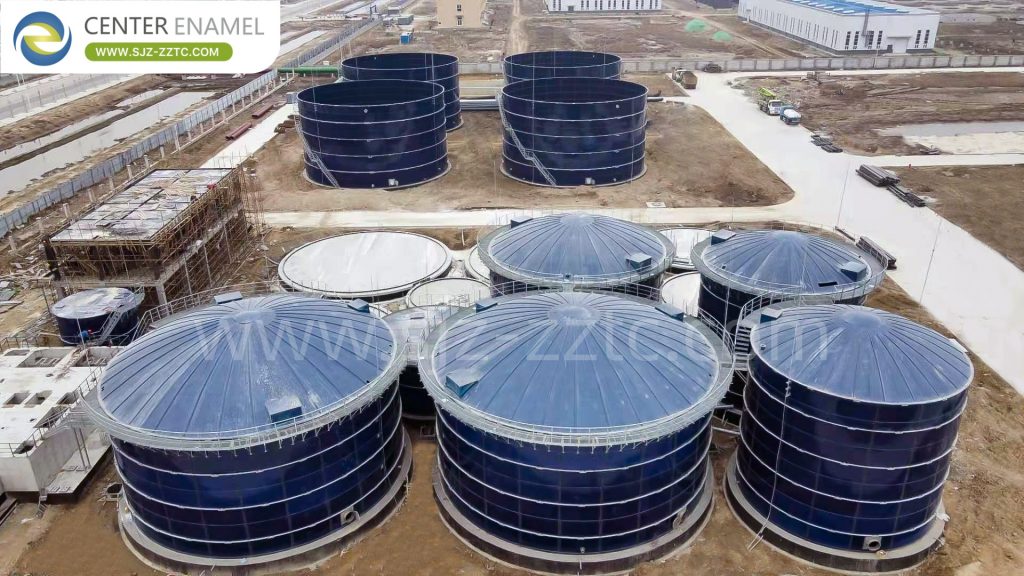
Within this evolving landscape, anaerobic treatment technologies have emerged as critical infrastructure for high-strength organic wastewater. In the anaerobic process segment, UASB, EGSB, and IC anaerobic reactors, with advantages of high loading rates, small footprints, and stable operation, are widely used in high-concentration organic wastewater pretreatment in food processing, pharmaceutical fermentation, alcohol brewing, chemical, and other industries. These reactors use steel tank shells, and their corrosion resistance and gas-tightness directly determine long-term operational stability. The application value of GFS Tanks in such scenarios is increasingly prominent.
GFS Tanks Corrosion Resistance Far Superior to Traditional Concrete Tanks
Center Enamel's independently developed double-sided double-layer enameling technology is the industry's leading coating anti-corrosion technology, with corrosion resistance completely surpassing concrete tanks. Concrete tank interiors are riddled with pores, allowing wastewater and acid/alkaline media to easily penetrate and corrode the structural layer. Long-term use leads to irreversible problems such as internal wall spalling, water seepage, and rebar corrosion, which are difficult to repair and cannot be fundamentally resolved.
GFS Tanks feature high-temperature enameling on both the interior and exterior surfaces of steel panels, with a dense, non-porous enamel finish that completely blocks corrosive liquids and biogas permeation. The enamel layer has extremely strong chemical stability, resisting acids, alkalis, salts, and microbial corrosion. Concrete tanks will develop extensive corrosion and leakage after 5-8 years of use, while GFS Tanks anti-corrosion service life can exceed 30 years, with no need for frequent internal lining repairs throughout the service life, significantly reducing long-term anti-corrosion maintenance investment and fundamentally eliminating environmental risks of medium leakage contaminating sites and groundwater.
Compared to traditional concrete and FRP tanks, GFS Tanks coatings have no risk of peeling or blistering, and are adaptable to highly corrosive conditions such as palm oil mill effluent, livestock manure, and chemical high-salinity wastewater, with outstanding long-term comprehensive cost advantages.
USR Process Advantages in Wastewater Treatment
The corrosion-resistant properties of GFS Tanks become especially valuable when paired with anaerobic treatment processes designed for challenging waste streams. High solids tolerance, clog resistance, and strong adaptability make the USR Process perfectly suited for high-suspended-solids, high-impurity, high-solids organic wastewater. Extremely simple equipment structure, no precision wear parts, low capital investment, long service life, virtually no clogging failures, and extremely low subsequent maintenance costs. No strict requirements on sludge morphology-no need to cultivate mature granular sludge, flocculent sludge can operate stably, with fast start-up and short sludge acclimation period for rapid commissioning. Gentle hydraulic disturbance results in low sludge washout and high sludge utilization, with stable organic pollutant degradation. Simple operation with low automation requirements and high error tolerance, suitable for remote sites, farms, and other settings with limited O&M capabilities-outstanding stability and practicality advantages.
POME Environmental Toxicity
The USR Process is particularly critical for Palm Oil Wastewater Treatment Projects because of the severe ecological risks that POME poses. POME pollutants are primarily natural plant organics with no synthetic toxic chemicals, heavy metals, or persistent organics-low acute chemical toxicity, but high-concentration organic and oil pollution have severe ecological impacts. High-concentration organics discharged to natural waters rapidly deplete dissolved oxygen-BOD load far exceeds self-purification capacity, causing severe oxygen depletion, anaerobic production of hydrogen sulfide and ammonia, black-odor conditions, mass mortality of fish and benthic organisms, and complete ecosystem collapse.
High-concentration oil forms surface films blocking atmospheric-water oxygen exchange-exacerbating oxygen depletion; oil adheres to fish gills and aquatic organism surfaces, directly affecting respiration, feeding, and movement; oil degrades slowly, causing persistent ecological damage. Acidic raw water (pH 4-5) acidifies receiving waters, causing pH drops beyond aquatic organism tolerance-leading to fish kills and aquatic vegetation die-off; acidic conditions promote heavy metal mobilization from sediments, creating secondary pollution risks. High suspended solids settle and cover riverbed sediments, blocking benthic habitats and fish spawning grounds; fruit pulp and fiber decomposition consumes sediment oxygen, causing anaerobic conditions and hydrogen sulfide accumulation. High ammonia nitrogen undergoes nitrification consuming dissolved oxygen-exacerbating eutrophication. Nitrogen and phosphorus nutrient enrichment triggers algal blooms (water blooms, red tides)-further degrading water quality.
In Southeast Asian palm oil producing regions with dense mill concentrations, untreated POME discharge can cause severe water quality degradation over tens of kilometers of rivers, with irreversible aquatic ecosystem damage-POME is a core source of water pollution in tropical regions, with increasingly strict environmental regulations. This environmental urgency makes selecting the right Palm Oil Wastewater Treatment Project partner essential.
Center Enamel's Core R&D Capabilities and Global Authoritative Certifications
Successful execution of Palm Oil Wastewater Treatment Projects demands more than just process expertise-it requires a manufacturer with proven technical depth and international credibility. Technology R&D is Center Enamel's core competitive advantage. The company independently masters over 200 differentiated anti-corrosion enamel formulations, with full self-control over the enamel raw material chain, holding nearly 100 invention and utility patents. Products have passed NSF, WRAS, ASME, BSCI, CE, ISO9001, and other global certifications.
Company certifications and honors include: National High-Tech Enterprise, National Specialized and Sophisticated "Little Giant," Hebei Manufacturing Single Champion, Provincial Smart Factory, Provincial Green Factory; complete environmental engineering and special equipment manufacturing compliance qualifications. The company maintains long-term collaborative research with multiple universities through joint materials laboratories-continuously iterating anti-corrosion coatings and large bolted tank structural design technologies. The proprietary material technology barrier creates an irreplaceable competitive advantage, with product performance comparable to high-end imported European/American storage equipment.
Full-Process Standardized Installation Quality Control
Technical excellence must be matched by execution discipline to deliver reliable GFS Tanks for critical Palm Oil Wastewater Treatment Project applications. Demonstrating high-standard installation quality through long-term stable global project performance, Center Enamel has established full-chain quality control standards across four dimensions: factory protection, on-site assembly construction, completion inspection, and long-term warranty-ensuring quality control for every GFS Tank.
At the factory stage, all enameled panels, seals, and structural components receive rust-proof and moisture-proof independent packaging with dedicated protective supports-preventing damage during sea and land transport and avoiding enamel coating damage. On-site construction strictly follows unified assembly process specifications-panel by panel tightening and leak testing in layers, with airtightness and verticality testing after each tank section completion-dual-membrane covers and anaerobic piping undergo simultaneous pressure testing and acceptance.
Differentiated quality acceptance standards are customized for different regions: EU/US projects follow stringent CE/NSF inspection criteria; Southeast Asian hot humid regions receive enhanced corrosion protection and sealing acceptance; remote African sites have additional foundation settlement re-inspection procedures. Upon project completion, complete construction inspection reports, pressure test records, and anti-corrosion appearance acceptance documents are issued, with full photo/video archives retained. Over 10,000 tanks delivered globally have operated long-term without large-scale leakage or structural deformation-preventing future O&M issues at source.
If you are currently seeking solutions for palm oil wastewater or other industrial wastewater treatment, please contact us - we will provide you with professional and efficient wastewater treatment solutions.
Frequently Asked Questions
Q1: Why are GFS Tanks preferred over concrete tanks for POME treatment?
Concrete tanks develop corrosion and leakage within 5-8 years due to porous surfaces. GFS Tanks feature non-porous enamel coatings that resist acids, alkalis, and microbial corrosion, with a service life exceeding 30 years without lining repairs.
Q2: How does the USR Process handle POME's high solids content?
The USR Process tolerates high suspended solids, oil, and impurities without clogging. Its simple structure, upflow hydraulics, and flocculent sludge operation ensure fast start-up, low maintenance, and stable COD removal of 80-90%.
Q3: What certifications validate GFS Tanks for wastewater projects?
Center Enamel's GFS Tanks hold NSF, WRAS, ASME, CE, ISO9001, and other global certifications, with over 200 enamel formulations and nearly 100 patents supporting their performance in corrosive environments.