
Global Biogas Project Contractor: Delivering Premium GFS Tanks and Sustainable Biogas Solutions
This article explores the role of a professional Biogas Project Contractor in delivering high-performance GFS tanks for sustainable energy and wastewater treatment. It examines the global policy drivers, technical advantages of GFS tanks, and application scenarios that make them the preferred choice for Biogas Project implementation. The content also highlights the operational efficiency and long-term value provided by experienced contractors in the renewable energy sector.
Global Policy Framework in Livestock Manure
The global livestock manure treatment policy system, with the US and EU as typical representatives, is shifting from end-of-pipe treatment to full-process nutrient management. The US establishes a manure management framework covering the entire livestock production process through Comprehensive Nutrient Management Plans. The EU, through the Nitrates Directive, strictly limits manure application amounts, with Germany and the Netherlands using tax instruments to mandate nitrogen and phosphorus recovery rates, and Denmark demonstrating distinctive features in livestock regulation and ecological compensation. The Netherlands uses a management mechanism linking manure treatment with phosphate quotas. China has issued a series of environmental regulations, with the current legal system providing comprehensive regulation of pollution from large-scale livestock operations.
This evolving regulatory landscape has intensified the demand for reliable infrastructure that ensures compliance while maximizing resource recovery. As a trusted Biogas Project Contractor, we bridge the gap between policy requirements and practical implementation through advanced GFS tanks designed for long-term environmental performance.
Full-Process Factory Standardized for GFS tanks
GFS tanks are fully factory-prefabricated to standardized specifications, with finished product quality stability far exceeding cast-in-place concrete tanks. All concrete tank processes are completed in the open air, with rebar tying, concrete pouring, and curing heavily influenced by worker skill, temperature, and rainfall. Wall thickness, density, and strength vary significantly between batches, with hidden defects like honeycombing, voids, and insufficient wall thickness common-quality cannot be uniformly controlled.
Center Enamel's GFS tank steel panels, seals, and reinforcement components are all mass-produced in automated factories. Steel stamping, high-temperature enameling, and dimensional cutting are all controlled by CNC equipment, with each panel's parameters and enamel thickness strictly following unified national standards. All components are uniformly packaged and transported to site, with assembly strictly following standardized construction drawings. Full-process quality inspection from raw materials to finished components ensures highly consistent product performance parameters, completely eliminating the uncontrollable quality risks of on-site concrete construction, with every tank delivering stable, consistent performance.
This manufacturing excellence directly supports the success of any Biogas Project, as GFS tanks provide the corrosion-resistant, gas-tight environment essential for anaerobic digestion. When you partner with a professional Biogas Project Contractor, you gain access to these factory-engineered advantages that ensure project predictability and longevity.
UASB Applicable Scenarios
Suitable for soluble medium-to-high concentration organic wastewater, covering light industrial wastewater from brewing, sugar refining, starch, papermaking, food processing, printing and dyeing, etc. Suitable for wastewater where organics are predominantly soluble with low suspended solids content, not suitable for high-solids, high-viscosity wastewater. Can be used alone as the primary treatment process or as a pretreatment for high-strength wastewater to reduce downstream aerobic load. Suitable for municipal wastewater anaerobic pretreatment and low-solids livestock wastewater treatment. With its low cost and stable operation advantages, it is suitable for long-term continuous, large-flow industrial wastewater treatment projects.
Understanding the appropriate application of different anaerobic processes is a hallmark of an experienced Biogas Project Contractor. Whether UASB or CSTR is selected, GFS tanks serve as the optimal reactor vessel, providing the durability and flexibility required for diverse wastewater treatment scenarios.
Livestock Wastewater Operation and Maintenance Cost Analysis
O&M costs are relatively low with excellent input-output ratio-the highest cost-effectiveness among the five wastewater types. Core treatment units are primarily physical separation, anaerobic digestion, and ecological polishing-no high-end precision equipment or expensive chemicals. Equipment is simple with low failure rates and low maintenance costs. Anaerobic digestion produces stable biogas for plant heating and power generation, offsetting energy costs. Ecological treatment units have virtually no ongoing O&M costs. Only periodic cleaning of sedimentation tanks and polishing ponds is required, with low labor costs. Manure solids, sludge, and digestate can be sold as resources, further reducing net treatment costs.
These economic advantages make livestock wastewater an ideal application for turnkey Biogas Project solutions. By utilizing durable GFS tanks, operators maximize biogas recovery while minimizing long-term maintenance expenditures, achieving the best return on investment.
Indonesia Palm Oil Biogas Project
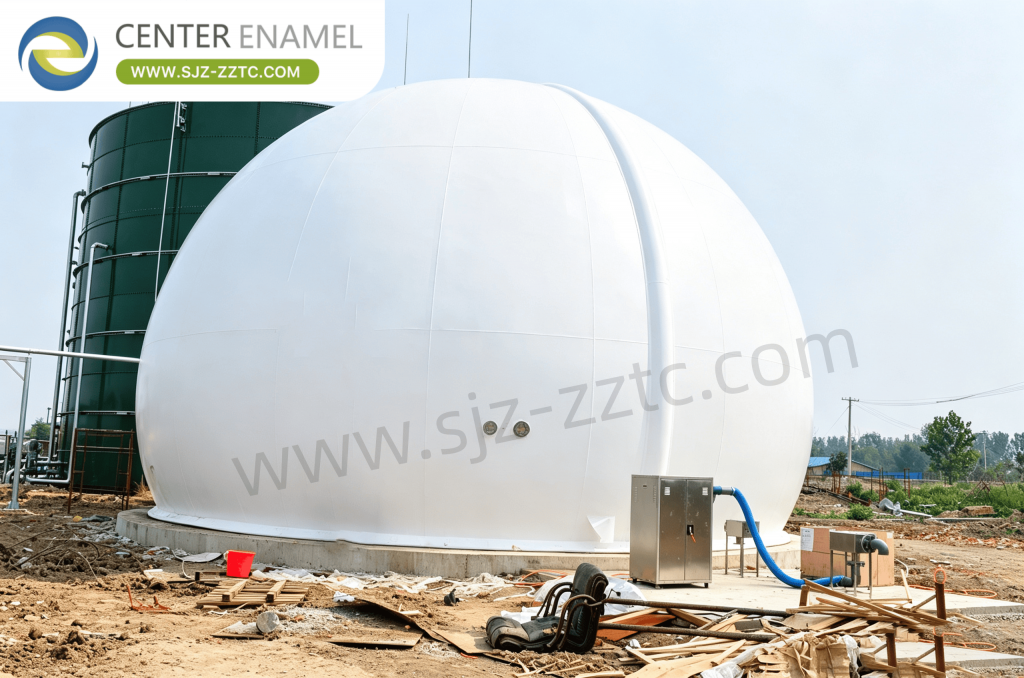
Specifically designed for high-concentration palm oil wastewater treatment with 3 GFS fermentation tanks, each 19.86 m diameter × 8.4 m height. Installation began November 2009 with only 7 construction personnel, completing all tank assembly in 40 days-highly efficient and time-saving. Tanks are fitted with dual-membrane gas storage covers for POME anaerobic digestion-degrading organics and recovering biogas energy while eliminating palm industry pollution. This is an early benchmark POME biogas treatment project in Southeast Asia.
This landmark project demonstrates the proven capability of a professional Biogas Project Contractor to deliver complex international installations efficiently. The success of these GFS tanks over 15+ years of continuous operation validates the long-term reliability of factory-engineered solutions in challenging environments .
After-Sales and Technical Support Team
The after-sales team adheres to the service principles of rapid response, professional efficiency, and full-cycle support-providing 24/7 full-lifecycle O&M support to global clients.
Standard remote services include fault diagnosis, process parameter adjustment, and tank anti-corrosion maintenance guidance. For domestic and long-distance overseas clients, overseas technical service personnel can be dispatched for on-site inspection, annual inspection, and equipment refurbishment as needed. The team also maintains long-term client feedback tracking mechanisms-regularly collecting tank and anaerobic equipment operational data to continuously optimize product structure and support processes.
Supporting external technical expert teams provide specialized support for anaerobic process commissioning, biogas upgrading O&M, and wastewater upgrade/retrofit projects-ensuring long-term stable operation of domestic and overseas projects, continuously improving global client satisfaction and repurchase rates.
Comprehensive after-sales support distinguishes a premier Biogas Project Contractor from equipment suppliers alone. With GFS tanks backed by responsive technical teams, clients can operate with confidence knowing their Biogas Project investment is protected throughout its lifecycle.
Flexible and Efficient Service Delivery System
Center Enamel's own cross-border construction teams + global localized agent network-modular GFS tank assembly with short construction periods and dismantlable/reusable capability-suitable for overseas short-term projects, phased expansions, and relocation needs-full-lifecycle after-sales O&M support ensuring long-term stable client operations.
This flexible delivery system positions Center Enamel as the preferred Biogas Project Contractor for clients requiring adaptable, scalable solutions. Whether for new installations or plant expansions, GFS tanks provide the modularity and efficiency that modern Biogas Project implementations demand.
FAQ
1. Why should I choose Center Enamel as my Biogas Project Contractor?
Center Enamel combines 30+ years of experience with global EPC capabilities, delivering turnkey Biogas Project solutions from design to commissioning. Our GFS tanks meet international standards (AWWA D103, ISO 28765) and have been deployed in over 100 countries .
2. What makes GFS tanks ideal for Biogas Projects?
GFS tanks feature a glass-fused-to-steel coating fired at 930°C, creating an inert barrier highly resistant to H₂S corrosion-critical for anaerobic digesters. They offer rapid installation, expandability, and a 30+ year service life with minimal maintenance .
3. How quickly can a Biogas Project be installed with GFS tanks?
With only 7-10 personnel, a typical GFS tank installation completes in 3-5 weeks-significantly faster than 4-6 months for concrete alternatives. The Indonesia palm oil project completed 3 tanks in just 40 days .